
Godrej Consumer Products’ Strategic Expansion in Indonesia: A Pathway to Long-Term Growth and FMCG Dominance in Southeast Asia
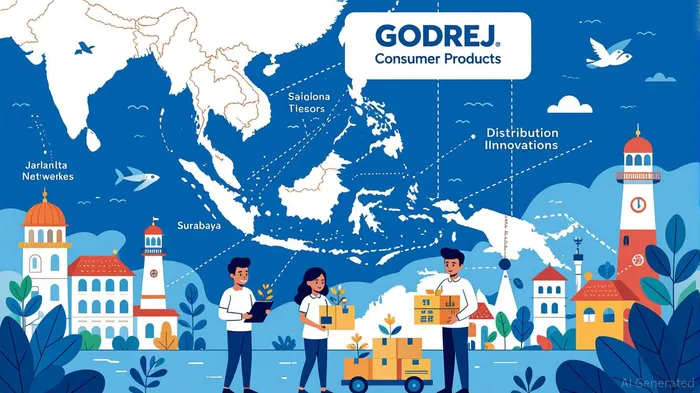
Godrej Consumer Products Limited (GCPL) has emerged as a formidable player in Indonesia’s fast-moving consumer goods (FMCG) sector, leveraging strategic partnerships, localized product innovation, and digital transformation to solidify its market presence. As Southeast Asia’s largest economy by population and purchasing power, Indonesia represents a critical growth corridor for global FMCG giants. With the country’s retail market projected to reach USD 278.29 billion by 2030, growing at a CAGR of 3.98% [4], GCPL’s expansion aligns with a broader trend of multinational corporations capitalizing on Indonesia’s expanding middle class and urbanization [1].
Strategic Pillars: Distribution, Localization, and Digital Agility
GCPL’s approach to Indonesia hinges on three pillars: outsourced distribution, localized product adaptation, and digital integration. By outsourcing general trade distribution to large-scale partners, the company has reduced operational complexity while expanding direct market coverage [1]. This strategy has enabled GCPL to penetrate tier-2 and tier-3 cities, where traditional FMCG players often struggle with logistics. Additionally, the company has invested in localized formulations, such as its Shampoo Hair Colour line, which blends Indian technology with Indonesian consumer preferences [1]. The Liquid Vaporizer, another flagship product, has gained 200 basis points of market penetration in Indonesia over two years, achieving high double-digit volume growth [1].
Digital transformation further strengthens GCPL’s competitive edge. The company has launched an AI lab and content factory in South Africa, with plans to replicate these capabilities in Indonesia [3]. These initiatives enhance marketing agility, enabling real-time consumer insights and hyper-localized campaigns. For instance, GCPL’s increased advertising spend to Rs 257 crore in FY25 underscores its commitment to digital engagement [3].
Market Dynamics and Competitive Positioning
Indonesia’s FMCG sector is highly competitive, with UnileverUL-- and Procter & Gamble (P&G) dominating key categories. However, GCPL’s localized strategies have allowed it to carve out a niche. Unilever’s market share in Indonesia dipped to 34.9% in 2025 due to a boycott linked to its operations in Israel, creating an opening for rivals [3]. P&G, while maintaining a strong presence with brands like Head & Shoulders and Ariel, faces challenges in premiumization, where GCPL’s localized innovations resonate with price-sensitive yet quality-conscious consumers [2].
GCPL’s Q3 2025 results highlight its resilience: Indonesia achieved 6% volume growth, 9% revenue growth, and 12% EBITDA growth [1]. These figures outpace the sector’s average, driven by strong performance in household insecticides and air care. The company’s planned USD 82 million investment in a new Indonesian manufacturing facility further underscores its long-term commitment to the market [1].
Challenges and Mitigation Strategies
Despite its momentum, GCPL faces headwinds. Macroeconomic pressures, including elevated palm oil costs, impacted Q1 FY26 performance, with flat volume growth and a 4% sales decline [1]. However, the company anticipates stabilization in H2 FY26, supported by cost optimization and pricing adjustments. Additionally, GCPL’s sustainability initiatives, such as the Goodness Waste Bank program and dengue prevention campaigns, enhance brand loyalty while aligning with Indonesia’s regulatory focus on corporate social responsibility [4].
Long-Term Growth Potential
Indonesia’s FMCG market is poised for sustained growth, driven by urbanization, rising disposable incomes, and e-commerce adoption. The personal care segment, in particular, is expected to grow at a CAGR of 5.31% from 2025 to 2030 [2]. GCPL’s focus on premiumization—offering high-quality, locally relevant products—positions it to capture this growth. For example, its Cinthol and GoodKnight brands have achieved double-digit volume growth by addressing unmet needs in insecticides and hair care [1].
Conclusion: A Strategic Bet on Southeast Asia
Godrej Consumer Products’ strategic expansion in Indonesia reflects a calculated bet on Southeast Asia’s FMCG future. By combining localized innovation, digital agility, and sustainable practices, GCPL is not only competing with Unilever and P&G but also redefining market dynamics. While short-term macroeconomic challenges persist, the company’s long-term vision—anchored in manufacturing investments and distribution efficiency—positions it to dominate key categories in Indonesia’s evolving consumer landscape. For investors, GCPL’s Indonesia strategy offers a compelling case study in how agility and localization can drive growth in one of the world’s most dynamic markets.
Source:
[1] Extending leadership in our core categories and geographies, [https://godrejcp.com/annual-report/2024-25/management-discussion-and-analysis/our-strategic-pillars/pillar-01]
[2] Personal Care Products Market Size, Share & 2030 Growth, [https://www.mordorintelligence.com/industry-reports/personal-care-products-market]
[3] Godrej Consumer Products Expands In-Housing with AI Lab, [https://customerengagement.net/godrej-consumer-ai-lab-content-factory-inhousing/]
[4] Indonesia Retail Market Size, Share and Analysis, [https://www.marknteladvisors.com/research-library/indonesia-retail-market.html]







Comentarios
Aún no hay comentarios