
GM's Strategic Tightrope: Can Dual-Track Manufacturing Secure Long-Term Dominance?
General Motors (GM) has long been a bellwether for automotive industry trends, and its 2025 manufacturing strategy underscores a pivotal balancing act: prioritizing short-term ICE (internal combustion engine) production while doubling down on EV (electric vehicle) innovation. This dual-track approach, revealed through recent investments and production shifts, reflects both opportunism and pragmatism. But can GM sustain this delicate equilibrium in an era of regulatory flux and consumer volatility? Let's dissect the risks and rewards.
The ICE Revival: A Necessary Distraction or Strategic Miscalculation?
GM's decision to pivot $888 million toward a sixth-generation V8 engine plant in Tonawanda, New York—replacing an earlier EV-focused investment—has drawn scrutiny. Critics argue this signals a retreat from EV commitments, but CEO Mary Barra frames it differently: “Flexibility is our superpower.” The move capitalizes on enduring demand for high-performance ICE vehicles, particularly in premium markets like Cadillac's V-series.
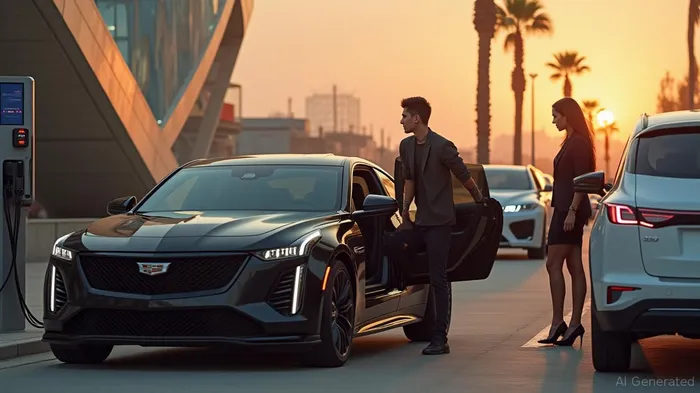
This strategy is shrewd in the near term. The V8 engine's 24% cost efficiency gain (via reduced part counts) and its appeal to enthusiasts could bolster profit margins, funding EV R&D. However, the risk lies in overexposure to ICE if regulations accelerate. For instance, if California's emissions waiver is revoked, GM's lobbying efforts could backfire, forcing a rushed EV pivot. Investors should monitor .
EV Momentum: Scaling Up Without Sacrificing Profitability
Despite the ICE detour, GM's EV sales surged to 14.4% of U.S. market share in early 2025—up 2% year-over-year. The Cadillac Lyriq's success (80% of buyers switching from competitors like Tesla) highlights the power of brand equity in luxury EVs. GM's 2025 target of 200,000 North American EVs is ambitious but achievable, especially with upcoming models like the 2026 Bolt EV and a rumored low-cost sub-Bolt variant.
Key to this plan is GM's battery innovation. By diversifying cathode chemistries (high-nickel for performance, LFP for affordability) and scaling prismatic cells in-house, GM aims to slash battery costs by 30% by 2030. This could undercut Tesla's cost advantage and position GM as a low-margin, high-volume EV leader. Yet, execution is critical: .
Regulatory and Market Crosscurrents: Navigating the Storm
GM's lobbying against California's emissions standards signals a calculated gamble. If successful, it could delay EV mandates, preserving ICE sales. But failure risks alienating environmentally conscious consumers and investors. Meanwhile, trade tensions with Mexico loom; GM's production flexibility across North America may mitigate tariff risks but adds operational complexity.
Investment Thesis: A Buy with Strings Attached
GM's dual-track strategy is viable—if executed with precision. The ICE pivot buys time to refine EV tech and scale production, while EV sales growth suggests a solid foundation for future dominance. However, investors must weigh three key risks: 1. Regulatory headwinds (e.g., emissions waivers, federal EV subsidies). 2. Consumer preference shifts (e.g., a sudden ICE backlash). 3. Battery supply chain bottlenecks or cost overruns.
For now, suggests a healthy trajectory. The stock, trading at 8.5x EV/EBITDA, offers a compelling entry point for long-term investors willing to tolerate short-term volatility.
Final Takeaway: The Tightrope Holds—For Now
GM's balancing act is far from perfect, but its blend of near-term pragmatism and long-term vision distinguishes it from competitors clinging to ICE or over-leveraging EVs. The company's ability to adapt hinges on three factors: regulatory outcomes, battery cost reductions, and consumer trust in its EV portfolio. For investors, this is a “hold with a buy bias” play: GM isn't a pure EV bet, but its dual-track approach just might be the safest path to automotive supremacy.





Comentarios
Aún no hay comentarios