
GM's Mechanical Innovation: A Cost-Efficient Path to Premium Perceptions
General Motors (GM) has long positioned itself as a leader in automotive innovation, but its recent patent-driven engineering efforts suggest a strategic pivot toward cost efficiency and premium branding that could redefine its competitive edge. From hybrid powertrains to reimagined two-stroke engines, GM's intellectual property portfolio is not just a defensive shield but a proactive tool for capturing market share and enhancing investor returns. This analysis explores how these innovations align with GM's broader financial and operational goals, offering a compelling case for long-term value creation.
Hybrid Powertrains: Balancing Efficiency and Performance
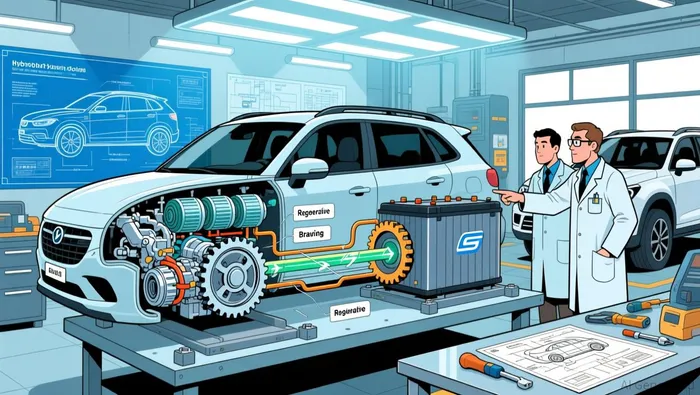
GM's newly patented hybrid propulsion system (USPTO 12,311,767 B1) exemplifies the company's ability to merge efficiency with performance. This system integrates an internal combustion engine with three electric motors and a high-voltage battery, enabling full electric all-wheel drive without the mechanical complexity of traditional AWD systems. By leveraging a planetary gear set, the design allows seamless switching between drive modes and optimizes regenerative braking efficiency, reducing energy waste.
The compact, modular nature of this hybrid system is particularly noteworthy. It can be adapted to a wide range of vehicles, from large trucks to smaller crossovers, enabling GM to scale production and reduce per-unit costs. This scalability is critical in an era where consumers demand both fuel efficiency and towing capability. For instance, the system's "Obstacle Climb (High Torque)" mode-designed for off-road and heavy-duty hauling- positions GM to capture premium segments traditionally dominated by competitors like Ford and Ram.
Financially, GM's hybrid strategy is already paying dividends. In Q3 2025, the company reported $48.59 billion in revenue, surpassing expectations, while its U.S. market share hit 17.0%, driven by strong demand for trucks and crossovers. The hybrid powertrain's potential to reduce reliance on large electric motors could further lower production costs, enabling GMGM-- to price its vehicles competitively while maintaining profit margins.
Two-Stroke Engines: A Nostalgic Leap Forward
GM's patent for a modernized two-stroke engine, filed in 2025, represents a bold departure from conventional four-stroke designs. The innovation introduces a movable sleeve between the piston and cylinder wall, controlled by an actuator, to manage air intake and exhaust more precisely. This design addresses historical issues like piston ring wear and unburned hydrocarbons, potentially extending engine longevity and improving emissions performance.
Investor sentiment around this patent remains speculative, as no direct financial link has been established between the two-stroke engine and GM's 2023–2025 returns. However, the patent itself signals innovation in GM's product pipeline, which could bolster investor confidence. The global two-stroke engine market is projected to grow significantly from 2025 to 2034, driven by applications in marine and agricultural sectors. If GM successfully commercializes this technology, it could tap into these markets while reinforcing its reputation for engineering ingenuity.
Strategic Synergies: Patents as a Competitive Moat
GM's patent strategy extends beyond individual technologies to create a broader competitive moat. For example, the company's road-condition monitoring system- patented in 2023-uses vehicle sensors and cloud-based analytics to alert drivers to poor road conditions. This innovation enhances the driver experience, potentially justifying premium pricing for GM's vehicles. Similarly, GM's centralized window control system, which allows multi-modal operation of multiple windows, underscores its focus on user-centric design.
Financially, GM's IP portfolio has already proven its worth. The company's Ultium battery platform, which underpins its EV strategy, has driven a 105% year-to-date increase in EV sales by Q3 2025, making GM the second-largest EV seller in the U.S. By reducing battery costs per kWh through partnerships like its collaboration with LG Energy Solution, GM is positioning itself to achieve price parity with gasoline-powered vehicles-a critical factor for mainstream EV adoption.
Risks and Mitigations
Despite these strengths, GM faces challenges. The two-stroke engine's emissions profile remains a hurdle, and the company's EV transition has incurred significant costs, including $1.6 billion in EV capacity realignment charges in Q3 2025. However, GM's financial discipline-evidenced by its $10–11 billion 2025 capital expenditure plan-suggests it is managing these risks effectively. Additionally, GM's litigation strategy, which has leveraged foundational patents to challenge competitors, reinforces its ability to protect its innovations.
Conclusion: A Pathway to Sustainable Value
GM's mechanical innovations are more than technical curiosities; they are strategic assets that align with the company's goals of cost efficiency, premium branding, and scalable growth. The hybrid powertrain patent, in particular, offers a blueprint for reducing production costs while enhancing performance, directly supporting GM's market share ambitions. Meanwhile, the two-stroke engine patent-though unproven commercially-signals GM's willingness to explore unconventional solutions to modern challenges.
For investors, the key takeaway is clear: GM's patent-driven engineering is not just about staying ahead of regulatory trends but about creating tangible value. As the company continues to refine these technologies and scale their deployment, the long-term returns for shareholders could be substantial. In an industry defined by rapid change, GM's ability to innovate at the intersection of cost and premium positioning may well determine its dominance in the decades to come.





Comentarios
Aún no hay comentarios