
GM's Bolt EV Relaunch: A Strategic Gambit to Reshape EV Adoption and Disrupt Legacy Automakers
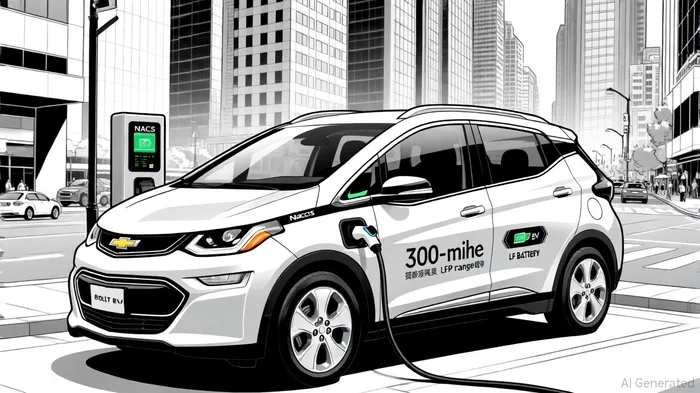
General Motors' relaunch of the Chevrolet Bolt EV in 2025 represents a calculated bid to reassert its position in the electric vehicle (EV) market, leveraging affordability, technological upgrades, and strategic positioning to address lingering consumer hesitations. As the EV landscape evolves amid shifting consumer preferences and intensifying competition, the Bolt's revival could catalyze broader adoption while challenging legacy automakers to adapt or risk obsolescence.
A Revamped Bolt: Affordability Meets Innovation
The 2025 Bolt EV, priced starting at $28,995 for the LT trim, according to the Detroit News, retains its role as one of the most accessible EVs in the U.S. market. Built on GM's Ultium platform, the new model features a lithium-iron-phosphate (LFP) battery supplied by CATL, offering a 255-mile range and 150 kW fast-charging capabilities (10-80% in 26 minutes), according to Electrek. These upgrades address two critical pain points for EV buyers: range anxiety and charging speed. Additionally, the Bolt now includes a North American Charging Standard (NACS) port, enabling access to Tesla's Supercharger network-a move that aligns with industry-wide efforts to standardize infrastructure, a point noted by Electrek.
The vehicle's design shift to a crossover SUV body style, coupled with a flat-floor interior and enhanced infotainment system, positions it as a practical yet modern option for budget-conscious buyers. GM's emphasis on affordability is further underscored by its plan to introduce an even more cost-competitive variant within its "family of Bolts," a detail reported by the Detroit News, signaling a long-term strategy to democratize EV ownership.
Market Context: Affordability as a Catalyst for Adoption
Consumer demand for EVs remains constrained by cost and infrastructure concerns. According to the J.D. Power study, 24% of shoppers are "very likely" to consider an EV, but 52% cite charging infrastructure as a barrier. The Bolt's sub-$30k price point and NACS compatibility directly tackle these issues, offering a low-risk entry point for buyers wary of higher-priced models.
Meanwhile, the U.S. EV market faces headwinds, including the expiration of the $7,500 federal tax credit, which spurred a short-term sales surge in August 2025, according to the BloombergNEF outlook. In contrast, China's EV market continues to thrive, with battery electric vehicles (BEVs) accounting for nearly 50% of sales in some months, driven by aggressive government policies and domestic competition noted in the BloombergNEF outlook. GM's Bolt relaunch, therefore, must contend with both a cautious U.S. market and the rising dominance of Chinese automakers like BYD and Chery, which are outpacing legacy players with rapid innovation and lower costs, as reported by EVXL.
Strategic Implications: Disrupting Legacy Automakers
The Bolt's relaunch could disrupt legacy automakers in two key ways. First, its affordability challenges competitors to match or exceed its value proposition. Ford, for instance, is developing a $30,000 EV pickup, while Hyundai and Volkswagen rely on U.S.-produced models like the Ioniq 5 and ID.4 to avoid 25% tariffs on imported EVs, a dynamic also discussed in reporting on Chinese automakers. GM's use of LFP batteries, which are cheaper and more durable than nickel-based alternatives, provides a cost edge that could pressure rivals to adopt similar technologies.
Second, the Bolt's NACS integration aligns GMGM-- with Tesla's charging ecosystem, a critical advantage in a market where infrastructure remains a sticking point. By leveraging Tesla's 40,000+ Superchargers, GM reduces a key barrier for first-time EV buyers, potentially accelerating adoption. This move also signals a broader industry shift toward interoperability, which could marginalize automakers that fail to adapt.
Risks and Challenges
Despite its strengths, the Bolt's success hinges on GM's ability to scale production efficiently. The Fairfax Assembly Plant, where the Bolt is being produced, must navigate supply chain bottlenecks and labor costs to maintain profitability, a challenge highlighted by the Detroit News. Additionally, the U.S. market's slower adoption rate-compared to China-means GM must rely on urban and CARB-compliant states, where EV purchase intent exceeds 38%, as noted in the J.D. Power study.
Competitors like BYD and Chery, with their agile development cycles and cost advantages, could erode GM's market share if the Bolt fails to differentiate itself beyond price. However, GM's Super Cruise technology and brand legacy provide a counterweight to these threats.
Conclusion: A Pivotal Move in the EV Transition
The 2025 Chevrolet Bolt EV is more than a product update-it is a strategic lever for GM to drive mass-market EV adoption. By combining affordability, technological innovation, and infrastructure compatibility, the Bolt addresses core consumer concerns while challenging legacy automakers to rethink their EV strategies. As the U.S. market grapples with policy uncertainty and Chinese rivals gain ground, GM's ability to execute this relaunch effectively could determine whether it remains a leader in the EV transition or cedes ground to disruptors.





Comentarios
Aún no hay comentarios