
GM's 2027 Chevrolet Bolt: A Catalyst for EV Supply Chain Valuation Opportunities
General Motors' 2027 Chevrolet Bolt has redefined affordability in the electric vehicle (EV) market, with a base price of $28,995 and a launch edition priced at $29,990, according to GM Authority. This strategic pricing positions the Bolt as a direct competitor to budget-friendly EVs like the Nissan Leaf while integrating cutting-edge technology, including a lithium iron phosphate (LFP) battery and a Tesla North American Charging Standard (NACS) port. For investors, the Bolt's launch underscores valuation opportunities in key supply chain players, from battery suppliers to charging infrastructure providers.
Pricing Strategy and Market Positioning
The Bolt's affordability is a calculated move to democratize EV ownership. By undercutting rivals, GMGM-- aims to capture price-sensitive consumers while maintaining profitability through cost-efficient LFP battery chemistry. According to InsideEVs, the Bolt's 65 kWh LFP battery, sourced from Contemporary Amperex Technology (CATL) initially, offers a 255-mile range and 150 kW fast-charging capability, reducing 10-80% charge times to 26 minutes. This balance of cost and performance could accelerate EV adoption, particularly in markets where sticker price remains a barrier.
Technological Innovations and Supply Chain Implications
The Bolt's reliance on LFP batteries highlights a shift in the industry toward safer, cheaper, and longer-lasting chemistries. While CATL currently supplies these batteries, General MotorsGM-- has partnered with LG Energy Solution to establish domestic LFP production in Tennessee by late 2027, as reported by GM Authority. This transition could benefit LG Energy Solution, whose U.S. expansion aligns with U.S. government incentives for local battery manufacturing. For CATL, the two-year contract with GM represents a significant revenue stream, though long-term risks exist if domestic production scales faster than anticipated.
The Bolt's adoption of the NACS port further reshapes the supply chain. By eliminating the need for adapters to access Tesla's Supercharger network, GM joins Ford, Audi, and BMW in standardizing charging infrastructure, as MotorTrend reports. This shift benefits Tesla, whose proprietary port design is now becoming an industry standard, and charging network operators like Ionna and ChargePoint, which are expanding NACS-compatible stations. The inclusion of a CCS adapter in the Bolt also ensures backward compatibility, easing the transition for existing infrastructure providers.
Valuation Opportunities in the EV Supply Chain
- LFP Battery Suppliers:
- CATL: The Chinese giant's short-term contract with GM could drive near-term revenue growth. However, investors should monitor GM's progress in domestic LFP production, which may reduce reliance on CATL by 2028.
LG Energy Solution: As GM's long-term partner, LG's Tennessee facility could become a cornerstone of U.S. LFP production. The company's collaboration with other automakers (e.g., Toyota, Stellantis) further strengthens its valuation case.
NACS Port Manufacturers and Charging Infrastructure Providers:
- Tesla: While Tesla's primary revenue remains vehicle sales, its Supercharger network's growing accessibility via NACS could enhance brand loyalty and data collection for future services.
Ionna and ChargePoint: These companies are expanding NACS-compatible networks, with Ionna's joint venture already operationalizing over 200 sites in 2025. ChargePoint's Omni Port technology, which streamlines NACS charging, positions it as a key infrastructure player.
Charging Adapter and Component Makers:
- The Bolt's dual-port strategy (NACS + CCS) ensures continued demand for adapters during the transition period. Companies like Plug and ChargePoint, which produce multi-standard adapters, may see incremental sales.
Risks and Considerations
While the Bolt's launch is a positive catalyst, investors must weigh risks. Limited production (one line at GM's Kansas plant) could constrain supply, potentially delaying broader market impact. Additionally, the LFP battery market is becoming increasingly competitive, with South Korean firms like Samsung SDI entering the U.S. market, as reported by KED Global.
Conclusion
The 2027 Chevrolet Bolt is more than a product-it is a strategic lever for GM to drive EV adoption while reshaping the supply chain. For investors, the focus should be on companies directly benefiting from LFP battery scaling and NACS standardization. CATL and LG Energy Solution offer near- and long-term opportunities, respectively, while Tesla and Ionna exemplify the charging infrastructure's evolving landscape. As the EV market matures, these supply chain players will be pivotal in determining the Bolt's-and the broader industry's-success.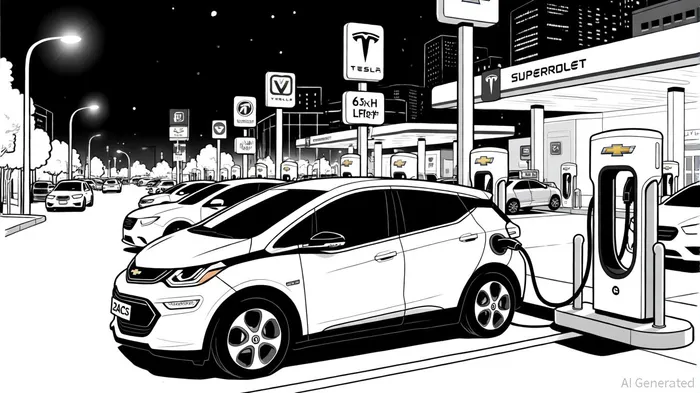





Comentarios
Aún no hay comentarios