
GM's $1.6 Billion Charge and the Challenges of U.S. EV Tax Credits
The automotive sector is grappling with a perfect storm of policy uncertainty and shifting market dynamics, epitomized by General Motors' (GM) $1.6 billion charge in Q3 2025. This charge, attributed to a reassessment of EV capacity and production strategies, underscores the broader challenges automakers face as U.S. federal tax incentives for electric vehicles (EVs) expire and regulatory support wanes. The fallout from these policy shifts is reshaping sector valuations, investor sentiment, and corporate strategies, with implications that extend far beyond GMGM--.
The Policy Shock: Tax Credits and Market Volatility
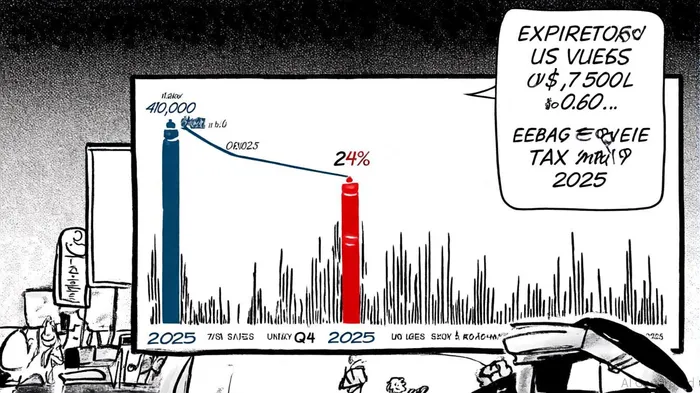
The expiration of the $7,500 federal tax credit for new EVs in September 2025 triggered a surge in last-minute purchases, with U.S. EV sales hitting 410,000 units in Q3 2025, according to Cox Automotive[1]. However, this pull-forward effect has left automakers scrambling to adjust to a post-incentive reality. BloombergNEF forecasts a 24% drop in plug-in vehicle sales year-on-year in Q4 2025, as the immediate financial incentive vanishes[2]. For GM, this translates to a $1.2 billion noncash impairment and $400 million in cash expenses tied to canceled supplier contracts and commercial settlements[3]. The company's stock initially fell 3% in premarket trading but recovered to close up 2%, outperforming broader market indices[4].
The policy uncertainty extends beyond tax credits. The Trump administration's revocation of production mandates and relaxed emissions standards has compounded the challenge[5]. As GM CEO Mary Barra noted, the absence of regulatory pressure to meet EV targets has forced a recalibration of production plans, with the company now prioritizing gas-powered vehicles to avoid excess EV inventory[3]. This shift reflects a broader industry trend: Ford and Hyundai have similarly slashed prices or offered lease credits to offset the loss of federal incentives[1].
Valuation Implications: A Sector in Recalibration
The automotive sector's valuation has been thrown into disarray by these policy shifts. According to a report by BloombergNEF, the U.S. EV market share-once projected to reach 11% in 2025 and 15% in 2026-is now expected to hover around 8% for both years[2]. This downward revision has sent ripples through investor sentiment. For instance, Ford CEO Jim Farley has warned that EV market share could plummet to 5% without sustained policy support[6]. Meanwhile, Tesla, which relies heavily on subsidies and global supply chains, faces added pressure from tariffs on lithium and other critical materials[7].
The stock market's reaction has been mixed. While GM's shares showed resilience post-charge, other automakers have struggled. Ford's stock, for example, has underperformed as the company scales back EV production and absorbs a $3 billion tariff-related hit[8]. Analysts at BCG argue that automakers with diversified strategies-such as Toyota and Honda's focus on hybrids-are better positioned to weather the storm[9]. This divergence highlights the sector's fragmentation: companies that overextended into EVs without hedging against policy risks now face steeper adjustments.
Strategic Adjustments: From Leasing Loopholes to Global Competitiveness
Automakers are adopting a range of tactics to mitigate the impact of policy uncertainty. One notable strategy is the "leasing loophole," where companies like GM and Ford extend $7,500 lease credits using in-house finance arms to pass on tax credit savings[10]. Hyundai has gone further, slashing the price of its 2026 Ioniq 5 by nearly $10,000 to replicate the value of the expired tax credit[1]. These moves underscore the industry's reliance on creative financial engineering to sustain demand in the absence of federal support.
However, such tactics are stopgaps. The long-term viability of the U.S. EV market hinges on automakers' ability to innovate and reduce costs. For example, GM and Ford are accelerating the launch of lower-cost EV models, such as the Chevrolet Bolt and Ford's Universal EV Program, to target price-sensitive buyers[11]. Meanwhile, state-level incentives-like Colorado's expanded $9,000 tax credit-are playing a critical role in filling the federal gap[1]. Yet, as InsideEVs notes, these efforts may not be enough to close the gap with global leaders like China, where EV production accounted for 70% of global output in 2024[12].
The Global Context: U.S. Lags as China and Europe Press Ahead
The U.S. is not the only region recalibrating its EV strategy, but it faces unique headwinds. China, which already accounts for over half of global EV sales, is projected to see 80% of new light-duty vehicle sales as plug-ins by 2030, driven by consumer demand rather than regulatory mandates[13]. Europe, meanwhile, remains committed to emissions targets, with EV sales expected to reach 60% of new vehicle sales by 2030[14]. These divergent trajectories are forcing U.S. automakers to rethink their global strategies. For instance, GM and Ford are shifting focus to hybrid technologies and expanding production in China to remain competitive[15].
Conclusion: A Test of Resilience
The removal of U.S. EV tax credits and the broader policy uncertainty have exposed vulnerabilities in the automotive sector's transition to electrification. GM's $1.6 billion charge is a stark reminder of the financial risks automakers face when aligning production with volatile regulatory environments. While short-term sales declines and valuation volatility are inevitable, the long-term trajectory of EV adoption remains intact-albeit at a slower pace. The winners in this new landscape will be those automakers that balance innovation with flexibility, leveraging both market-driven demand and strategic policy engagement to navigate the uncertainties ahead.





Comentarios
Aún no hay comentarios