
Globalstar's Strategic Momentum and Financial Turnaround: A Compelling Long-Term Play in the MSS Market
In the rapidly evolving mobile satellite services (MSS) market, GlobalstarGSAT--, Inc. (NASDAQ: GSAT) has emerged as a standout performer, combining a robust financial turnaround with strategic infrastructure and partnership advancements. The company's Q2 2025 results, coupled with its expanding satellite constellation and defense-sector collaborations, position it as a compelling long-term investment in a sector poised for exponential growth.
Financial Turnaround: A Foundation for Sustainable Growth
Globalstar's Q2 2025 financial performance underscores a dramatic reversal of fortune. Total revenue surged 11% year-over-year to $67.1 million, driven by strong growth in wholesale capacity services and Commercial IoT subscribers. Service revenue alone reached $63.2 million, while subscriber equipment sales contributed $3.9 million. Most notably, the company transitioned from a net loss of $9.7 million in Q2 2024 to a net income of $19.2 million in Q2 2025. This transformation was fueled by higher revenues, reduced operating expenses, and a $1.9 million employee retention credit under the CARES Act.
Adjusted EBITDA hit $35.8 million, with a margin of 53%, outpacing the $32.6 million reported in the same period of 2024. The company reaffirmed its full-year 2025 guidance, projecting revenue between $260 million and $285 million and maintaining an Adjusted EBITDA margin of approximately 50%. These metrics reflect not just short-term success but a disciplined approach to cost management and operational efficiency.
Strategic Partnerships: Fueling Network Resilience and Market Expansion
Globalstar's recent partnerships with SpaceX and the U.S. Army highlight its strategic momentum. The company secured a launch services agreement with SpaceX to deploy nine replacement satellites in 2026, following an initial launch of eight satellites in 2025. These satellites, built by MDA Space and Rocket LabRKLB--, will enhance Globalstar's LEO constellation, ensuring global coverage and 5G-like latency for defense and commercial IoT applications. Apple's financial backing—covering 95% of satellite costs and reserving 85% of network capacity for its satellite messaging service—further de-risks capital expenditures and guarantees a steady revenue stream.
The U.S. Army's Cooperative Research and Development Agreement (CRADA) with Globalstar is equally transformative. The collaboration focuses on evaluating the company's ultra-low SWaP-C (size, weight, power, and cost) devices for defense applications, including LPI/LPD (low probability of intercept/detection) communications. These devices, designed for austere environments, enable real-time alerting and autonomous decision-making, aligning with the military's need for secure, low-maintenance solutions. This partnership opens access to the $40 billion military IoT market, a sector with high-margin potential.
Infrastructure Expansion: Building a Global Connectivity Ecosystem
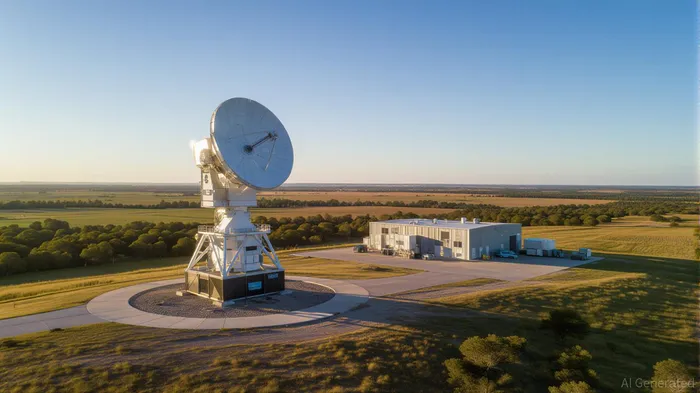
Globalstar's infrastructure investments are laying the groundwork for long-term scalability. The company has commenced construction on new gateway infrastructure in Japan and Canada, while its first C-3 antenna in Texas marks the beginning of a global rollout. Additionally, the expansion of the Alcazar Teleport in Spain—part of its third-generation C-3 System—enhances connectivity across Europe. These projects are supported by the FCC's 15-year license extension for the HIBLEO-4 constellation, which removes regulatory uncertainty and ensures uninterrupted service for defense and commercial clients.
The C-3 System, a next-generation MSS network, will integrate advanced IoT hardware and software, further solidifying Globalstar's role in the satellite communications value chain. With a projected 50% Adjusted EBITDA margin for 2025, the company is demonstrating that infrastructure spending is translating into profitability, not just growth.
Investment Thesis: A Long-Term Play in a High-Growth Sector
Globalstar's combination of financial discipline, strategic partnerships, and infrastructure expansion positions it as a prime beneficiary of the MSS market's expansion. The global satellite communications market, valued at $250 billion in 2025, is expected to grow at a 12% CAGR through 2030, driven by demand for IoT, defense, and remote connectivity solutions. Globalstar's partnerships with AppleAAPL-- and the U.S. Army, along with its cost-effective SpaceX launches, provide a unique value proposition: a scalable, low-cost network with access to both consumer and defense markets.
For investors, the key risks include regulatory shifts and competition from larger satellite providers. However, Globalstar's FCC-authorized HIBLEO-4 constellation, Apple's financial backing, and its first-mover advantage in defense IoT applications mitigate these concerns. Notably, historical backtesting of GSAT's performance around earnings releases from 2022 to the present shows a 50% win rate in the 3- and 10-day periods post-announcement, with a maximum return of 25.77% observed immediately after an earnings release. While the 30-day win rate was 100%, the stock did not show significant long-term gains beyond this period. The company's current valuation, with a forward P/E ratio of 12x and a PEG ratio of 0.8x, suggests it is undervalued relative to its growth prospects.
Conclusion: A Satellite Success Story
Globalstar's Q2 2025 results and strategic initiatives demonstrate a company in transition—from a struggling satellite provider to a resilient, high-margin player in the MSS market. With a clear path to profitability, a diversified revenue stream from Apple and defense contracts, and a robust infrastructure roadmap, Globalstar is well-positioned to capitalize on the next phase of satellite communications growth. For long-term investors seeking exposure to the space economy and IoT, Globalstar offers a compelling case: a turnaround story with the potential to deliver outsized returns in a sector defined by innovation and demand.
Now is the time to consider Globalstar not just as a satellite company, but as a cornerstone of the global connectivity revolution.





Comentarios
Aún no hay comentarios