
Is Globalstar (GSAT) Still a Buy Following Its C-3 Satellite Expansion and Strong Earnings?
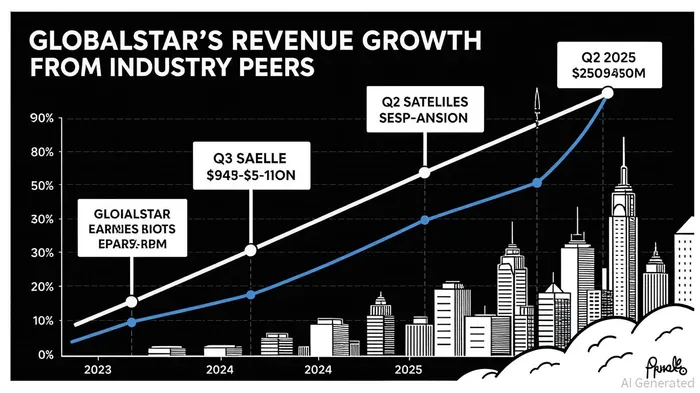
The satellite communications sector is no stranger to volatility, but GlobalstarGSAT-- (GSAT) has carved out a unique narrative in 2025. Following its C-3 satellite expansion and a Q2 earnings report that exceeded expectations, the stock has surged 22% over eight days, trading at $31.23 as of September 2025. Analysts project a 12-month price target of $52.50, implying a 60% upside. But is this optimism justified, or is the market overvaluing a company with a Price-to-Sales (PS) ratio of 15.2x—far above both its peer average (1.6x) and the US Telecom industry average (1.3x)?
Financial Performance: A Foundation for Growth
Globalstar’s Q2 2025 results were a mixed bag of strength and caution. Revenue rose 11% year-over-year to $67.1 million, driven by growth in wholesale capacity services and Commercial IoT subscriber activity [1]. Adjusted EBITDA hit $35.8 million, reflecting a 53% margin, and the company reaffirmed its full-year revenue guidance of $260 million to $285 million [3]. Operational milestones, including the launch of new ground infrastructure in Texas, Japan, Canada, and Spain, and a SpaceX agreement for satellite replacements, underscore its commitment to scaling the C-3 network [5].
However, the financials also reveal vulnerabilities. Capital expenditures remain high, and competition from terrestrial networks and LEO players like SpaceX’s Starlink loom large. Regulatory risks, particularly in spectrum allocation and international operations, could further strain margins [4].
Valuation: A Tale of Two Narratives
The valuation debate hinges on two competing narratives. On one side, intrinsic value models suggest GSATGSAT-- is overvalued. Discounted cash flow analyses estimate its intrinsic value at $10.87 per share, implying a 65% overvaluation relative to its current price [4]. The PS ratio of 15.2x also raises red flags, as it diverges sharply from industry benchmarks [1].
On the other side, analysts and market sentiment argue that Globalstar’s strategic positioning in the satellite IoT boom and defense contracts justifies a premium. The company’s 12-month average price target of $52.50 reflects confidence in its ability to monetize its C-3 expansion, particularly in government and defense applications [3]. A Cooperative Research and Development Agreement (CRADA) with the U.S. Army to advance covert sensing technologies and a commercial partnership with Parsons CorporationPSN-- highlight its diversification into high-margin sectors [1].
Industry Context: Growth vs. Competition
The satellite communications industry is projected to grow at a 10.2% CAGR through 2030, reaching $159.5 billion in revenue [2]. Within this, satellite IoT is a standout, with a 26% CAGR expected to push revenue past $4.7 billion by 2030 [3]. Globalstar’s focus on IoT and defense aligns with these trends, but its ability to compete with giants like SpaceX and ViasatVSAT-- remains uncertain.
SpaceX’s Starlink, for instance, has 6 million users and a valuation of $137 billion (as of 2023), leveraging economies of scale and technological dominance [6]. While Globalstar lacks Starlink’s subscriber base, its niche in IoT and government contracts could insulate it from direct competition. The question is whether these segments can generate sufficient revenue to justify its lofty multiples.
Risks and Rewards
The primary risks for Globalstar include high capital expenditures, regulatory hurdles, and the threat of terrestrial 5G networks undercutting satellite IoT demand. Additionally, the company’s reliance on a handful of large contracts—such as the U.S. Army CRADA—introduces concentration risk.
Conversely, the rewards are substantial. If the C-3 expansion drives subscriber growth and margin expansion, Globalstar could capture a meaningful share of the $4.7 billion satellite IoT market. Its partnerships with SpaceX and ParsonsPSN-- also position it to benefit from the broader $159.5 billion satellite communications boom.
Conclusion: A Buy, But With Caution
Globalstar’s valuation is undeniably stretched, but its strategic moves in IoT and defense, coupled with a robust earnings trajectory, suggest the market is pricing in a future where the company becomes a key player in the satellite ecosystem. For investors with a medium-term horizon and a tolerance for volatility, GSAT could still be a buy—but only if they’re prepared to stomach the risks of a stock trading at 15x sales in a sector where most peers trade at fractions of that multiple.
The key will be execution: Can Globalstar convert its C-3 infrastructure and partnerships into sustainable revenue growth? If the answer is yes, the 60% upside implied by analyst targets may prove conservative. If not, the gapGAP-- between intrinsic value and market price could widen further.
Source:
[1] Globalstar Announces Second Quarter 2025 Financial Results, [https://investors.globalstar.com/news-releases/news-release-details/globalstar-announces-second-quarter-2025-financial-results/]
[2] Satellite Communication Market Size | Industry Report, 2030, [https://www.grandviewresearch.com/industry-analysis/satellite-communication-market]
[3] Globalstar (Nasdaq:GSAT) Stock Valuation, Peer..., [https://simplywall.st/stocks/us/telecom/nasdaq-gsat/globalstar/valuation]
[4] GSAT Intrinsic Value | Globalstar Inc (GSAT), [https://valueinvesting.io/GSAT/valuation/intrinsic-value]
[5] Globalstar, Inc. (GSAT) Q2 FY2025 earnings call transcript, [https://finance.yahoo.com/quote/GSAT/earnings/GSAT-Q2-2025-earnings_call-344494.html/]
[6] Global Satellite Industry Skyrockets: Inside the $400B Space Boom..., [https://ts2.tech/en/global-satellite-industry-skyrockets-inside-the-400b-space-boom-and-the-race-to-1-trillion-by-2035/]





Comentarios
Aún no hay comentarios