
GlobalFoundries' Q3 Outperformance and Q4 Guidance as a Catalyst for Shareholder Value: Strategic Operational Resilience and Margin Expansion in a Volatile Semiconductor Market
The Q3 Outperformance: Margin Expansion as a Strategic Lever
GF's Q3 results were a masterclass in operational execution. While revenue declined slightly year-over-year (YOY), the company's gross margin expanded by 1.2 percentage points compared to Q2 2025, driven by a "product mix shift toward higher-margin automotive and communications infrastructure segments," according to a Tokenist analysis. This wasn't luck-it was a calculated move. By prioritizing orders from sectors with inelastic demand (e.g., automotive and industrial IoT), GF avoided the pricing wars that have eroded margins at foundries like TSMC and Samsung.
The company's non-IFRS operating margin of 15.4%, according to a Manila Times report, further underscores its cost discipline. This metric excludes one-time charges, but the underlying trend is clear: GF is squeezing more profit from every dollar of revenue. For context, in Q3 2024, its operating margin stood at 10.1%, according to the Manila Times report. This 530-basis-point improvement in just 12 months is rare in capital-intensive industries and signals a structural shift in profitability.
Strategic Operational Resilience: Capacity, Technology, and Geography
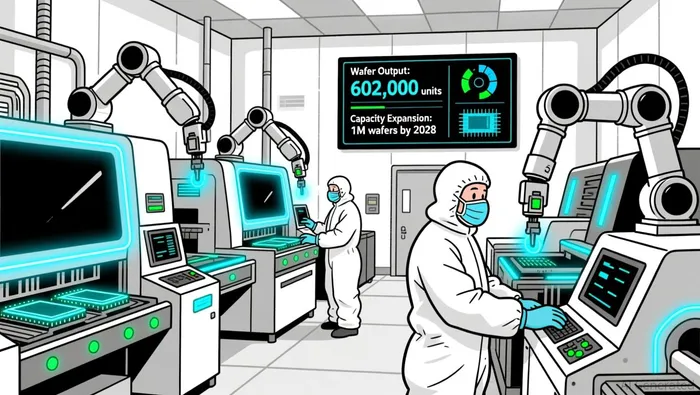
GF's outperformance isn't just about pricing-it's about positioning. The company's €1.1 billion Dresden expansion (funded under the European Chips Act), as reported in a GF press release, is a prime example. By 2028, this project will boost wafer output to 1 million units annually, targeting markets where Europe has long been a net importer: automotive semiconductors, quantum computing substrates, and defense-grade chips. This isn't just capacity-it's geopolitical insurance. As the EU pushes for tech sovereignty, GF's Dresden hub becomes a critical node in a de-risked supply chain.
Meanwhile, the CBIC (Custom Bipolar, BiCMOS, and Compound Semiconductor) production release in Q3 2025, as reported by StockTitan, highlights GF's technical differentiation. These advanced analog and RF technologies are essential for 5G infrastructure and IoT devices-segments growing at 12% CAGR, according to Tokenist. By securing long-term partnerships with firms like Silicon Labs on 40nm ULP (ultra-low-power) technology, as reported by StockTitan, GF is locking in recurring revenue from applications that can't be commoditized.
Q4 Guidance: A Test of Sustained Momentum
GF's Q4 2025 guidance-$1.8 billion in revenue and a 27.6% gross margin-suggests the company isn't resting on its laurels, according to the StockTitan report. The projected 280-basis-point margin expansion from Q3 is aggressive, especially in a market where foundry pricing remains under pressure. But GF's playbook gives it an edge:
- Geographic Diversification: With 40% of revenue now coming from Europe and North America, according to Tokenist, GF is less exposed to China's cyclical slowdown.
- Technology Leadership: Its FDX (Fully Depleted Silicon-on-Insulator) platform is gaining traction in automotive and AI edge computing, offering a 30% power efficiency boost over traditional nodes, according to the Manila Times report.
- Balance Sheet Strength: $4.2 billion in cash and equivalents, according to the StockTitan report, provides flexibility to fund both organic R&D (e.g., silicon photonics) and strategic M&A.
The Bigger Picture: A Semiconductor Sector Rebalance
GF's story is emblematic of a broader industry trend: the shift from "scale at all costs" to "strategic specialization." While TSMC and Samsung chase 3nm and 2nm nodes, GF is dominating in the "foundry of choice" narrative by focusing on:
- Niche Technologies: GaN, SiC, and RF-SOI for 5G and EVs.
- Resilient Markets: Automotive (growing at 8% CAGR) and industrial IoT (growing at 14% CAGR), according to Tokenist.
- Geopolitical Alignment: Aligning with U.S. and EU subsidies to avoid over-reliance on China.
This strategy isn't without risks. The Dresden expansion will take three years to fully materialize, and CBIC demand could face short-term volatility. But for investors with a 2–3 year horizon, GF's margin trajectory and operational discipline offer a compelling case.
Conclusion: A Catalyst for Shareholder Value
GlobalFoundries' Q3 outperformance and Q4 guidance aren't just numbers-they're a blueprint for navigating semiconductor volatility. By combining margin expansion, strategic capacity investments, and a focus on inelastic demand, GF is transforming from a "cost-competitive" foundry into a "value-creating" one. For shareholders, the question isn't whether the semiconductor cycle will correct-it's whether GF's operational resilience will outpace the next downturn.





Comentarios
Aún no hay comentarios