
Global Wheat Oversupply Pressures: Assessing the Long-Term Implications for Commodity Investors
The global wheat market is at a crossroads. Record production levels, geopolitical tensions, and shifting trade dynamics have created a perfect storm of oversupply, driving prices to multi-year lows and forcing investors to rethink their strategies. As of September 2025, the market is grappling with a structural bearish outlook, with global wheat output projected to reach 808.5 million tonnes in the 2025/26 season—despite production shortfalls in key regions like the European Union and Russia[1]. For commodity investors, the challenge lies not only in navigating the immediate volatility but in rebalancing portfolios to mitigate long-term risks while capitalizing on emerging opportunities.
The Oversupply Dilemma: Production vs. Demand
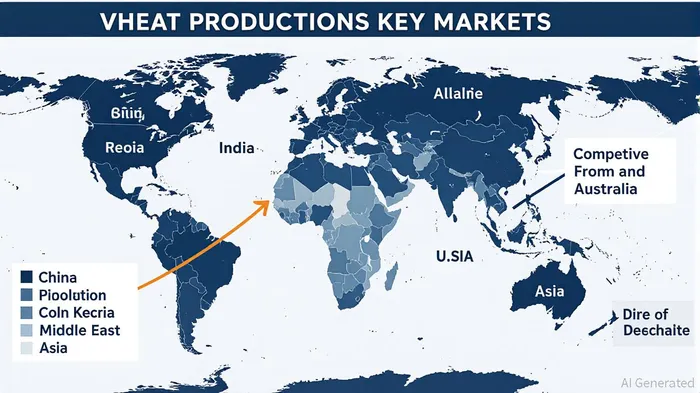
Global wheat production for 2024/25 hit 798.2 million tons, with China and India accounting for 140 million and 114 million tons, respectively[2]. However, these gains have been offset by logistical bottlenecks and geopolitical shifts. Russia, for instance, is projected to export 41.5 million metric tons in 2025/26, leveraging its competitive pricing to dominate markets in North Africa and the Middle East[3]. Meanwhile, Australia's bumper harvest of 32.3 million metric tons has further intensified global competition[4].
Demand, however, has failed to keep pace. Global consumption is expected to reach 802.4 million tons in 2024/25, driven by industrial and seed use in India[2]. Yet, with ending stocks projected to fall to their lowest level since 2015/16, the market is caught in a fragile equilibrium[5]. Prices have plummeted, with U.S. wheat hitting $285/MT in June 2025—a 10.96% drop year-over-year[6]. The bearish trend is compounded by U.S. logistical challenges and trade tensions, such as tariffs on China and Mexico, which have eroded its market share[7].
Portfolio Rebalancing: Diversification and Dynamic Hedging
For investors, the oversupply crisis underscores the need for strategic rebalancing. Wheat's role as a hedge during geopolitical crises—such as the Russia-Ukraine war—offers a glimmer of hope. Studies show that wheat's correlations with equity indices like the S&P 500 and DAX 30 weakened during such events, making it a weak safe haven for portfolios[8]. However, this dynamic is short-lived and frequency-dependent, requiring nuanced timing.
A more robust approach lies in diversifying into other agricultural commodities with stronger fundamentals. Brazil and Argentina, for example, are poised for record outputs in 2025/26, offering alternative avenues for exposure[9]. Additionally, investors can leverage advanced risk mitigation tools, such as partial correlation-based connectedness (PCBC) analysis, which identifies directional dependencies between commodities and financial assets[10]. This method outperforms traditional models in detecting crisis onsets and optimizing portfolio efficiency[11].
Cross-Asset Risks and Geopolitical Uncertainty
Wheat's interdependencies with oil, gas, and emerging market equities add another layer of complexity. During periods of volatility, these assets exhibit heightened co-movements, amplifying systemic risks[12]. For instance, oil price fluctuations can indirectly impact wheat demand through biofuel policies, while emerging market equities may react to food inflation in importing nations. Investors must account for these cross-asset dynamics using time-varying copulas and quantile time-frequency analyses to model extreme market movements[13].
The Road Ahead: Strategic Recommendations
- Diversify Exposure: Shift allocations to commodities with resilient demand, such as corn and soybeans, which are less prone to oversupply pressures[14].
- Adopt Dynamic Hedging: Utilize PCBC frameworks to monitor real-time correlations and adjust positions accordingly[15].
- Monitor Geopolitical Shifts: Track trade policies and tariffs, particularly in China and the EU, which could disrupt supply chains[16].
- Leverage Short-Term Volatility: Use wheat futures to capitalize on price swings driven by weather anomalies and logistical bottlenecks[17].
The wheat market's structural bearishness is unlikely to abate soon. Yet, for investors willing to adapt, the crisis presents an opportunity to refine strategies, hedge against systemic risks, and position portfolios for long-term resilience. As the adage goes, markets don't move in straight lines—but with the right tools, investors can navigate the turbulence.







Comentarios
Aún no hay comentarios