
Global Wheat Market Volatility: Geopolitical Risks vs. Abundant Supplies
The global wheat market in late 2025 remains a battleground of competing forces: geopolitical tensions that threaten supply chains and Southern Hemisphere harvests that bolster global stocks. For investors, navigating this duality requires a nuanced understanding of how these dynamics interact to shape price trends and risk profiles.
Geopolitical Tensions: A Persistent Wild Card
The Russia-Ukraine war continues to cast a long shadow over wheat markets, despite the Black Sea grain corridor remaining operational through alternative routes. According to a report by , Russia and Ukraine together are projected to export 41.5 million and 15 million metric tons of wheat in 2025/26, respectively, maintaining their dominance in global exports. However, the war's lingering uncertainty-particularly the potential for a peace deal-introduces volatility. A resolution could theoretically increase global supplies by freeing up Ukrainian production, but such an outcome remains speculative.
Meanwhile, U.S.-China trade tensions add another layer of complexity. Reduced Chinese wheat imports, coupled with U.S. tariffs, have redirected demand toward Russian and EU suppliers. India's export restrictions, meanwhile, have tightened the demand side of the market, further amplifying sensitivity to geopolitical shifts. As noted by , the market's volatility is exacerbated by the non-linear impact of geopolitical risks, which disproportionately affect price swings in extreme scenarios.
Southern Hemisphere Harvests: A Stabilizing Force
Ample supplies from the Southern Hemisphere have provided a counterbalance to geopolitical risks. Australia and Argentina, two of the world's largest wheat exporters, are on track for record-breaking harvests. Argentina's production was revised upward to 27.7 million metric tons, while Australia is projected to harvest its third-largest crop,
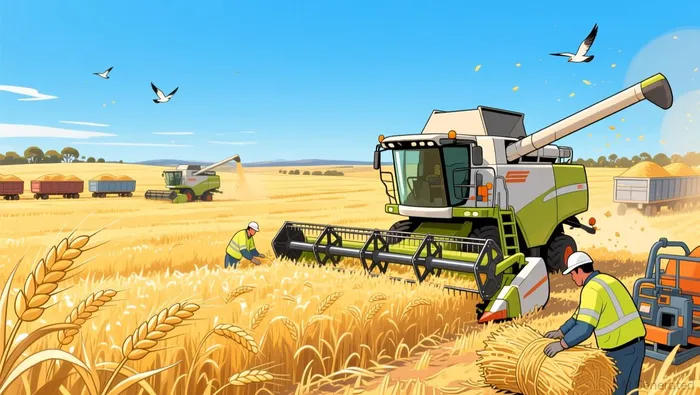
contributing to a global surplus. These harvests have pushed Chicago wheat futures to an eight-week low, capping prices around $5.52 per bushel as of early 2025, with further declines to $5.03 expected by year-end. Global stocks are also rising. The International Grains Council forecasts 2025/26 global wheat stocks at 271.4 million tonnes-a 10-million-tonne increase from the previous year-reinforcing a bearish outlook. However, localized issues such as droughts in the U.S. and Canada, along with logistical bottlenecks in the Rhine and Danube river systems, underscore the fragility of this surplus.
Investment Implications: Balancing Bearish and Bullish Scenarios
For investors, the wheat futures market presents a paradox: structural oversupply coexists with persistent geopolitical risks. The November 2025 USDA WASDE report highlighted this duality, noting global ending stocks at their highest in nearly a decade while warning of regional supply disruptions. Speculative net positions in U.S. wheat futures have turned deeply bearish, with short positions exceeding 110,000 contracts, reflecting trader confidence in continued price declines.
Yet, the market remains vulnerable to shocks. A sudden escalation in the Russia-Ukraine conflict, a drought in key producing regions, or a policy shift in China could trigger sharp price swings. For instance, India's recent export restrictions and warmer-than-expected temperatures in its wheat belt have already introduced uncertainty. Investors must also monitor the 2026/27 season, when lower plantings and weather-related risks could tighten supplies despite projected comfortable stocks.
Strategic Recommendations for Investors
Conclusion
The global wheat market in 2025 is a study in contrasts: geopolitical risks loom large, yet Southern Hemisphere harvests and rising global stocks temper their impact. For investors, success lies in balancing these forces-leveraging oversupply to capitalize on bearish trends while remaining vigilant to the ever-present threat of geopolitical or weather-driven shocks. As the market enters 2026, the interplay between these dynamics will remain the defining factor in wheat futures trading.







Comentarios
Aún no hay comentarios