
Global Wheat Market Dynamics: Strategic Entry Opportunities Amid Paris Price Declines and U.S. Crop Uncertainty
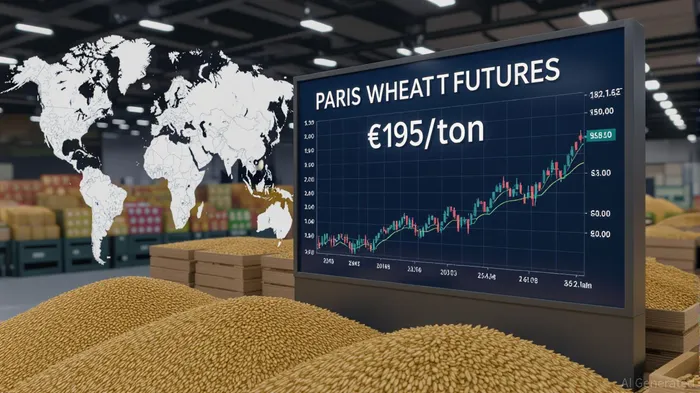
The global wheat market in 2025 is navigating a complex interplay of bearish fundamentals, geopolitical shifts, and currency volatility. Paris Wheat Futures (FR0000000207) have plummeted to €195/ton—the lowest level since early 2021—driven by a confluence of factors including the EU's waning competitiveness, the euro's strength, and aggressive pricing from Black Sea and U.S. suppliers. Meanwhile, pending U.S. wheat crop estimates and global supply dynamics are creating asymmetric risk-reward scenarios for income-focused investors. This article dissects these dynamics and outlines actionable strategies for capitalizing on the current environment.
The Perfect Storm in Paris Wheat Futures
The €195/ton level for Paris Wheat Futures reflects a market in distress. The EU's soft wheat exports face a 13% price disadvantage compared to Black Sea wheat, which trades at $244/ton FOB. This gap has redirected demand to cheaper alternatives, particularly in Egypt, Turkey, and Sub-Saharan Africa. The euro's rise to $1.12 has compounded this issue, making EU wheat less attractive in dollar-denominated markets. Technically, the RSI for the December 2025 contract has fallen below 30, signaling oversold conditions, while the €200/ton psychological barrier has been breached. A sustained move below €190/ton could trigger a cascade of short-covering and hedge fund liquidation, accelerating the downtrend.
U.S. Wheat Crop Estimates: A Double-Edged Sword
The USDA's August 2025 World Agricultural Supply and Demand Estimates (WASDE) report projects global wheat production at 808.6 million metric tons (MMT) for 2025/26, unchanged from June. However, U.S. spring wheat production is expected to decline by 13% to 540.5 million bushels due to reduced acreage and yields. This contrasts with improved winter wheat conditions and strong export demand, which have pushed U.S. wheat exports to 820 million bushels in the 2024/25 marketing year. The U.S. dollar's weakness has made American wheat more competitive, but the market remains sensitive to weather disruptions in key regions like Russia and China.
Strategic Entry Opportunities for Income-Focused Investors
Shorting Paris Wheat Futures with Risk Management
The technical and fundamental bear case for Paris Wheat Futures remains intact. Investors can target short positions with a stop-loss above €190/ton, leveraging the RSI's oversold condition and the euro's strength. However, hedging against unexpected supply shocks (e.g., droughts in the EU or Black Sea) is critical.Arbitrage Between EU and Black Sea/U.S. Wheat
The 8% price differential between EU and Black Sea wheat presents arbitrage opportunities. Traders can short Paris Wheat Futures while going long on U.S. or Black Sea wheat futures, paired with USD/EUR or RUB/EUR currency hedges to offset exchange rate risk. This strategy benefits from both price divergence and potential euro depreciation.Bearish ETFs and Currency Hedges
Instruments like the Teucrium Wheat Fund (NWZ) offer exposure to wheat prices but are currently in a downtrend. Pairing these with long USD/EUR futures can amplify returns if the euro weakens further.Monitoring Global Supply Tightening
While the global wheat balance sheet appears oversupplied, the August WASDE report notes a tightening supply-demand gap. If production falls short of projections due to weather or geopolitical disruptions, prices could rebound sharply. Investors should allocate a portion of their portfolios to high-conviction long positions in U.S. wheat futures or export-driven ETFs, hedged against currency risk.
Risks and Mitigation Strategies
- Supply Shocks: Droughts in the EU or Black Sea, or a Russian export ban, could trigger a short squeeze. Diversifying across regions and using options for downside protection can mitigate this.
- Currency Volatility: The euro's strength is a double-edged sword. Traders should use forward contracts or currency ETFs to hedge EUR exposure.
- Policy Shifts: Changes in EU import caps or U.S. biofuel policies could alter demand dynamics. Staying informed on trade agreements and policy updates is essential.
Conclusion
The global wheat market in 2025 is a textbook example of how macroeconomic forces, geopolitical shifts, and technical indicators converge to create asymmetric opportunities. For income-focused investors, the decline in Paris Wheat Futures and the uncertainty surrounding U.S. crop estimates offer a rare chance to capitalize on a bearish environment while hedging against upside risks. By combining disciplined risk management with strategic positioning in arbitrage and currency-linked instruments, investors can navigate this volatile landscape profitably.
"""







Comentarios
Aún no hay comentarios