
Global Trade Slowdown and the Implications for Tariff-Exposed Sectors
The global trade slowdown of 2025 has emerged as a defining feature of the post-pandemic economic landscape, driven by escalating trade tensions, policy fragmentation, and the financialisation of trade. With growth projected to decline to 1.8% in 2025-well below the pre-pandemic average of 4.9%-the implications for tariff-exposed sectors are profound. As nations recalibrate supply chains and investors grapple with policy uncertainty, strategic asset reallocation has become a critical imperative. This analysis examines the sector-specific impacts of trade policy risks and the evolving strategies to mitigate them.
The Trade Slowdown: A Policy-Driven Downturn
The WTO Goods Trade Barometer, a near-real-time indicator of global merchandise trade, fell to 101.8 in September 2025, down from 102.2 in June, signaling a moderation in growth after a first-half surge driven by import frontloading ahead of tariff hikes. While the barometer remains above its baseline of 100, the underlying trend reflects a shift from global integration to regional fragmentation. The World Bank and IMF have warned of a "critical juncture" in the global economy, with divergent policy positions and deteriorating trade sentiment tightening financial conditions and threatening long-term growth.
The financialisation of trade-whereby 90% of global trade relies on credit lines, payment networks, and capital flows-has amplified the sensitivity of trade to interest rate shifts and investor sentiment. This dynamic was evident in 2025, as accommodative monetary policies and lower energy prices eased financial conditions in the latter half of the year. However, the uneven impact of trade restrictions persists, with advanced economies facing sharper headwinds.
Sector-Specific Impacts and Investor Responses
Manufacturing: Tariffs and Supply Chain Reengineering
The U.S. manufacturing sector has borne the brunt of 2025's tariff regime, with the average effective tariff rate reaching 18.6%-the highest since 1933. These tariffs have driven a 1.8% increase in consumer prices for durable goods and a 0.5 percentage point reduction in real GDP growth for 2025 and 2026. In response, manufacturers are accelerating domestic sourcing and reshoring strategies. For example, aerospace and defense firms have formed multifunctional task forces to navigate policy changes, while automotive producers are reevaluating regional supply chains.
Investor reallocation strategies in manufacturing reflect a shift toward domestic firms with robust local capabilities. Acquisitions targeting supply chain control have surged, with companies prioritizing vertical integration to mitigate tariff-related costs. The Federal Reserve has noted that tariffs contributed 0.5 percentage points to headline PCE inflation in the June–August 2025 period, underscoring the sector's vulnerability to policy-driven price pressures.
Technology: AI and Cloud as Strategic Buffers
The technology sector, with its high foreign revenue exposure, has faced unique challenges from 2025's trade policy risks. The U.S. imposition of a 10% minimum tariff on imports and reciprocal tariffs tied to trade imbalances triggered significant market repricing. While some firms, particularly hyperscalers, have leveraged AI and cloud infrastructure to offset costs, others have experienced abnormal stock returns due to supply chain vulnerabilities.
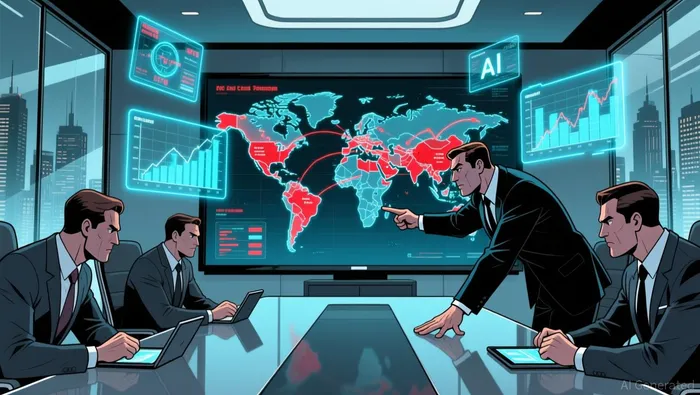
Deloitte's 2025 technology industry outlook highlights a 29% compound annual growth rate in global AI spending from 2024 to 2028, with generative AI, cybersecurity, and software transformation as key priorities. However, trade uncertainty has introduced risks to AI initiatives, particularly in securing supply chains and managing geopolitical tensions. Morgan Stanley recommends favoring services-oriented industries like cybersecurity and software over goods-oriented sectors, which face greater tariff exposure.
Agriculture and Energy: Diversification and Resilience
In November 2025, the agriculture and energy sectors are recalibrating strategies to address trade policy risks. The OECD notes that front-loading of goods production ahead of higher tariffs has provided short-term resilience, but long-term investment in these sectors is expected to decline. For agriculture, geographic diversification and reshoring are gaining traction, while energy firms are prioritizing resilience amid geopolitical conflicts and the transition to renewables.
The Inflation Reduction Act in the U.S. has incentivized renewable energy investment, but global energy price shocks have underscored the need for diversified strategies. Invesco's Global Tactical Allocation Model recommends a shift toward value and small- and mid-cap equities, as well as reduced fixed income duration, to capitalize on expected economic recovery.
Strategic Reallocation: Navigating Policy Uncertainty
Investors are increasingly adopting asymmetric strategies to hedge against trade policy risks. Financial institutions are boosting capital reserves and investing in AI-driven risk management tools to navigate volatility. In manufacturing and healthcare, automation and AI are being leveraged to offset rising costs. Meanwhile, JPMorgan's analysis highlights the role of AI adoption and pro-business policies in sustaining economic resilience despite tariff headwinds.
For the technology sector, the balance between AI-driven growth and supply chain risks remains critical. Firms with strong capital expenditure cycles, particularly hyperscalers, are positioned to drive GDP growth through strategic reallocation toward infrastructure and innovation. The analysis underscores the importance of proactive adaptation to policy-driven volatility.
Conclusion
The 2025 trade slowdown, driven by policy fragmentation and tariff escalation, has reshaped global economic dynamics. For tariff-exposed sectors, strategic asset reallocation is no longer optional but essential. Investors must navigate a landscape where regional integration, technological innovation, and supply chain resilience determine competitive advantage. As the OECD and UNCTAD caution, the long-term impact of trade policy risks will hinge on the ability of firms and investors to adapt to an increasingly fragmented and volatile global economy.







Comentarios
Aún no hay comentarios