
Global Trade Realignment: Opportunities Amid U.S. Tariff Threats on India and China Over Russian Oil Imports
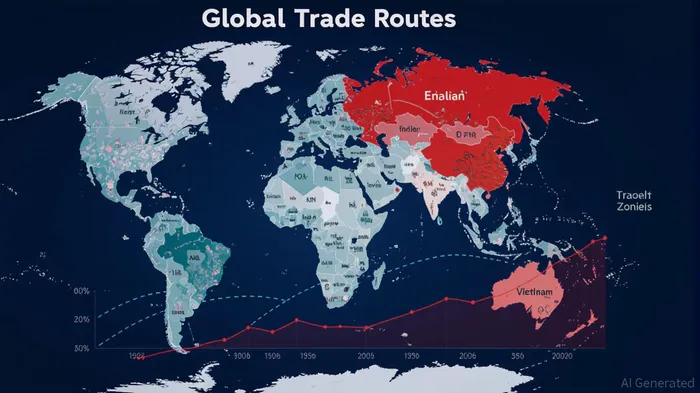
The U.S. tariff war on India and China over Russian oil imports has ignited a seismic shift in global trade dynamics. While the Trump administration's 50% tariff on Indian goods and its selective leniency toward China's $62.5 billion in Russian oil imports have sparked diplomatic tensions, they also reveal a critical investment opportunity: geopolitical risk arbitrage. By leveraging supply chain diversification and capitalizing on alternative trade hubs, investors can navigate—and profit from—this reshaped global economic landscape.
The U.S. Tariff Strategy: A Double-Edged Sword
The U.S. has weaponized tariffs to pressure India into curbing Russian oil imports, framing it as a national emergency to counter Russia's war in Ukraine. This move, however, exposes a strategic inconsistency: China, the largest buyer of Russian oil, faces no comparable tariffs. White House officials justify this by citing India's “recalcitrance” in trade negotiations and its role as a “release valve” for Russia's economy. Yet, this selective enforcement creates a vacuum in global supply chains, which India, Vietnam, and other nations are swiftly filling.
For investors, the key lies in identifying sectors and regions that benefit from this realignment. The U.S. trade deficit with India ($45.8 billion in 2024) and its aggressive tariff hikes on Indian textiles, auto parts, and gems have pushed Indian manufacturers to pivot toward domestic and Southeast Asian markets. Meanwhile, China's continued access to Russian oil—without U.S. retaliation—has allowed it to maintain its dominance in critical mineral supply chains, a lifeline for U.S. tech and defense sectors.
Supply Chain Diversification: The “China+1” Playbook
The U.S. tariff policy has accelerated the “China+1” strategy, with India and Vietnam emerging as prime beneficiaries. India's 0% tariffs on electronics have attracted AppleAAPL--, Samsung, and Foxconn to shift AirPods and smartphone production from China. In 2025, India's mobile phone exports surged 55% year-over-year, outpacing China's decline. The Indian government's Production Linked Incentive (PLI) scheme further sweetens the deal, offering subsidies for electronics manufacturing.
Vietnam, meanwhile, is capitalizing on its 0% electronics tariffs and strategic location. Apple plans to shift 65% of AirPods production to Vietnam by 2025, while VinFast's $36 billion investment in EVs and semiconductors positions it as a regional tech powerhouse.
Investors should prioritize companies in India's electronics sector (e.g., Tata Electronics, Wipro) and Vietnam's semiconductor and EV industries (e.g., VinFast, FPT Corporation). These firms are not only adapting to U.S. tariffs but also leveraging them to capture market share.
Energy Infrastructure: The New Frontier
The U.S. focus on energy security has also spurred investment in alternative energy infrastructure. While the American Clean Power Association's $100 billion battery storage initiative aims to reduce reliance on Chinese supply chains, emerging markets are stepping in to fill gaps. India's renewable energy sector, for instance, is expanding rapidly, with solar and wind projects accounting for 30% of global infrastructure deals in Q1 2025.
Countries like Brazil and Indonesia are also benefiting. Brazil's MSCIMSCI-- index rose 13.3% in Q2 2025, driven by its pivot to green energy and agricultural exports. Indonesia's nickel and lithium reserves are attracting EV battery manufacturers seeking to bypass U.S.-China tensions.
Geopolitical Risk Arbitrage: The Art of the Possible
The U.S. tariff policy creates a unique arbitrage opportunity: investing in regions and sectors insulated from—or thriving under—geopolitical friction. For example, Mexico's 90-day tariff extension under USMCA allows firms like ToyotaTM-- to split production between the U.S. and Mexico, avoiding 25% tariffs while leveraging regional trade benefits.
Similarly, Southeast Asia's CAFTA 3.0 and RCEP agreements are fostering intraregional trade, reducing reliance on U.S.-China corridors. Thailand and Malaysia's stable political environments and competitive labor costs make them ideal for reshoring.
Investment Advice: Diversify, Hedge, and Stay Agile
- Sector Rotation: Overweight emerging market equities in energy infrastructure (e.g., India's Adani Green Energy, Brazil's Neoenergia) and digital infrastructure (e.g., Vietnam's FPT Corporation).
- Currency Hedging: Use futures contracts to mitigate currency volatility in India and Vietnam, where the rupee and dong have weakened against the dollar.
- AI-Driven Supply Chains: Invest in firms using AI for tariff modeling and logistics optimization (e.g., KPMG's supply chain tools, DHL's AI logistics platforms).
- Defensive Plays: Prioritize sectors with low import exposure, such as utilities and healthcare, to balance risk.
Conclusion: Navigating the New Normal
The U.S. tariff war on India and China is not just a geopolitical flashpoint—it's a catalyst for global supply chain reinvention. By targeting alternative trade hubs, energy infrastructure, and emerging market equities, investors can turn geopolitical risk into reward. The key is agility: adapting to shifting trade policies while capitalizing on the long-term structural shifts they create.
In this new era of trade realignment, the winners will be those who see the storm not as a threat, but as an opportunity to rebuild—and profit—from the ground up.







Comentarios
Aún no hay comentarios