
Global Trade Policy Uncertainty and the U.S.-EU Deal: A New Equilibrium for Risk and Capital
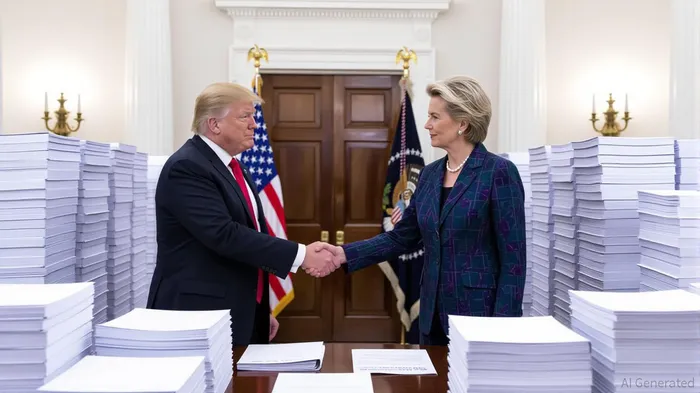
The recent U.S.-EU trade deal, announced on July 27, 2025, marks a pivotal shift in global trade dynamics. By avoiding a transatlantic trade war, the agreement has temporarily reduced policy uncertainty, but its long-term implications for risk premiums and capital flows remain complex. This deal, while imperfect, offers a window into how high-tariff environments reshape market behavior and investor strategies.
The Tariff Framework and Its Immediate Effects
The deal replaces Trump's 30% tariff threat with a 15% baseline tariff on most EU exports to the U.S., while the EU agreed to cut tariffs on U.S. cars to 2.5% from 10%. Sectors like steel, aluminum, and pharmaceuticals remain under negotiation, with the U.S. maintaining a 50% tariff on metals but agreeing to a quota system. These adjustments have reduced short-term volatility in equity and currency markets. The euro initially fell 1% against the dollar post-announcement, reflecting a recalibration of risk perceptions, while European equity funds saw inflows into Germany, a rare bright spot in an otherwise cautious market.
Risk Premiums in a High-Tariff World
Historically, trade policy uncertainty has elevated risk premiums, as investors demand higher returns for exposure to geopolitical and economic instability. The 2025 U.S.-EU deal, while stabilizing, introduces new asymmetries. For example, the 15% tariff on EU goods—applied to machinery, chemicals, and semiconductors—will likely increase input costs for European manufacturers, pushing them to hedge against currency and commodity risks. This could drive capital toward safer assets, such as U.S. Treasuries, further widening the yield gap between U.S. and European bonds.
The EU's non-binding $750 billion energy import pledge and $600 billion investment commitment are symbolic but lack enforceability. This ambiguity creates a “shadow risk premium,” where investors discount the likelihood of these commitments materializing. The result is a fragmented capital flow landscape: while short-term trade tensions are eased, long-term investment into EU energy infrastructure and U.S. tech sectors remains uncertain.
Capital Flows and Sectoral Shifts
The deal's sectoral nuances will drive capital reallocation. The “zero-for-zero” tariff regime on aircraft, semiconductors, and certain agricultural goods supports sectors with strong U.S. and EU value chains. For instance, European aerospace firms like Airbus may see renewed demand, while U.S. semiconductor companies could benefit from relaxed export controls. Conversely, sectors facing higher tariffs—such as German automotive and industrial machinery—will likely see capital outflows and a shift toward cost optimization strategies.
The energy dimension of the deal is particularly intriguing. The EU's pledge to import $750 billion in U.S. LNG and oil over three years could temporarily boost U.S. energy stocks and infrastructure investment. However, the feasibility of this target is questionable given the EU's current import levels of less than $80 billion annually. Investors should monitor whether this translates into tangible projects or remains a rhetorical tool to placate U.S. protectionists.
Investment Implications and Strategic Considerations
For investors, the U.S.-EU deal underscores the need for a nuanced approach to risk and return in a high-tariff world:
Defensive Equities and Currency Hedges: Sectors with low exposure to transatlantic trade, such as utilities and consumer staples, may outperform. Given the euro's vulnerability to U.S. tariff policy, hedging EUR exposure in European portfolios could mitigate downside risks.
Energy and Semiconductors: The deal's focus on energy and tech sectors suggests a structural shift. U.S. LNG producers and semiconductor manufacturers with EU partnerships could see near-term gains, but valuations should reflect execution risks.
Bond Markets and Yield Differentials: The U.S.-EU yield spread is likely to widen further as the U.S. is perceived as a safer haven. Investors in European bonds should prioritize high-quality sovereign and corporate debt over riskier peripheral bonds.
Emerging Markets and Diversification: The U.S.-EU focus on bilateral deals may accelerate fragmentation in global trade. Emerging markets with diversified trade partners, such as India and Brazil, could attract capital as alternative hubs.
The Long Shadow of Tariffs
While the U.S.-EU deal reduces immediate trade war risks, it does not resolve deeper structural issues. The EU's internal criticism of the agreement—particularly from France—highlights the fragility of consensus in multilateral negotiations. Future policy shifts, such as the U.S. Section 232 investigation on pharmaceuticals or EU retaliatory measures on steel, could reignite volatility.
In this environment, investors must balance short-term stability with long-term adaptability. The key lies in identifying sectors and regions that can thrive in a fragmented trade landscape while hedging against policy-driven shocks. The U.S.-EU deal is a temporary truce, not a permanent solution—a reminder that in a high-tariff world, flexibility is the ultimate competitive advantage.







Comentarios
Aún no hay comentarios