
Global Tariffs and the Rise of Nearshoring: Identifying Undervalued Industrial and Logistics Firms in 2025
The escalating global tariffs and trade fragmentation in 2025 are accelerating a seismic shift in multinational supply chains. As nations prioritize economic sovereignty and resilience, companies are reconfiguring operations to mitigate risks from geopolitical tensions and volatile trade policies. This transformation has catalyzed a surge in nearshoring-relocating production and logistics closer to end markets-and created fertile ground for undervalued industrial and logistics firms to thrive. By analyzing valuation metrics, ESG alignment, and corporate strategies, this article identifies key players poised to benefit from the nearshoring boom.
The Nearshoring Imperative: A Structural Shift in Supply Chains
The U.S. and its allies are increasingly moving manufacturing and logistics operations to regions like Mexico, India, and Vietnam to reduce dependency on China. This trend is driven by a combination of rising labor costs, geopolitical risks, and the lessons learned from pandemic-induced supply chain disruptions. Mexico, in particular, has emerged as a critical hub for automotive and semiconductor manufacturing, bolstered by its proximity to the U.S. and the USMCA trade agreement.
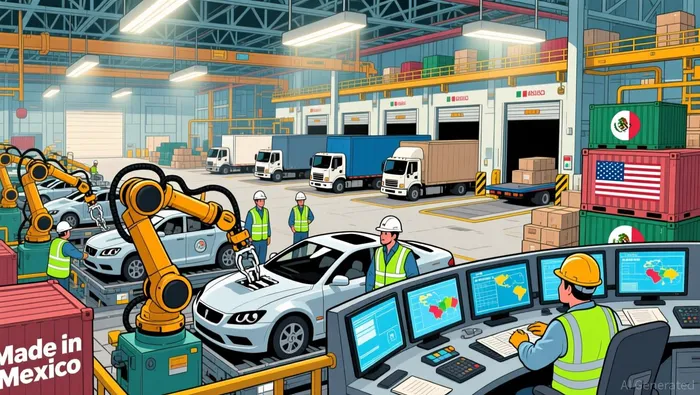 For logistics firms, nearshoring demands robust infrastructure and digital tools to manage cross-border operations. Companies like DP World are expanding port and trade corridor networks to facilitate smoother transitions, while others are leveraging AI and IoT for real-time tracking and predictive analytics. These innovations are not just operational necessities but competitive advantages in a market where agility and transparency are paramount.
Undervalued Industrial Firms: Building the Nearshoring Infrastructure
Industrial companies supplying materials and automation solutions for nearshoring initiatives are gaining traction. Vulcan Materials (VMC), a leading supplier of construction aggregates, is a prime example. With a P/E ratio of 32.6 and an analyst-upside estimate of 3.1%, VMC is well-positioned to benefit from domestic infrastructure projects critical to nearshoring according to market analysis. Similarly, Rockwell Automation (ROK) is capitalizing on the "smart factory" boom, providing automation systems for U.S. manufacturers seeking to reduce overseas reliance. ROK's P/E of 30.7 and 1.6% analyst-upside reflect its alignment with reshoring trends according to market analysis.
RTX Corporation (RTX), a defense and aerospace giant, is another standout. Its localized supply chain strategies align with U.S. policies to secure critical industries. RTX's P/E of 25.6 and 5.6% analyst-upside underscore its resilience in a sector prioritized for domestic production according to market analysis. These firms exemplify how industrial players are leveraging nearshoring to enhance margins and market share.
Logistics Firms: Navigating the New Supply Chain Landscape
Logistics companies are pivotal in enabling nearshoring, with U.S.-Mexico trade volumes surging to $74 billion in May 2025-a 2.6% annual increase. FedExFDX-- (FDX) and United Parcel ServiceUPS-- (UPS) are adapting to this shift, though their strategies differ. FDXFDX-- trades at a P/E of 15.3, with a forward P/E below 13x for UPSUPS--, which faces challenges like declining free cash flow and dividend sustainability concerns. Meanwhile, smaller players like Imperative Worldwide LLC are seeing 6% revenue growth in 2025, driven by pricing and margin improvements according to market analysis.
The sector's valuation multiples have normalized, with a median TEV/EBITDA of 9.96x and TEV/Revenue of 1.43x in Q3 2025 according to market analysis. This suggests undervalued opportunities for firms with scalable logistics infrastructure, such as those involved in cross-border trade or ESG-aligned operations.
ESG Alignment: A Catalyst for Long-Term Value
Environmental, Social, and Governance (ESG) factors are reshaping supply chain strategies. Nearshoring reduces carbon emissions by shortening transportation routes and aligning with labor standards according to market analysis. The green logistics market, projected to grow at 8.29% CAGR to $2.06 trillion by 2030, is attracting investors prioritizing sustainability. Companies integrating ESG into their operations-such as those using recyclable materials or digital traceability-are commanding premium valuations.
Investor demand for ESG-aligned firms is surging, with $33.9 trillion in institutional investments expected to focus on sustainability by 2026. This trend positions logistics firms with strong ESG frameworks to outperform peers, particularly as regulatory pressures and consumer preferences evolve.
Challenges and Risks
Despite the opportunities, nearshoring and logistics firms face headwinds. Persistent driver shortages in the U.S. trucking industry and rising diesel costs threaten profitability according to market analysis. Additionally, geopolitical tensions could disrupt trade routes, requiring firms to diversify supplier bases and adopt predictive analytics for risk mitigation. Investors must weigh these challenges against the long-term growth potential of nearshoring-driven demand.
Conclusion: A Strategic Investment Opportunity
The confluence of global tariffs, nearshoring, and ESG priorities is creating a unique inflection point for industrial and logistics firms. Companies like VMC, ROK, and RTX are building the infrastructure for a resilient supply chain era, while logistics providers are adapting to cross-border demands and sustainability mandates. With valuation metrics suggesting undervaluation and ESG alignment driving investor interest, these firms represent compelling opportunities for investors seeking to capitalize on the 2025 supply chain transformation.







Comentarios
Aún no hay comentarios