
Global Sumud Flotilla and Its Strategic Relevance in Global Markets
The Global Sumud Flotilla, launched in mid-2025, has emerged as a bold challenge to the Israeli blockade of Gaza, but its implications extend far beyond humanitarian aid. For investors, the flotilla represents a unique intersection of geopolitical risk, maritime innovation, and undervalued assets. By analyzing the flotilla's operational framework, insurance dynamics, and strategic resilience, we uncover opportunities in a sector often overlooked by traditional markets.
The Flotilla as a Geopolitical Catalyst
The flotilla's decentralized model-comprising over 50 small to mid-sized civilian vessels from 44 countries-has disrupted conventional maritime paradigms. Unlike commercial shipping, which relies on centralized logistics, the flotilla's distributed structure complicates interception by state actors, even as it faces drone attacks and potential naval confrontations, as described in the Global Sumud Flotilla Wikipedia article. This operational agility mirrors trends in the broader marine vessels market, where small-to-mid-sized ships are gaining traction due to their flexibility in volatile environments, according to a marine vessels market report.
The flotilla's success hinges on its ability to leverage international law. By operating in international waters and carrying humanitarian cargo, the vessels assert their legal right to transit, a principle enshrined in the United Nations Convention on the Law of the Sea (UNCLOS). This legal shield, however, is not foolproof. Israeli authorities have previously intercepted aid vessels like the Madleen and Handala, underscoring the fragility of such claims in practice, as Al Jazeera reported. Yet, the flotilla's persistence highlights a growing global demand for alternative routes to bypass geopolitical blockades-a trend that could reshape maritime asset valuation.
Undervalued Assets: Vessels and Insurance Frameworks
The flotilla's reliance on small, non-commercial vessels points to an undervalued segment of the marine market. According to industry forecasts, the global marine vessels market is projected to grow at a 3.4% CAGR through 2035, driven by demand for energy-efficient and agile ships. While container ships and megamax vessels dominate headlines, the flotilla's use of smaller craft-such as the Alma and Family Boat-reflects a niche market with untapped potential. These vessels, often repurposed for humanitarian missions, are cheaper to operate and less vulnerable to large-scale sabotage than commercial freighters.
However, the geopolitical risks associated with such missions have driven up insurance costs. In 2025, marine war-risk premiums in conflict zones like the Red Sea and Mediterranean have surged, with some insurers charging up to 1% of a vessel's value for a single week of coverage-triple pre-crisis rates, a trend reported by Al Jazeera. This volatility creates a paradox: while the flotilla's vessels are inherently low-cost, their insurance expenses now rival those of high-value commercial ships. For investors, this discrepancy suggests an opportunity to capitalize on underpriced risk mitigation strategies, such as hybrid propulsion systems or blockchain-based tracking, which could reduce insurance premiums by enhancing transparency and security, as noted in the flotilla's Wikipedia entry.
Strategic Resilience in a Fractured World
The flotilla's geopolitical resilience lies in its ability to mobilize global solidarity. With participants from 44 countries-including activists, doctors, and artists-the mission transcends traditional diplomatic divides. This broad coalition has attracted support from unexpected quarters, such as the Italian and Spanish navies, which deployed vessels to protect the flotilla from drone attacks. Such alliances complicate Israel's ability to isolate the mission, creating a de facto insurance against total failure.
For investors, this resilience mirrors the diversification strategies seen in other high-risk sectors. Just as tech startups hedge against regulatory risks by operating in multiple jurisdictions, the flotilla's multi-port departure strategy (from Spain, Tunisia, and Malaysia) ensures that no single point of failure can halt its mission, according to reporting by Al Jazeera. This model could inform investment in maritime assets that prioritize redundancy and adaptability, such as modular cargo ships or AI-driven route optimization systems.
Conclusion: Navigating the New Maritime Frontier
The Global Sumud Flotilla is more than a humanitarian endeavor; it is a case study in how geopolitical tensions can both destabilize and redefine markets. For investors, the flotilla underscores the value of assets that thrive in uncertainty-small, agile vessels; innovative insurance frameworks; and decentralized logistics networks. While the risks are undeniable, the flotilla's persistence in the face of drone attacks and diplomatic pushback demonstrates a resilience that could translate into long-term gains.
As the maritime industry grapples with rising geopolitical volatility, the flotilla's lessons are clear: the future belongs to assets that can navigate chaos as deftly as they navigate the seas.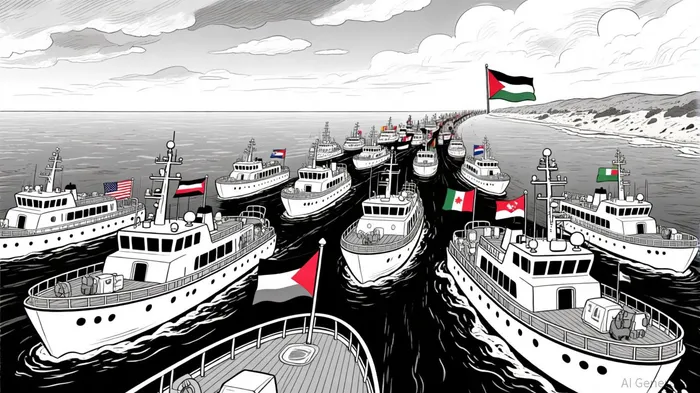







Comentarios
Aún no hay comentarios