
Global Sugar Market Imbalance and Its Impact on Commodity Prices
The global sugar market is experiencing a critical inflection point, driven by divergent supply strategies in Brazil and India-two nations that together account for over 50% of global sugar exports. As these countries navigate production surpluses, policy shifts, and export quotas, their actions are reshaping commodity price dynamics and creating volatility for investors. This analysis examines how Brazil's export dominance and India's strategic recalibration are amplifying market imbalances, with implications for global sugar prices and related sectors.
Brazil: A Dual-Force Engine of Supply and Sustainability
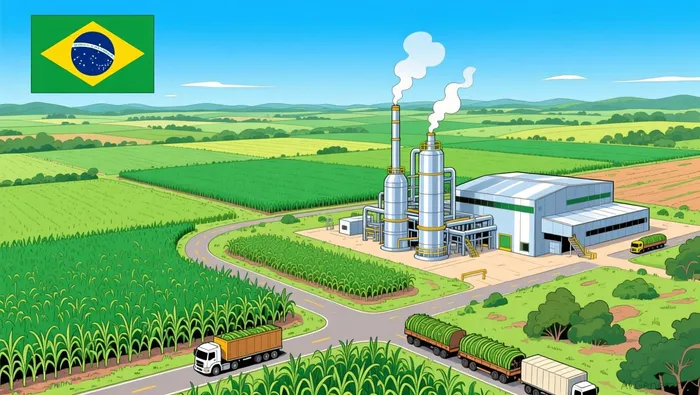
Brazil's 2024/25 sugar production of 41.5 million metric tons (MMT) has solidified its position as the world's largest sugar producer and exporter, with exports projected to reach 29 MMT-nearly half of global trade, according to Brazilian Sugar Industry 2025. Favorable weather, expanded sugarcane cultivation, and a 3.5% increase in sugar recovery rates have underpinned this surge. However, the country's export strategy is not solely driven by volume. Brazil's sugar-ethanol production split (48% sugar, 52% ethanol) allows mills to pivot based on global price signals, ensuring competitive pricing in international markets, as noted by Brazilian Sugar Industry 2025.
Sustainability initiatives further differentiate Brazil's exports. Programs like Renovabio, which promote low-carbon agriculture and renewable energy, are positioning Brazilian sugar as a premium product in carbon-conscious markets, as noted by Brazilian Sugar Industry 2025. Yet, this dual focus on volume and sustainability carries risks. For instance, the strength of the Brazilian real against the U.S. dollar has discouraged export sales, creating short-term price pressures, according to Sugar Prices Rebound as Brazilian Real Strength Sparks ....
India: Strategic Export Quotas and Domestic Surpluses
India's sugar production is set to rise by 16% in the 2025/26 season to 34.35 MMT, driven by robust monsoons and a marginal increase in sugarcane acreage, according to Sugar production seen up 16%. After accounting for 3.4 MMT diverted to ethanol, the country faces a surplus of 30.95 MMT, creating pressure to expand exports. This marks a stark contrast to the 2023/24 season, when a near-total export ban was imposed to curb domestic inflation, as reported by India Urged to Double Sugar Exports to 2 Million Tons Amid Rising Surplus in 2025/26 Season.
The Indian Sugar and Bio-energy Manufacturers Association (ISMA) is advocating for a doubling of export quotas to 2 MMT in 2025/26, arguing that early exports-before Brazil's new season begins-could stabilize global prices, as reported by India Urged to Double Sugar Exports to 2 Million Tons Amid Rising Surplus in 2025/26 Season. However, mills face challenges: domestic sugar prices remain 20% higher than global benchmarks, and a 50% export duty on molasses complicates cost structures, according to India plans 1.5 mln ton sugar export quota on higher domestic surplus. The government's decision to revise the minimum sales price (MSP) of sugar, which has been frozen since 2019, could further influence export competitiveness, according to Sugar production seen up 16%.
Interplay of Policies and Price Volatility
The interplay between Brazil's export momentum and India's policy-driven adjustments is a key driver of global sugar price volatility. Brazil's record 2024/25 output has flooded markets with supply, pushing prices toward five-year lows, according to Sugar Prices Rebound as Brazilian Real Strength Sparks .... Meanwhile, India's cautious approach-balancing domestic needs with export ambitions-has created a "window of opportunity" for mills to offload surplus before Brazilian supplies dominate, as reported by India Urged to Double Sugar Exports to 2 Million Tons Amid Rising Surplus in 2025/26 Season.
This dynamic is evident in recent data: Brazil's October 2025 exports rose 12% to 4.2 MMT, while India's proposed 2 MMT export quota could add further downward pressure on prices, as reported by India Urged to Double Sugar Exports to 2 Million Tons Amid Rising Surplus in 2025/26 Season. However, both countries are also exploring alternative ethanol feedstocks (e.g., corn in Brazil, feedstock in India) to mitigate domestic price spikes-a shift that could reduce sugar exports and stabilize prices in the long term, as reported by India Urged to Double Sugar Exports to 2 Million Tons Amid Rising Surplus in 2025/26 Season.
Investment Implications and Outlook
For investors, the sugar market's volatility presents both risks and opportunities. Brazil's dominance ensures that any disruption in its production or currency trends (e.g., a weaker real) could trigger sharp price swings. Conversely, India's strategic export policies offer a hedge against over-supply, provided the government aligns its quotas with market realities.
The key takeaway is that global sugar prices will remain sensitive to policy decisions in these two nations. Investors should monitor Brazil's ethanol-sugar split, India's export quota approvals, and the pace of sustainability initiatives in both countries. Additionally, the role of alternative ethanol feedstocks and currency fluctuations will be critical in shaping the market's trajectory.







Comentarios
Aún no hay comentarios