
The Global Spillover of the U.S. Tech Sell-Off: Implications for International Markets
The U.S. technology sector's dramatic sell-off in Q3 2025 has sent shockwaves through global equity markets, exposing vulnerabilities in a financial system increasingly reliant on a handful of AI-driven behemoths. What began as a correction in overvalued tech stocks quickly morphed into a broader contagion, with international markets feeling the aftershocks of investor caution, geopolitical tensions, and structural imbalances in the global economy. The implications for systemic risk and sectoral interconnectedness are profound, demanding a reevaluation of how investors and regulators assess stability in an era defined by technological concentration and macroeconomic uncertainty.
A Sell-Off Rooted in Valuation Fears and Macroeconomic Uncertainty
The U.S. tech sector's decline in Q3 2025 was fueled by a perfect storm of factors. Elevated valuations, particularly in AI infrastructure firms, raised concerns about sustainability as companies borrowed heavily to fund speculative projects. Compounding this, the Federal Reserve's delayed rate cuts and shifting investor sentiment created a volatile environment. By October, institutional investors had pulled a staggering $42.93 billion from U.S. stocks, with capital flowing into passive vehicles like ETFs to mitigate exposure to high-risk equities according to market intelligence reports. This exodus was not confined to the U.S.: Canadian markets, for instance, saw their main stock index drop over 570 points as spillover effects from U.S. tech losses rippled across borders.
Global Markets as a Buffer-and a Vulnerability
While the U.S. tech sell-off unfolded, international markets initially appeared to offer a refuge. Europe and Asia outperformed, buoyed by fiscal stimulus, infrastructure spending, and a weaker U.S. dollar according to market commentary. Germany's fiscal plans and Japan's structural reforms, including the NISA tax-advantaged investment account, provided tailwinds as reported in financial analysis. Yet this divergence masked a deeper truth: the global economy remains inextricably linked to U.S. tech dynamics. The EU's Non-bank Financial Intermediation Risk Monitor 2025 warned that European investment funds' heavy exposure to U.S. tech stocks could amplify sharp corrections, creating a feedback loop of forced deleveraging and liquidity stress.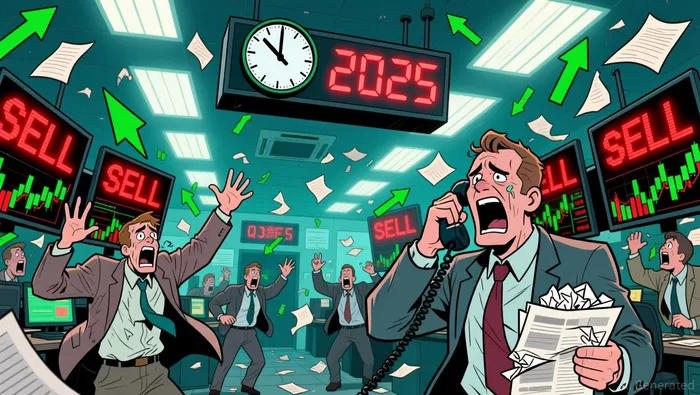 Similarly, China's A-share market, with its high centrality in global financial networks, demonstrated how interconnected entities can disproportionately amplify systemic risks.
Systemic Risk Metrics and the New Normal
Traditional systemic risk indicators, such as CoVaR (Conditional Value at Risk) and SRISK, are now being applied to non-financial sectors like technology, reflecting the sector's outsized influence. The top ten global tech firms, with a combined market cap of $24.6 trillion, have skewed portfolio risk exposure and liquidity dynamics. A 10-15% correction in these firms could trigger cascading effects across asset classes, from equities to cryptocurrencies. Meanwhile, advanced methodologies like the eigen-pair approach-used to analyze interconnectedness in global banking-highlight how contagion spreads through networks, often underestimated by conventional metrics.
The EU's risk monitor also underscored the growing interdependence between crypto-assets and traditional finance, with stablecoins and AI-driven valuations introducing new layers of complexity. This blurring of boundaries complicates risk assessment, as seen in the October sell-off, where Bitcoin's decline mirrored equity market declines.
Policy and Investment Implications
For investors, the lesson is clear: diversification must now account for correlated drawdowns in dominant tech firms. The dispersion of returns in Q3 2025-where Synopsys plummeted on weak guidance while Oracle surged on strong earnings-highlights the need for granular risk analysis. For regulators, the challenge lies in addressing the systemic risks posed by non-financial sectors. The ECB's Financial Stability Review noted that rigid exchange rate regimes and underdeveloped financial systems in emerging markets are particularly vulnerable to U.S. tech-driven volatility.
Policymakers must also grapple with the geopolitical dimensions of this crisis. Trade tensions and the U.S.-China supply chain realignments have already reshaped investment flows. A further downturn in the global financial cycle could exacerbate these risks, particularly in economies reliant on capital inflows from tech-driven markets as research indicates.
Conclusion
The Q3 2025 tech sell-off is a harbinger of a new era in global finance-one where sectoral concentration, technological innovation, and macroeconomic volatility converge to create systemic risks previously unseen. While the U.S. market's resilience, supported by AI-driven earnings, and a Fed rate cut, has cushioned some of the blow, the spillover effects on international markets underscore the fragility of a system built on interconnectedness. Investors and regulators must adapt to this reality, embracing tools that capture network-level risks and stress-testing portfolios against scenarios where a single sector's collapse could reverberate globally.
As the dust settles on Q3's turbulence, one question looms: Can the global economy withstand the next shock without a coordinated response to the systemic vulnerabilities now laid bare?







Comentarios
Aún no hay comentarios