
Global Real Estate Securities in a High-Yield Environment: Strategic Positioning for Capital Preservation and Income Generation Post-Rate Hikes
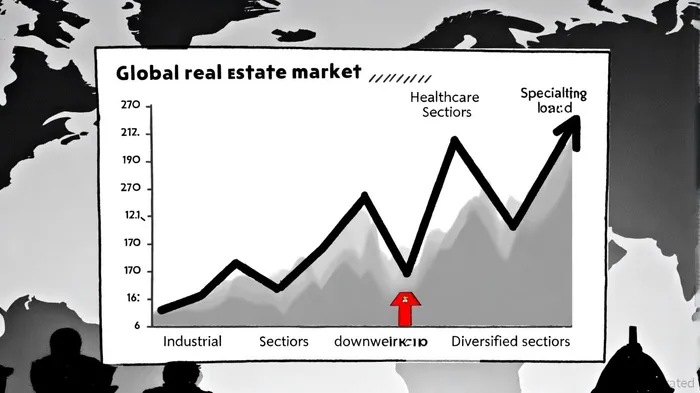
The global real estate securities market is navigating a high-yield, post-rate-hike environment marked by divergent performance across sectors and geographies. After a sharp contraction in 2023—when global commercial-property deal volumes fell 48% year-over-year to their lowest level since 2012[3]—the market has entered a tentative recovery phase in 2024 and 2025. However, this recovery remains uneven, with capital values in the U.S. and UK still 18% and 22% below their mid-2022 peaks, respectively[3]. For investors, the challenge lies in balancing capital preservation with income generation in a landscape where traditional strategies are being redefined by structural shifts and macroeconomic uncertainty.
Market Dynamics in a High-Yield, Post-Rate Hike Environment
The interplay of rising interest rates and shifting demand has reshaped real estate fundamentals. Office propertiesOPI--, for instance, have been among the hardest-hit sectors, with U.S. capital values declining 32% from their 2022 peak[3]. This reflects structural challenges, including the persistent shift to remote work and corporate downsizing. Conversely, industrial real estate has shown resilience, with U.S. logistics markets maintaining a modeled price gap of -5.2% as of late 2023[2], driven by e-commerce growth and supply chain reconfiguration.
Yield differentials have also widened. In 2024, global real estate securities returned just +1.6%, lagging behind equities due to rising U.S. 10-year bond yields[1]. Yet, subsectors like data centers and New York offices have outperformed, while Sunbelt apartments and cold storage have lagged[1]. This dispersion underscores the importance of granular asset selection.
Strategic Allocation: Sectors and Geographies to Watch
Investors are increasingly prioritizing sectors aligned with long-term structural trends. Data centers, for example, have surged as AI adoption and digital infrastructure demand accelerate. PrologisPLD-- (NYSE: PLD), a leading industrial REIT, has benefited from sustained e-commerce growth, with logistics leasing volumes in Q2 2025 reaching their highest level since 2019[2]. Similarly, healthcare and specialty real estate—sectors tied to aging populations and regulatory tailwinds—posted robust returns of +21.0% and +18.7% in 2024[1].
Geographically, Europe has emerged as a focal point. Currency tailwinds and strong multifamily and logistics performance drove 4.8% total returns for European real estate in 2024[2]. Purpose-Built Student Accommodation (PBSA) in undersupplied university cities, such as those in Germany and the UK, is particularly attractive, offering stable cash flows and alignment with decarbonization goals[1]. In Asia Pacific, Japan and Australia have outperformed, with developers and hotel REITs rebounding amid tourism recovery[1].
Risk Mitigation and Capital Preservation Techniques
The post-rate-hike environment demands disciplined risk management. Indirect core investing and secondaries strategies—such as GP-led and LP-led transactions—are gaining traction as tools to access high-quality assets while mitigating liquidity risks[1]. These approaches allow investors to aggregate income-producing properties in resilient sectors like residential and logistics, leveraging operational expertise to enhance returns.
Environmental, social, and governance (ESG) integration is another critical lever. According to Cohen & Steers, ESG factors not only align with regulatory trends but also enhance risk-adjusted returns by prioritizing assets with long-term value retention[4]. For retirees or risk-averse investors, fixed-income instruments and grocery-anchored retail in the U.S. provide defensive income streams, as these assets remain less exposed to trade volatility[1].
The Road Ahead: Opportunities and Challenges in 2025
While the market faces refinancing risks—particularly in the U.S. and Europe, where maturing loans may be "underwater" given current asset values[1]—the outlook is cautiously optimistic. Anticipated rate cuts in the second half of 2024 and early 2025 are expected to spur a recovery in transaction activity. Cross-border investment, for instance, rose 21% year-over-year in Q2 2025, with Asia Pacific seeing an 87% surge[2].
However, structural uncertainties persist. Trade tensions, inflationary pressures, and geopolitical risks could delay a full normalization. Investors must remain agile, favoring sectors with strong demand visibility—such as data centers and healthcare—and geographies with favorable demographic or policy tailwinds. As JPMorgan and Deloitte note, the coming year will likely bring increased clarity, but strategic patience and active asset selection will remain paramount[3].
In conclusion, global real estate securities offer compelling opportunities for capital preservation and income generation in a post-rate-hike world. By focusing on high-conviction sectors, leveraging innovative investment strategies, and maintaining a disciplined risk framework, investors can navigate the current volatility and position themselves for long-term outperformance.







Comentarios
Aún no hay comentarios