
The Global Rally Sputters: Why U.S. Investors Should Rebalance Now
The global equity market rally that defined much of 2025 has shown signs of fatigue in early 2026, as cross-market momentum shifts and positioning risks converge to create a volatile backdrop for U.S. investors. While the S&P 500 closed Q4 2025 with a 2.7% gain, driven by defensive sectors like healthcare and a resilient corporate earnings environment, the broader picture reveals a market increasingly disconnected from fundamentals. International equities, meanwhile, outperformed their U.S. counterparts, with the MSCIMSCI-- ACWI ex-US index surging 32% in 2026, fueled by fiscal stimulus and monetary easing in Europe and emerging markets. This divergence underscores a critical inflection point: U.S. investors must now reassess their portfolios to mitigate overexposure to domestic equities and capitalize on more balanced opportunities.
Cross-Market Momentum: A Tale of Two Markets
The U.S. equity market's dominance in 2025 was underpinned by a narrow concentration of gains. Nearly half of the S&P 500's weight is tied to AI-related activities, with tech-driven capital expenditure and earnings growth propelling large-cap stocks to record valuations. However, this momentum is increasingly at odds with broader economic realities. The S&P 500's forward price-to-earnings ratio now approaches levels last seen in the late 1990s, raising concerns about overvaluation despite the current crop of AI companies being generally profitable-a contrast to the dotcom era.
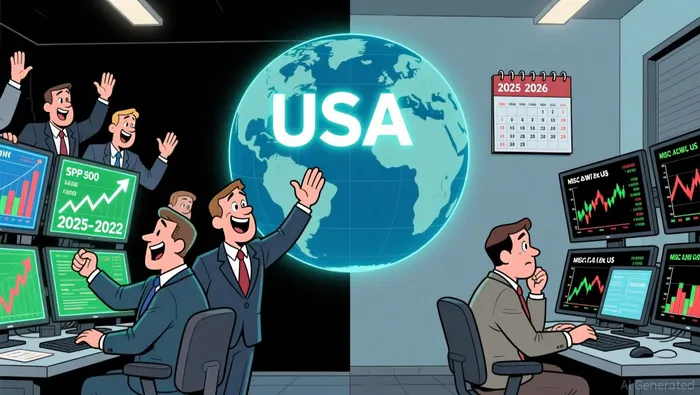 Meanwhile, international markets have demonstrated superior adaptability. European and emerging market equities have benefited from policy clarity and fiscal support, with infrastructure and private credit sectors offering attractive inflation-protected returns. According to a report by Morgan Stanley, U.S. large-cap stocks now account for nearly 25% of the global equity market, creating a structural imbalance that leaves portfolios vulnerable to sector-specific shocks.
Positioning Risks: Valuations, Inflation, and Geopolitical Uncertainty
The risks of maintaining a U.S.-centric portfolio are magnified by three key factors. First, sticky inflation in the U.S. remains a wildcard. While global inflation trends downward, the U.S. CPI has lingered above 3%, potentially delaying the Federal Reserve's anticipated rate cuts. This uncertainty complicates yield expectations for both bonds and equities, as investors grapple with the possibility of prolonged high rates.
Second, the AI-driven valuation boom has created a "bubble" risk. Unlike the dotcom era, today's AI companies are profitable, but their valuations are still vulnerable to earnings shortfalls. As noted by Fiduciary Trust, the market's optimism about AI's transformative potential may outpace its actual economic impact, leading to a correction if productivity gains fall short of expectations.
Third, geopolitical tensions and trade barriers continue to weigh on global growth. U.S. tariffs and ongoing supply chain disruptions have acted as a brake on international trade, while fiscal surprises-such as the record-breaking government shutdown in Q4 2025-have introduced further volatility. These factors highlight the need for diversification beyond U.S. borders.
The Case for Rebalancing: Diversification and Quality
For U.S. investors, the path forward lies in rebalancing portfolios to address these risks. First, reducing overexposure to U.S. large-cap equities-particularly in the tech sector-can mitigate valuation-driven volatility. Second, increasing allocations to international markets, especially those with structural growth drivers like infrastructure and private credit, offers a hedge against U.S. economic headwinds. Third, emphasizing quality assets with durable cash flows can provide stability in a low-growth, high-inflation environment. According to Comerica, this approach offers resilience in uncertain markets.
Morgan Stanley projects the S&P 500 to rise 14% in 2026, but this optimism is contingent on favorable policy shifts and continued AI adoption. Investors who fail to rebalance now risk missing out on opportunities in small- and mid-cap stocks, which are poised to benefit as AI adoption spreads beyond the tech sector. As Oppenheimer notes, these sectors represent emerging growth opportunities.
Conclusion
The global rally of 2025 has sputtered as cross-market momentum shifts and positioning risks come into focus. U.S. investors must act decisively to rebalance portfolios, diversifying into international equities, private credit, and high-quality assets to navigate the uncertainties of 2026. As the Federal Reserve's policy path remains uncertain and AI valuations face scrutiny, a disciplined approach to risk management will be critical. The time to act is now-before the next market correction erodes hard-won gains.





Comentarios
Aún no hay comentarios