
Global Oil Supply Resilience in 2025: Navigating Surpluses and Geopolitical Uncertainty
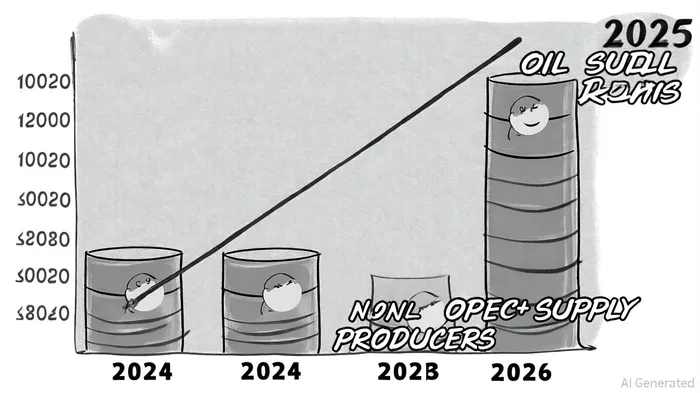
The International Energy Agency's (IEA) September 2025 Oil Market Report paints a nuanced picture of global oil supply resilience, revealing both the strength and fragility of the sector in a rapidly shifting landscape. With global oil production hitting a record 106.9 million barrels per day (mb/d) in August 2025, the market is grappling with a surplus that threatens to undermine energy sector valuations. This surplus, driven by overproduction from OPEC+ members and robust output from non-OPEC+ producers, has created a volatile environment for investors.
Supply Dynamics: OPEC+ and Non-OPEC+ Divergence
The unwinding of OPEC+ output cuts, initiated in April 2025, has led to a surge in global supply. However, the coalition's cohesion remains fragile. While some members, such as Saudi Arabia and the UAE, have adhered to production targets, others, including Russia and Iran, have exceeded their quotas, exacerbating the surplus[1]. Meanwhile, non-OPEC+ producers—led by the United States, Brazil, and Canada—have added 2.1 mb/d to global output in 2025 alone[4]. This dual-track approach has created a supply glut that outpaces demand growth, with non-OPEC+ nations accounting for 70% of the projected 2025 supply increase[2].
Demand Trends: A Tale of Two Halves
Global oil demand is forecast to grow by 700,000 barrels per day (bpd) in both 2025 and 2026, but this growth is uneven. OECD demand surged in the first half of 2025 due to strong industrial activity and post-pandemic recovery, only to contract in the latter half as seasonal factors and economic cooling measures took effect[3]. This volatility has left markets uncertain about the sustainability of demand-side momentum, compounding the challenges posed by oversupply.
Surplus and Price Pressure: A Bearish Outlook
The IEA estimates a 600,000 bpd surplus in 2025, a figure that could expand if OPEC+ fully lifts its voluntary cuts by year-end[1]. This imbalance has already pushed benchmark crude prices below $67/bbl in August 2025, reflecting bearish investor sentiment[1]. For energy sector valuations, the surplus signals a potential shift from the post-2023 rally to a more cyclical, earnings-driven market. Companies with high operating leverage or exposure to volatile regions may face margin compression, while those with cost advantages in non-OPEC+ markets could gain relative strength.
Geopolitical Risks: Sanctions and Strategic Shifts
Geopolitical tensions continue to shape supply dynamics. Sanctions on Iran and Russia, coupled with the EU's impending ban on refined products derived from Russian crude, could disrupt trade flows and create localized shortages[2]. However, these risks are partially offset by the resilience of non-OPEC+ producers, whose ability to scale output quickly has reduced reliance on traditional OPEC+ hubs. Investors must weigh these competing forces, as geopolitical shocks could either amplify price volatility or accelerate the transition to a more diversified supply base.
Implications for Energy Sector Valuations
The current environment demands a recalibration of investment strategies. Energy stocks with exposure to non-OPEC+ production—particularly in the U.S. shale sector—may offer better resilience, given their flexibility to respond to price swings. Conversely, integrated oil majors with significant OPEC+ assets could face valuation headwinds if the surplus persists. Additionally, the surplus may delay capital expenditures in high-cost projects, favoring companies with low breakeven costs and strong balance sheets.
In conclusion, the IEA's analysis underscores a market at a crossroads. While global oil supply has demonstrated remarkable resilience in the face of geopolitical and economic headwinds, the looming surplus and uneven demand growth pose significant risks. For investors, the key will be to balance exposure to supply-side flexibility with hedging against demand-side uncertainties—a strategy that mirrors the sector's own efforts to navigate an increasingly complex energy transition.







Comentarios
Aún no hay comentarios