
Global Market Volatility and Regional Divergence: Strategic Asset Reallocation Amid U.S. Fiscal Uncertainty and Asian Macro Pressures
The global investment landscape in 2025 is defined by stark regional divergence. On one side, the United States grapples with escalating fiscal uncertainty, while on the other, Asian economies navigate structural challenges amid shifting trade dynamics. This divergence is reshaping asset allocation strategies, compelling investors to balance risk mitigation in the West with opportunistic positioning in the East.
U.S. Fiscal Uncertainty: A Looming Storm
The U.S. fiscal trajectory remains precarious, with the Congressional Budget Office projecting a $1.9 trillion deficit for fiscal year 2025-6.2% of GDP and the third-highest in American history. Total federal debt now exceeds $37.6 trillion, equivalent to 122.6% of GDP, with interest payments alone surpassing $879.9 billion annually-outpacing defense and Medicare spending, according to a JEC analysis. Over the next decade, deficits are expected to balloon cumulatively to $21.8 trillion, with the 2025 shortfall serving as a starting point; by 2035 the deficit could reach $2.5 trillion (5.8% of GDP), while interest costs will consume 22% of federal revenue.
These figures underscore a fiscal path unsustainable in the long term. The IMF Fiscal Monitor warns that U.S. public debt will rise faster than most advanced economies, driven by high deficits, tax cuts, and rising interest costs. The ripple effects are already evident: U.S. Treasury yields have surged, tightening global financial conditions and raising borrowing costs for emerging markets, as noted in the report. For investors, this environment demands caution. Overexposure to U.S. Treasuries, once a safe haven, now carries inflationary and liquidity risks as the Federal Reserve's policy flexibility diminishes, according to a Deloitte forecast.
Asian Macro Pressures: Structural Shifts and Trade Tensions
While the U.S. falters on the fiscal front, Asia faces its own headwinds. The IMF Regional Outlook has slashed growth forecasts for key economies: China's 2025 projection fell to 4% from 4.6%, India's to 6.2% from 6.5%, and Japan's to 0.6% from 1.1%. These revisions reflect trade tensions, U.S. tariff policies, and domestic structural challenges.
China, for instance, is pivoting toward domestic consumption amid slowing exports. Its central bank has pledged an "appropriately loose" monetary policy to counteract trade barriers and stabilize the yuan, according to a Reuters report. Meanwhile, Japan's demographic crisis-exacerbated by a shrinking labor force-necessitates automation and labor reforms, and India, despite its robust youth demographic, must address employment gaps through initiatives like the Production Linked Incentive (PLI) scheme.
Trade dynamics further complicate the outlook. U.S. tariffs have spurred supply chain realignments, with Southeast Asia-Vietnam, Indonesia, and the Philippines-gaining U.S. sourcing shares as Chinese demand wanes, according to the QIMA barometer. However, this shift is not without risks. The World Bank cautions that South Asia's growth could slow to 5.8% in 2026 due to global uncertainty and AI-driven job displacement.
Strategic Reallocation: Navigating Divergence
Investors must adopt a dual strategy to navigate these divergent trends. In the U.S., the focus should shift from traditional safe havens to sectors insulated from fiscal volatility. Infrastructure and renewable energy, supported by bipartisan policy frameworks, offer long-term resilience, as highlighted by a Stanford analysis. Additionally, hedging against inflation through commodities or real assets becomes critical as Treasury yields remain volatile, as Deloitte notes.
In Asia, opportunities lie in structural reforms and regional integration. China's domestic consumption pivot and India's manufacturing push present growth avenues, albeit with geopolitical risks. Southeast Asia's role as a manufacturing hub-bolstered by U.S. tariff-driven relocations-offers exposure to supply chain resilience. However, diversification is key: investors should balance exposure to high-growth markets with defensive positions in Japan's technology-driven revival or India's services sector.
Conclusion
The 2025 investment landscape demands agility. U.S. fiscal uncertainty and Asian macro pressures are not isolated phenomena but interconnected forces reshaping global capital flows. By reallocating assets toward U.S. structural strengths and Asia's adaptive growth engines, investors can hedge against volatility while capitalizing on regional asymmetries. The challenge lies in balancing caution with conviction-a task requiring both rigorous analysis and strategic foresight.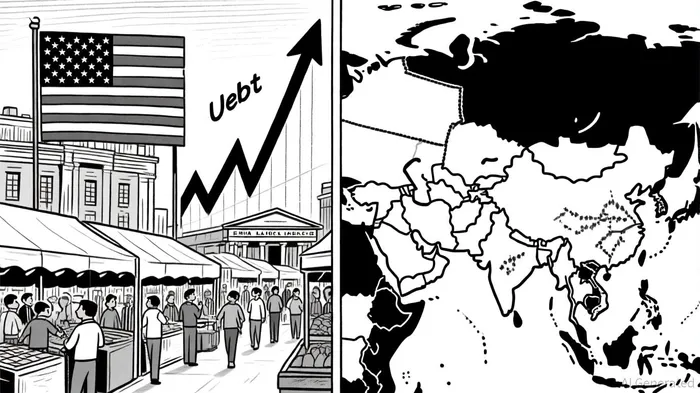







Comentarios
Aún no hay comentarios