
Global Market Implications of the World Bank's Recent Policy Shifts
The World Bank's strategic repositioning in 2023–2025 has sent ripples through global capital markets, particularly in emerging economies. Two pivotal shifts-decentralization of operations and climate policy recalibration-are reshaping equity exposure and capital flows in ways that demand closer scrutiny for investors. These changes, driven by both geopolitical pressures and operational pragmatism, are creating a dual narrative: one of enhanced access to capital and another of constrained climate action.
Decentralization: A Catalyst for Capital Flows
The World Bank's decision to relocate two-thirds of its operations staff to regional hubs in Dubai, Singapore, and Nairobi by 2025, according to a Reuters report, is not merely a logistical adjustment but a strategic pivot to deepen engagement with emerging markets. By decentralizing, the institution aims to reduce bureaucratic lag and align its interventions more closely with local needs. The report notes this move is expected to improve client satisfaction and operational efficiency, with senior managers now embedded in regions like Southeast Asia and Sub-Saharan Africa.
This proximity has already spurred innovative financial tools to attract private capital. For instance, the World Bank Group's inaugural securitization transaction in 2025-repackaging International Finance Corporation (IFC) loans into rated securities-has opened a new asset class for institutional investors. By meeting the risk-return profiles of pension funds and asset managers, this model could unlock trillions in private capital for infrastructure and green projects. IIF data suggests that such initiatives could boost capital inflows to emerging markets by 15–20% in 2025, even as global flows contract to $71 billion.
Climate Policy: A Tightrope Between Ambition and Pragmatism
While the World Bank remains committed to allocating 45% of its annual lending to climate-related projects, its public messaging has softened under U.S. pressure. A Klean Industries analysis notes that the Trump administration's skepticism has forced the bank to adopt a "balanced energy strategy," including investments in nuclear and natural gas. This shift, while politically expedient, risks diluting the urgency of climate action in emerging markets.
The consequences are stark. A 2024 a World Bank report reveals that nearly 60% of banks in Emerging Market and Developing Economies (EMDEs) allocate less than 5% of their portfolios to climate-related investments, with over a quarter offering none at all. This underinvestment is exacerbated by the lack of green taxonomies in 90% of EMDEs, compared to 76% in advanced economies. Meanwhile, adaptation finance remains critically underfunded, with only 16% of climate-related capital directed toward resilience-building-a gap the World Bank warns could widen without private-sector participation.
Equity Performance and Capital Flow Dynamics
Emerging market equities have shown resilience amid these shifts. The MSCI EM IMI Index surged 12.7% in Q2 2025, driven by a weaker U.S. dollar, attractive valuations, and improved macroeconomic stability in countries like India and Indonesia, according to a Capital Markets report. However, this growth is uneven. the OECD projects that while Emerging Asia is set to grow at 4.8% in 2025, Latin America and Sub-Saharan Africa lag behind at 2.5% and 4.1%, respectively.
The World Bank's decentralization efforts may amplify these disparities. For example, Dubai and Singapore-two of the proposed hubs-are already financial gateways for Gulf and Asian capital. This could accelerate flows to nearby markets like the UAE and Vietnam while leaving others, such as parts of Africa, further marginalized. A 2025 Fitch report underscores this risk, warning that fragmented policy signals and geopolitical tensions could exacerbate regional imbalances.
Strategic Implications for Investors
For equity investors, the World Bank's policies present both opportunities and risks. Decentralization and securitization models offer access to high-impact projects in infrastructure and clean energy, particularly in Asia and the Middle East. However, climate policy ambiguity could deter long-term commitments in sectors like renewables, where regulatory shifts under U.S. influence may create uncertainty.
Investors should also monitor the evolution of green taxonomies in EMDEs. As the World Bank pushes for standardized frameworks, early adopters-such as Brazil and South Africa-could attract a disproportionate share of climate capital. Conversely, markets lacking such frameworks may face higher borrowing costs and reduced investor appetite.
Conclusion
The World Bank's 2023–2025 policy shifts are redefining the landscape for emerging markets. Decentralization is unlocking new capital channels, while climate policy adjustments are creating a patchwork of opportunities and constraints. For investors, the key lies in balancing short-term gains from securitization and regional hubs with long-term bets on climate resilience. As the OECD aptly notes, "The future of emerging markets will be shaped not just by policy, but by the agility of capital to adapt to it."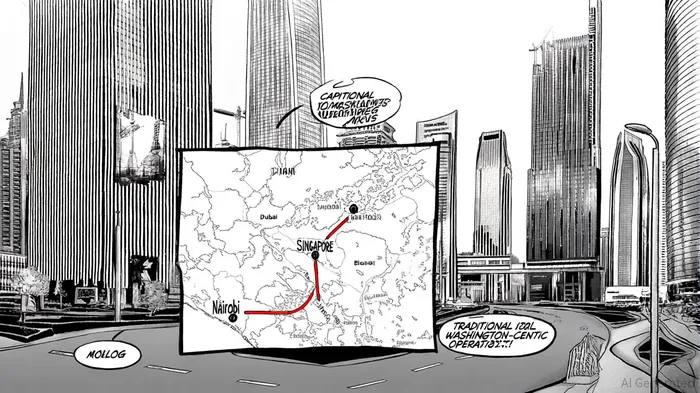







Comentarios
Aún no hay comentarios