
Global Market Divergences: European Equities Outperform U.S. Futures in 2025
The global equity markets have witnessed a striking divergence in 2025, with European indices outpacing their U.S. counterparts for the first time since 2005. This shift challenges long-standing assumptions about the U.S. equity premium and raises critical questions for investors navigating a rapidly evolving macroeconomic landscape.
A Historic Reversal: European Equities Gain Momentum
The Euro Stoxx 50, a bellwether for European markets, has surged 24.2% year-to-date as of August 29, 2025, while the S&P 500 eked out a modest 9.8% gain during the same period [1]. By September 30, the Euro Stoxx 50 closed at 5,529.96, reflecting a 4.6% increase from its January 1, 2025, level of 5,287.15 [2]. In contrast, the S&P 500 remains mired in a correction, having declined 0.5% year-to-date as of March 2025 before clawing back to a 9.8% gain by August [3]. This marks the first time since 2005 that European stocks have outperformed U.S. equities, a trend driven by divergent fiscal and economic trajectories [4].
Drivers of Divergence: Fiscal Policy and Macroeconomic Dynamics
The outperformance of European equities is rooted in aggressive fiscal expansion across the region. Governments in Germany, France, and the UK have implemented stimulus measures to offset energy transition costs and bolster domestic industries, creating a tailwind for corporate earnings [4]. Meanwhile, the U.S. faces a confluence of headwinds: a potential trade war looms as the Trump administration threatens tariffs on imports, and stagflationary pressures persist with inflation stubbornly above 3% despite slowing growth [2].
The Federal Reserve's policy response has further exacerbated the divergence. While the central bank has reduced quantitative tightening (QT) to $5 billion per month from $25 billion, this liquidity injection has been insufficient to offset broader economic concerns [2]. In contrast, the European Central Bank's dovish stance and coordinated fiscal support have stabilized investor sentiment in Europe, allowing equities to thrive.
U.S. Futures: A Tale of Two Narratives
U.S. futures markets tell a nuanced story. As of October 8, 2025, the S&P 500 Index closed up 0.58%, and the Nasdaq 100 hit a record high, buoyed by AI-driven optimism and strong earnings from semiconductor firms like Broadcom [3]. However, these gains mask underlying fragility. The S&P 500's correction in Q3 2025-driven by soft economic data and recession risks-underscores the sector's vulnerability to macroeconomic shocks [2]. Analysts warn that without a de-escalation of trade tensions or a shift toward pro-growth policies, the U.S. equity rally may remain constrained [2].
Implications for Investors
The divergence highlights the importance of regional diversification. European equities, particularly in energy transition and industrial sectors, offer compelling value amid U.S. market volatility. However, investors must remain cautious: the Euro Stoxx 50's gains are partly attributable to a weaker euro, which boosts export-oriented firms but could reverse if inflationary pressures resurface in Europe.
For U.S. investors, the focus should shift to sectoral rotation. AI and semiconductors remain strongholds, but defensive sectors like utilities and healthcare may provide stability amid macroeconomic uncertainty. The Fed's balancing act-managing inflation while avoiding a liquidity crunch-will be pivotal in determining the S&P 500's trajectory.
Conclusion
The 2025 market divergence underscores a fundamental shift in global economic dynamics. European equities have capitalized on fiscal stimulus and stable policy environments, while U.S. markets grapple with trade tensions and stagflation. As the year progresses, investors must weigh regional fundamentals against currency risks and policy outcomes to navigate this new era of market asymmetry.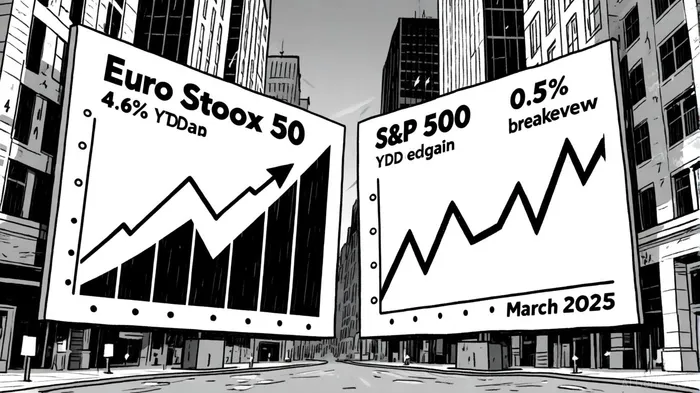







Comentarios
Aún no hay comentarios