
Global Market Divergences in 2025: Capital Flows and Regional Momentum Shifts
In 2025, global capital flows have become a barometer of economic fragmentation, with investors recalibrating portfolios amid divergent regional momentum and policy landscapes. The year has seen a pronounced shift of capital from the United States to Europe and Asia, driven by trade tensions, geopolitical uncertainties, and evolving central bank strategies. This reallocation reflects a broader recalibration of risk and return in a world where traditional safe havens are being redefined.
U.S. Market Dynamics: A Shift in Investor Priorities
The U.S. has experienced a relative outflow of capital as investors prioritize safer assets. According to Market Report Analytics, global bond and money market funds saw record inflows of over $600 billion and $1 trillion, respectively, in 2024–2025. While equity markets attracted significant capital in 2024, early 2025 saw a pullback due to macroeconomic volatility and concerns over inflationary pressures, according to Financial Vines. This trend underscores a growing preference for liquidity and yield stability, particularly as U.S. growth cycles appear to be entering a more balanced phase.
Europe's Resurgence: Policy-Driven Attraction
Europe has emerged as a key beneficiary of this reallocation. CBRE reports cross-regional investment into the region surged by 30% year-over-year in 2024, reaching $18.4 billion, with industrial and logistics assets accounting for a significant share. The European Central Bank's (ECB) initial rate cut in June 2024 and its projected further reductions have created a more accommodative environment for real investment, a point noted in the CBRE analysis. By Q3–Q4 2025, the ECB aims to target a deposit rate of 2%, balancing growth and inflationary risks while addressing deflationary pressures through targeted lending programs, as discussed by Sustainable Trade and Finance. This policy pivot has made Europe an attractive destination for capital seeking both yield and structural resilience.
Asia-Pacific's Attraction: Growth and Policy Flexibility
The Asia-Pacific region has also seen a surge in capital inflows, driven by aggressive central bank easing and growth-oriented policies. In Q2 2025, cross-border investment into the region reached $31.2 billion, a 15% increase year-on-year, with Japan, South Korea, and India leading the charge, according to JLL. India, in particular, has attracted U.S.-based investors seeking exposure to its expanding consumer base and favorable regulatory environment, the JLL tracker notes. Meanwhile, China's accommodative monetary policy, including rate cuts by the People's Bank of China, has further enhanced the region's appeal. However, geopolitical risks-such as trade tensions and supply chain disruptions-remain a drag on sectors reliant on global integration.
Central Bank Policies: The Invisible Hand of Capital Flows
Central banks have played a pivotal role in shaping 2025's investment landscape. The ECB's rate cuts and asset purchase schemes contrast with the U.S. Federal Reserve's more cautious approach, creating a transatlantic divergence that has redirected capital toward Europe, as highlighted by Sustainable Trade and Finance. In Asia, the Reserve Bank of India and the Reserve Bank of Australia have slashed policy rates to multi-year lows, reducing borrowing costs and stimulating real economy activity, a dynamic captured in the JLL analysis. These divergent policies have not only influenced regional capital flows but also reinforced the need for diversified portfolios in an increasingly fragmented world.
Conclusion: Navigating a Fragmented Global Economy
The 2025 investment landscape is defined by stark regional divergences. While the U.S. remains a cornerstone of global finance, its relative outflows signal a shift toward Europe and Asia, where policy flexibility and growth potential are reshaping capital allocation. Investors must now balance exposure to high-yield emerging markets with the stability of developed economies, all while navigating geopolitical headwinds. As central banks continue to adjust their strategies, the ability to adapt to these divergent currents will determine long-term portfolio resilience.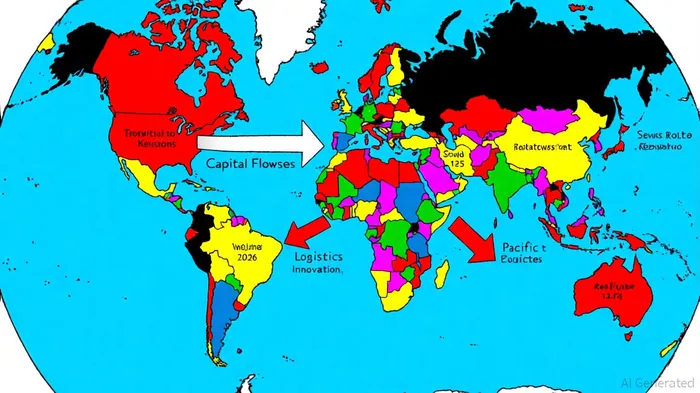







Comentarios
Aún no hay comentarios