
Global HIV Prevention Market Expansion: The Investment Potential of Indian Generic Drugmakers
The global HIV prevention drugs market is undergoing a transformative phase, driven by a confluence of medical innovation, public health priorities, and the urgent need for equitable access to life-saving therapies. For investors, this sector represents a unique intersection of high-growth potential and socially impactful outcomes. At the forefront of this evolution are Indian generic drugmakers, whose strategic partnerships, cost-effective production capabilities, and global licensing agreements position them as critical enablers of market expansion.
Market Dynamics: A Booming Sector with Diverse Projections
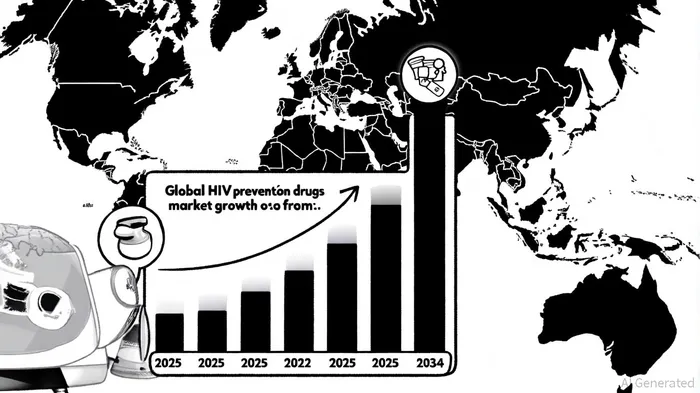
The HIV prevention drugs market is projected to grow at a compound annual growth rate (CAGR) of 4.3–6.2% between 2025 and 2034, with total value expected to surge from $36.55 billion in 2025 to $66.16 billion by 2034 [3]. This growth is fueled by several factors:
1. Rising HIV Prevalence: Despite global efforts, approximately 39 million people live with HIV, with 1.2 million new infections reported annually [6].
2. Innovation in Drug Delivery: Long-acting injectables (e.g., lenacapavir) and multi-class combination therapies are gaining traction, offering improved adherence and reduced stigma compared to daily oral regimens [1].
3. Expanding Access in Low- and Middle-Income Countries (LMICs): Governments and NGOs are prioritizing affordable treatment, creating a $10 million annual demand for prevention tools in high-burden regions [4].
North America currently dominates the market, accounting for 70.58% of global revenue in 2023 [1], but the Asia-Pacific region is emerging as a high-growth hub. India, in particular, is leveraging its robust generic drug manufacturing ecosystem to capture a significant share of this demand.
Indian Generic Drugmakers: Pioneers of Affordable Access
Indian pharmaceutical companies are redefining the economics of HIV prevention through strategic licensing agreements and cost-reduction initiatives. Key developments include:
- Lenacapavir (Yeztugo) Generic Production: Dr. Reddy's Laboratories and Hetero Labs have secured royalty-free licenses from Gilead SciencesGILD-- to produce the twice-yearly injectable HIV pre-exposure prophylaxis (PrEP) drug lenacapavir. Priced at $40 per patient annually—versus $28,000 for the branded version—this generic version is expected to launch in 2027, pending regulatory approvals [1]. Clinical trials have demonstrated nearly 100% efficacy, making it a game-changer for populations struggling with adherence to daily oral PrEP [4].
- Global Partnerships: These initiatives are backed by Unitaid, the Gates Foundation, and the Clinton Health Access Initiative, which provide technical and financial support to scale production and distribution [1]. Such collaborations underscore India's role as a bridge between cutting-edge biopharma innovation and global health equity.
- Market Growth in India: The Indian HIV drugs market is projected to grow at a CAGR of 4.9% from 2025 to 2033, expanding from $1.25 billion to $1.83 billion [2]. Government programs like the National AIDS Control Programme (NACO) are accelerating antiretroviral therapy (ART) access, with over 1.69 million individuals currently receiving treatment [2].
Strategic Advantages for Investors
Indian generic drugmakers offer a compelling investment thesis due to their:
1. Cost Leadership: By producing high-margin, high-impact drugs at a fraction of branded prices, companies like Dr. Reddy's and Hetero Labs are capturing market share in both domestic and international markets.
2. Scalability: India's pharmaceutical sector is expected to grow at 11.3% CAGR from 2025 to 2030, driven by contract manufacturing opportunities and unbranded generic drug exports [4].
3. Regulatory and Social Support: Government-led initiatives, such as NACO's expansion of ART access, and global health funding create a stable demand environment.
Challenges and Mitigation Strategies
While the sector's potential is vast, challenges such as high R&D costs for novel formulations and socioeconomic disparities in drug access persist. However, Indian companies are mitigating these risks through:
- Public-Private Partnerships: Collaborations with global health organizations ensure sustainable funding and regulatory clarity.
- Diversification into Fixed-Dose Combinations: These improve patient adherence and reduce treatment costs, further enhancing market competitiveness [2].
Conclusion: A Win-Win for Investors and Global Health
The HIV prevention drugs market is not merely a commercial opportunity but a cornerstone of public health progress. Indian generic drugmakers, with their ability to democratize access to advanced therapies, are uniquely positioned to drive this transformation. For investors, the sector offers a dual return: financial gains from a high-growth, high-demand market and the satisfaction of contributing to a world where HIV prevention is accessible to all.







Comentarios
Aún no hay comentarios