
Global Grain Market Oversupply Risks: Navigating Futures Positioning and Risk Management in 2025
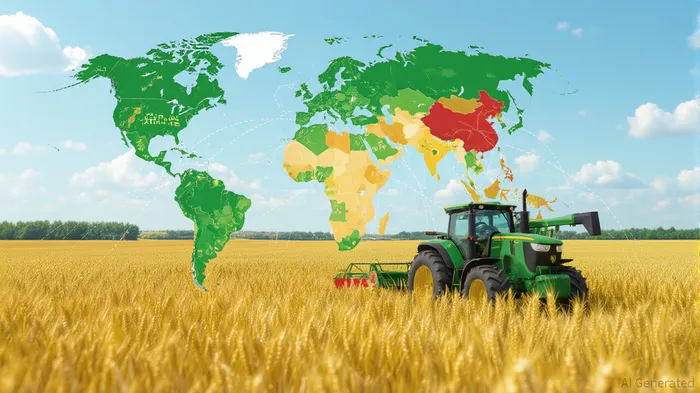
The global grain market in 2025 is at a crossroads, with oversupply risks emerging as a critical concern for investors and producers alike. A confluence of record harvests, climate volatility, and shifting trade policies has created a speculative environment where futures markets are increasingly bearish. For investors, understanding the interplay between speculative positioning and risk management strategies is essential to navigating this complex landscape.
Oversupply and Speculative Positioning: A Bearish Outlook
The 2025 wheat harvest is projected to exceed 770 million tons, driven by strong yields in key producing regions[1]. However, this bounty is tempered by climate-related disruptions, including droughts in North America and erratic rainfall in Europe. These factors have led to a surge in speculative short positions in grain futures, as traders anticipate downward price pressures.
In the canola market, for instance, China's 75.8% tariff has triggered a sharp decline in futures prices, reflecting investor concerns over export demand[2]. Similarly, barley and flax markets are showing signs of oversupply, with Canada's record harvests outpacing global demand[2]. Pea and lentil markets, meanwhile, remain constrained by ongoing Chinese tariffs and elevated global supplies, forcing buyers to reduce bids[2]. These dynamics underscore a broader trend: speculative positioning in grain futures is increasingly aligned with bearish fundamentals, as investors hedge against oversupply risks.
Risk Management: Technology as a Mitigation Tool
To counteract the volatility of oversupply, producers and investors are turning to advanced technologies. Precision agriculture, for example, is being deployed to optimize crop yields and reduce input costs. According to a report by Farmonaut, AI-driven tools and autonomous machinery could boost wheat yields by up to 20%, offering a buffer against climate-related shocks[1]. These innovations not only enhance productivity but also provide investors with more predictable supply-side data, enabling better-informed futures trading decisions.
Another critical risk management strategy involves diversifying export markets. Canadian flax producers, for instance, are exploring alternative markets as Kazakhstani and Russian supplies begin to saturate traditional export routes[2]. While this approach mitigates dependency on a single buyer, it also highlights the fragility of global trade networks in the face of geopolitical and policy shifts.
Strategic Implications for Investors
For investors, the key lies in balancing short-term hedging with long-term adaptability. Futures contracts remain a vital tool for managing price volatility, but their effectiveness is contingent on real-time monitoring of supply-side developments. For example, the recent softening of Canadian flax exports underscores the importance of tracking regional yield forecasts and trade policy changes[2].
Moreover, the integration of AI and precision agriculture into risk management frameworks offers a dual benefit: it stabilizes supply chains while creating new data-driven investment opportunities. Investors who align their portfolios with these technological advancements may find themselves better positioned to weather the cyclical nature of grain markets.
Conclusion
The 2025 grain market is a microcosm of a broader challenge: how to manage oversupply in an era of climate uncertainty and geopolitical fragility. Speculative positioning in futures markets reflects a growing consensus that prices will remain under pressure, but proactive risk management—leveraging technology and diversified trade strategies—can mitigate these risks. For investors, the path forward requires a nuanced understanding of both macroeconomic trends and the granular realities of agricultural production.







Comentarios
Aún no hay comentarios