
Global Food Security in the Shadow of the Soviet Collapse: Agricultural Tech and Supply Chain Resilience
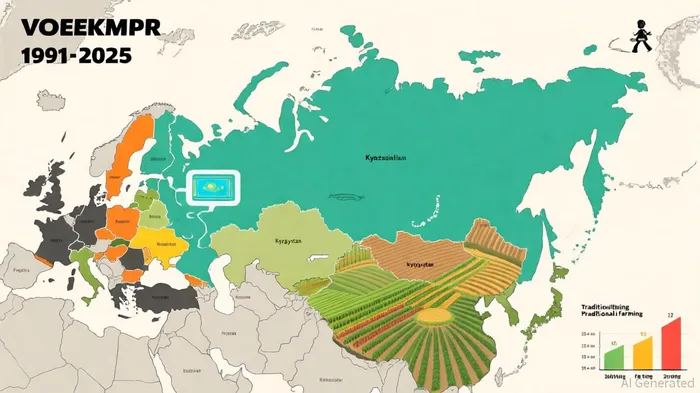
The collapse of the Soviet Union in 1991 reshaped global food markets, agricultural policies, and supply chain dynamics in ways that continue to reverberate today. For investors, understanding the interplay between historical geopolitical shifts, agricultural technology adoption, and supply chain resilience is critical to navigating the evolving landscape of global food security.
The Soviet Collapse and the Fractured Agricultural Transition
The Soviet Union's centralized agricultural system was plagued by inefficiencies, chronic food shortages, and rigid bureaucratic controls[1]. Post-1991, the dissolution of this system led to immediate contractions in agricultural output, hyperinflation, and a breakdown of domestic supply chains[2]. Newly independent states faced a dual challenge: transitioning to market economies while integrating into global trade networks. In Central and Eastern Europe, land privatization and the rise of family farms drove productivity gains, but in Central Asia and the Transcaucasus, overreliance on small-scale farming perpetuated low productivity and rural poverty[3].
This divergence underscores a key lesson for investors: agricultural restructuring is not a one-size-fits-all solution. Countries like Kazakhstan, which embraced corporate and family farming models, saw capital inflows and labor productivity improvements[4]. In contrast, nations with fragmented land ownership and weak institutional frameworks, such as Kyrgyzstan, struggled to adapt to climate shifts and demographic changes[5].
Agricultural Technology: A Mixed Bag of Progress
Post-Soviet states have adopted a patchwork of agricultural technologies, with uneven impacts on supply chain resilience. Precision agriculture, digital tools, and climate-resilient practices remain underutilized due to high costs and farmer conservatism[6]. However, targeted interventions—such as land restitution programs in Eastern Europe—have shown promise. For example, Georgia's rapid farm individualization in the 1990s, though initially disruptive, eventually stabilized local food systems through diversified production[7].
Data from the World Bank highlights that farmer education, access to credit, and land tenure security are critical enablers of technology adoption[8]. In Kyrgyzstan, where growing seasons have become drier and hotter, the lack of modern irrigation systems has exacerbated vulnerabilities[9]. Conversely, Kazakhstan's investment in large-scale agribusinesses has enhanced its role as a global wheat exporter, illustrating how strategic policy choices can bolster supply chain resilience[10].
Geopolitical Shifts and Commodity Market Volatility
Historical geopolitical events have repeatedly disrupted food commodity markets. The 1973 oil crisis, for instance, triggered a 300% surge in oil prices, cascading into inflation and stagflation that destabilized global food systems[11]. Similarly, China's 1978 economic reforms reshaped global demand for soybeans and iron ore, creating a commodities supercycle that persists today[12].
More recently, the Russian invasion of Ukraine in 2022 has exposed the fragility of global food supply chains. Ukraine, a key exporter of wheat and sunflower oil, saw its agricultural output plummet, driving wheat prices up by 2% and exacerbating food insecurity in Africa and the Middle East[13]. This crisis mirrors the Soviet era's reliance on energy exports, but with a critical twist: geopolitical conflicts now directly weaponize food as a tool of coercion[14].
Investment Implications: Diversification and Innovation
For investors, the post-Soviet experience offers three key takeaways:
1. Diversify Supply Chains: Overreliance on single regions or commodities increases vulnerability. The Ukraine conflict demonstrated how a 10% disruption in global wheat exports can trigger systemic volatility[15].
2. Prioritize Technology-Driven Agriculture: Investments in precision farming, digital tools, and climate-resilient crops can mitigate risks in regions with unstable political environments. For example, Kazakhstan's adoption of GIS mapping has stabilized crop yields despite erratic weather patterns[16].
3. Leverage Geopolitical Realignment: As post-Soviet states like Moldova and Armenia pivot toward Western integration, opportunities arise in agribusiness partnerships and infrastructure development[17].
Conclusion
The Soviet collapse and its aftermath have left a complex legacy for global food security. While agricultural technology adoption and geopolitical shifts have created both challenges and opportunities, the path forward requires a nuanced understanding of regional dynamics. For investors, the lesson is clear: resilience in food systems hinges on adaptability, diversification, and a willingness to invest in innovation—lessons as relevant today as they were in the 1990s.







Comentarios
Aún no hay comentarios