
Global Financial Instability and the Rise of Hybrid Hedges: A 2025 Investment Playbook
In an era marked by geopolitical volatility, inflationary pressures, and the rapid evolution of digital finance, investors are increasingly turning to hybrid strategies that blend traditional hard assets with emerging digital currencies. As global financial systems face unprecedented stress-exacerbated by events like the Russia-Ukraine conflict, the TerraLUNA-- Luna implosion, and the lingering aftershocks of the pandemic-the need for robust hedging mechanisms has never been more urgent. This article examines the empirical performance of gold, BitcoinBTC--, and other assets during systemic crises and outlines actionable reallocation strategies for 2025.
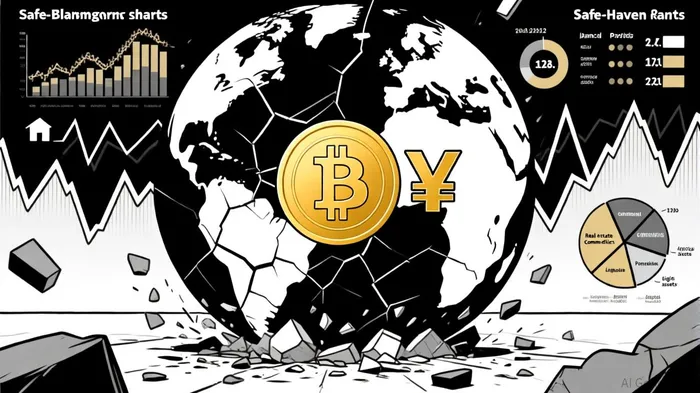
The Gold Standard: A Timeless Hedge
Gold has consistently outperformed digital assets as a safe-haven asset during periods of extreme uncertainty. According to a 2025 study spanning 2013–2021, gold demonstrated a strong negative correlation with global stock indices during geopolitical shocks, such as the 2022 Russia-Ukraine war and the 2023 banking sector turmoil. This resilience is rooted in its dual role as a store of value and a hedge against fiat currency devaluation. For instance, during the 2020–2021 pandemic, gold prices surged by 25% as central banks flooded markets with liquidity, while Bitcoin's price trajectory remained erratic-a SpringerOpen analysis documents that Bitcoin peaked at $64,899 in November 2021 before collapsing by 60% in 2022.
The Japanese yen, meanwhile, has emerged as an unexpected contender. Research from the Journal of Financial Stability reveals that the yen outperformed both gold and Bitcoin as a safe-haven currency across all major stock indices during 2020–2025, driven by its role as a low-yield, high-liquidity asset in times of panic. This underscores the importance of diversifying safe-haven exposure beyond commodities and cryptocurrencies.
Digital Assets: A Dual-Edged Sword
Bitcoin's performance as a hedge remains contentious. While it exhibited brief safe-haven properties during the early stages of the pandemic-showing a -0.3 correlation with the S&P 500 in March 2020-an NCBI study argues that its volatility has since eroded confidence in its reliability. A Julius Baer analysis from 2024 found that Bitcoin's correlation with equities rose to +0.6 during the 2023–2024 market selloff, causing it to behave more like a risk-on asset than a hedge. This duality complicates its role in crisis portfolios, particularly when compared to gold's consistent performance.
Ethereum and other altcoins fared worse. During the 2022 Terra Luna collapse, a ScienceDirect study reports EthereumETH-- experienced a 70% drawdown, while gold lost less than 10% of its value. DeFi and NFT tokens, meanwhile, became net receivers of risk, amplifying losses rather than mitigating them, according to an Emerald study. Stablecoins, despite their name, also failed as hedges; Tether's peg to the U.S. dollar remained intact during the 2023 banking crisis, but its lack of volatility meant it offered no downside protection, as discussed in an IMF article.
Strategic Reallocation: Building a Hybrid Portfolio
To navigate systemic risks, investors must adopt a multi-layered approach that combines the strengths of hard assets and digital currencies. Here are three evidence-based strategies:
Dynamic Rebalancing with Risk Thresholds
A 2025 asset-allocation model recommends a 60/30/10 split: 60% equities, 30% fixed income, and 10% in a hybrid basket of gold, real estate, and Bitcoin. This allocation adjusts dynamically based on macroeconomic signals. For example, when the VIX volatility index exceeds 30-a threshold reached during the 2022 energy crisis-investors should increase exposure to gold and Bitcoin while reducing equity holdings, a tactic outlined in a PurelyInvesting guide.Hybrid Real Estate-Digital Portfolios
Real estate and Bitcoin are being combined in innovative ways. Major firms like Blackstone and Apollo have launched hybrid funds that allocate 50% to income-generating properties and 50% to Bitcoin, leveraging rental yields to offset crypto volatility, according to a MoneyInc article. Small businesses are also adopting this model, with 75% of firms allocating 10% of net income to Bitcoin via dollar-cost averaging (DCA) to build a digital treasury, as reported in a Business Initiative report.Geographic and Currency Diversification
Investors should diversify across regions and currencies. For example, U.S. real estate in high-growth areas like Florida's Space Coast offers appreciation potential, while Bitcoin exposure provides long-term growth, as highlighted in a CFRAResearch blog. Pairing this with yen-denominated assets-such as Japanese government bonds-can further hedge against dollar depreciation, particularly in a world where CBDCs may fragment global financial systems, a risk noted in an Atlantic Council brief.
The Road Ahead: Navigating the New Normal
As financial instability becomes the new normal, the key to survival lies in adaptability. Gold remains the bedrock of crisis portfolios, but its role is being supplemented by strategic allocations to Bitcoin and real estate. However, investors must remain cautious: digital assets are still speculative, and CBDCs may introduce new risks. The most successful strategies will be those that balance tradition with innovation, leveraging the strengths of both worlds to weather the next crisis.






Comentarios
Aún no hay comentarios