
Global EV Sales Surge 30% in Q2, BYD Leads the Pack as Tesla Sales Sink
PorAinvest
martes, 19 de agosto de 2025, 10:15 am ET1 min de lectura
TSLA--
The slowdown in Tesla's deliveries can be attributed to several factors. The EV market has reached a saturation point, with early adopters making up a significant portion of the market. Additionally, Tesla's gross margin contracted to 16.3% in Q2 2025, down from 18.3% in Q2 2024, due to factors such as tariffs, the expiration of the U.S. EV tax credit, and higher interest rates [1]. Geopolitical tensions, particularly the U.S.-China trade war, have also impacted Tesla's supply chain, as China supplies 80% of the critical battery materials [1].
In contrast, BYD's strong performance can be attributed to its aggressive pricing strategy and expansion into new markets. The company set a new sales record in India and plans to expand into Europe next year. BYD's market share in China also increased significantly, further cementing its position as the leading BEV manufacturer [1].
Despite the recent setbacks, Tesla is pivoting its business model to focus on AI and robotaxi services, which are projected to generate $75 billion in revenue by 2030. This shift represents a significant strategic move for the company, aiming to capture a $25 trillion automation market [1]. However, the success of these initiatives is not guaranteed, and investors should be aware of the risks associated with this transition.
In conclusion, while Tesla faces significant challenges in the short term, its long-term strategic pivot to AI and robotaxi services could position it for future growth. Meanwhile, BYD's strong performance in Q2 2025 highlights the company's dominance in the EV market. Investors should carefully consider the risks and potential rewards before making investment decisions.
References:
[1] https://www.ainvest.com/news/tesla-valuation-sustainable-delivery-slumps-geopolitical-risks-2508/
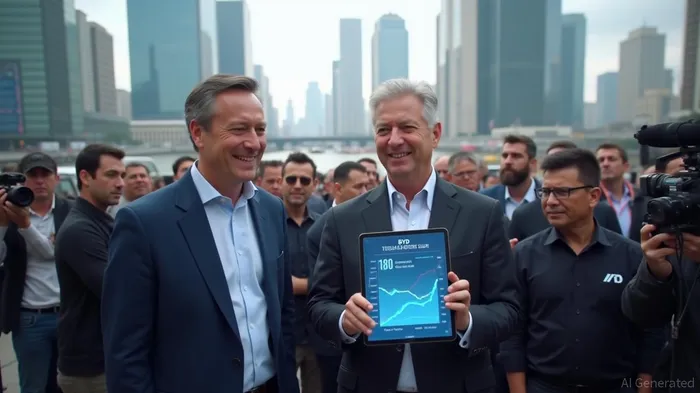
BYD leads the global EV market with a 30% YoY growth in Q2 2025, surpassing Tesla's 14% YoY drop in sales. BYD retains its position as the leading BEV manufacturer, capturing over 18.3% of the total market share, while Tesla comes in second with an 11.7% market share. BYD also hits a new sales record in India and plans to expand into Europe next year.
In the second quarter of 2025, Tesla reported a significant decline in vehicle deliveries, marking a 13.5% year-over-year drop, the company's largest ever. This decline was driven by a combination of market saturation, margin compression, and geopolitical risks [1]. Meanwhile, BYD emerged as the global leader in the electric vehicle (EV) market, achieving a 30% year-over-year growth in Q2 2025, surpassing Tesla's 14% year-over-year drop in sales. BYD's market share increased to 18.3% of the total market, while Tesla's market share fell to 11.7% [1].The slowdown in Tesla's deliveries can be attributed to several factors. The EV market has reached a saturation point, with early adopters making up a significant portion of the market. Additionally, Tesla's gross margin contracted to 16.3% in Q2 2025, down from 18.3% in Q2 2024, due to factors such as tariffs, the expiration of the U.S. EV tax credit, and higher interest rates [1]. Geopolitical tensions, particularly the U.S.-China trade war, have also impacted Tesla's supply chain, as China supplies 80% of the critical battery materials [1].
In contrast, BYD's strong performance can be attributed to its aggressive pricing strategy and expansion into new markets. The company set a new sales record in India and plans to expand into Europe next year. BYD's market share in China also increased significantly, further cementing its position as the leading BEV manufacturer [1].
Despite the recent setbacks, Tesla is pivoting its business model to focus on AI and robotaxi services, which are projected to generate $75 billion in revenue by 2030. This shift represents a significant strategic move for the company, aiming to capture a $25 trillion automation market [1]. However, the success of these initiatives is not guaranteed, and investors should be aware of the risks associated with this transition.
In conclusion, while Tesla faces significant challenges in the short term, its long-term strategic pivot to AI and robotaxi services could position it for future growth. Meanwhile, BYD's strong performance in Q2 2025 highlights the company's dominance in the EV market. Investors should carefully consider the risks and potential rewards before making investment decisions.
References:
[1] https://www.ainvest.com/news/tesla-valuation-sustainable-delivery-slumps-geopolitical-risks-2508/
Divulgación editorial y transparencia de la IA: Ainvest News utiliza tecnología avanzada de Modelos de Lenguaje Largo (LLM) para sintetizar y analizar datos de mercado en tiempo real. Para garantizar los más altos estándares de integridad, cada artículo se somete a un riguroso proceso de verificación con participación humana.
Mientras la IA asiste en el procesamiento de datos y la redacción inicial, un miembro editorial profesional de Ainvest revisa, verifica y aprueba de forma independiente todo el contenido para garantizar su precisión y cumplimiento con los estándares editoriales de Ainvest Fintech Inc. Esta supervisión humana está diseñada para mitigar las alucinaciones de la IA y garantizar el contexto financiero.
Advertencia sobre inversiones: Este contenido se proporciona únicamente con fines informativos y no constituye asesoramiento profesional de inversión, legal o financiero. Los mercados conllevan riesgos inherentes. Se recomienda a los usuarios que realicen una investigación independiente o consulten a un asesor financiero certificado antes de tomar cualquier decisión. Ainvest Fintech Inc. se exime de toda responsabilidad por las acciones tomadas con base en esta información. ¿Encontró un error? Reportar un problema


SOBRE NOSOTROS
Nuestra historiaAutores de noticiasBase de conocimientosPolítica de privacidadTérmino de usoDescargo de responsabilidad de corretaje de tercerosTérminos de uso de AIMEDivulgaciones de riesgos de AInvest AICarrerasCONTÁCTENOS
Email: support@ainvest.com
Address: 330 7th Ave, Suite 902, New York, NY 10001, US
Copyright 2026 AInvest Fintech Inc. All rights reserved.


Comentarios
Aún no hay comentarios