
The Global EV Race: Why China's Dominance Presents a High-Conviction Investment Opportunity
The global electric vehicle (EV) race has reached a pivotal inflection point, with China's electrification strategy reshaping the automotive industry's future. By 2025, China accounts for over 70% of global EV production and dominates domestic sales, with 11 million units sold in 2024. This dominance is not accidental but the result of a meticulously designed policy framework, technological innovation, and geopolitical manufacturing advantages. For investors, the implications are clear: China's EV ecosystem offers a high-conviction opportunity, driven by its strategic positioning in electrification and its ability to outmaneuver Western competitors in a resource-constrained world.
Strategic Policy and Market Maturation
China's rise in the EV sector began with aggressive government intervention. For years, Beijing provided direct subsidies for new energy vehicles (NEVs), protected domestic battery material supply chains, and invested heavily in charging infrastructure. These policies catalyzed a surge in market penetration, which rose from 6.3% in 2020 to 48% in 2024. However, the latest five-year plan (2026–2030) signals a strategic pivot: EVs are no longer listed as a "strategic industry," reflecting the government's belief that the sector has matured beyond the need for direct subsidies.
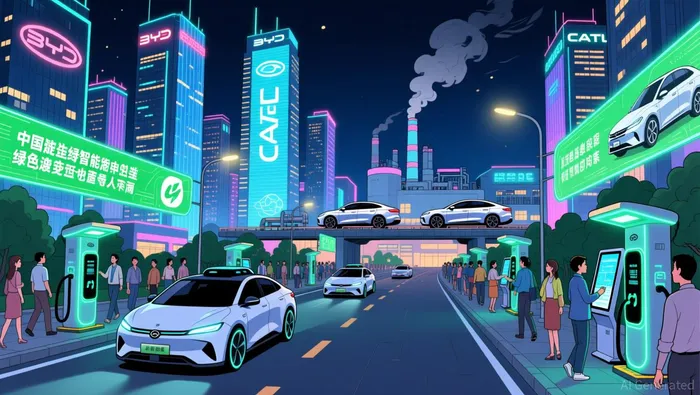 This shift is not a retreat but a recalibration. By stepping back from subsidies, the government aims to address overcapacity and the "neijuan" (involution) price war that has collapsed over 400 EV startups. Instead of propping up unprofitable firms, Beijing is redirecting resources to emerging technologies like quantum computing and hydrogen energy. Yet, the EV industry remains a priority through indirect support-targeted investments in solid-state batteries, intelligent driving systems, and global market expansion. This approach fosters a more sustainable, innovation-driven sector, positioning Chinese firms to compete on global markets without relying on state handouts.
Geopolitical Manufacturing Advantages
China's dominance is underpinned by its control over critical supply chains and manufacturing scale. Domestic battery producers like CATL have pioneered breakthroughs, including 5-minute fast-charging technology and a near-monopoly on global EV battery production. Meanwhile, Chinese automakers such as BYD have leveraged vertical integration and cost efficiencies to capture 34.1% of the domestic market in 2024. These advantages are amplified by geopolitical tailwinds: despite 100% U.S. tariffs and 35.3% EU tariffs, Chinese firms are bypassing trade barriers by establishing local production hubs in Brazil, Southeast Asia, and Europe.
This global footprint is not merely a response to protectionism but a calculated strategy to diversify markets and reduce domestic overcapacity. For instance, BYD and NIONIO-- have begun building factories in Europe and Latin America, mirroring the playbook of Chinese tech giants like Huawei and Xiaomi. Such moves not only insulate firms from Western trade restrictions but also position them to capitalize on emerging markets where EV adoption is still nascent.
Investment Implications
For investors, the key opportunities lie in China's technological leadership and its ability to scale globally. First, the phase-out of subsidies will accelerate industry consolidation, favoring firms with robust R&D capabilities and cost advantages. Companies like CATL and BYD, which have already achieved economies of scale, are well-positioned to dominate next-generation battery technologies and export markets.
Second, the geopolitical realignment of EV production creates a "China-plus-one" investment thesis. Firms expanding into Southeast Asia and Latin America-regions with lower labor costs and growing middle classes-stand to benefit from both margin preservation and market diversification.
However, risks remain. Western governments are likely to intensify trade barriers, and domestic overcapacity could persist if demand growth slows. Yet, these challenges also present opportunities for nimble investors. Chinese EV firms that adapt to a subsidy-free environment-by focusing on innovation, cost efficiency, and global partnerships-will outperform peers in markets still reliant on government handouts.
Conclusion
China's EV dominance is a product of both policy foresight and industrial might. While the phase-out of subsidies marks a new chapter, it also signals a transition to a more resilient, market-driven industry. For investors, this represents a high-conviction opportunity: a sector where technological leadership, geopolitical agility, and scale converge to create long-term value. As the global EV race enters its next phase, China's playbook-rooted in strategic patience and relentless execution-offers a roadmap for sustained growth.





Comentarios
Aún no hay comentarios