
Global Equity Rotation Amid the U.S. Federal Reserve Decision: Capital Flows into Europe Amid Geopolitical and Policy Shifts
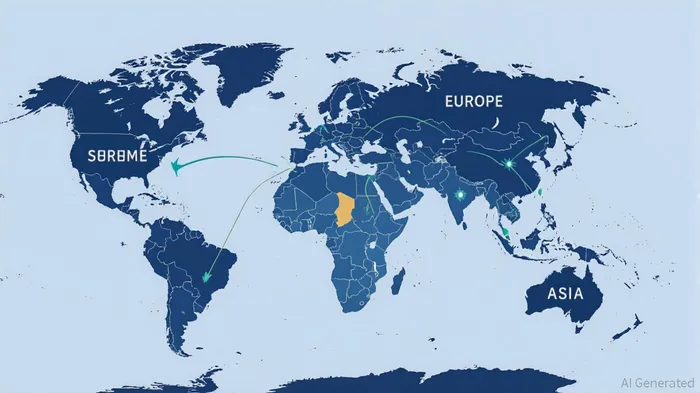
The U.S. Federal Reserve's 25-basis-point rate cut in September 2025 marked a pivotal shift in global monetary policy, triggering a reallocation of capital flows toward Europe and other markets. This decision, driven by a weakening labor market and persistent inflation above the 2% target[1], has set off a chain reaction in international financial markets. As the Fed signals a more accommodative stance, investors are recalibrating their portfolios, with Europe emerging as a key beneficiary of this policy-driven rotation.
The ECB's Cautious Stance and Its Implications
While the U.S. Federal Reserve has embraced rate cuts, the European Central Bank (ECB) has adopted a more measured approach. In September 2025, the ECB maintained its key interest rate at 2%, despite inflation nearing its target, to navigate ongoing uncertainties from U.S. trade policies and global geopolitical tensions[2]. This data-dependent strategy reflects concerns about the spillover effects of U.S. tariffs and the risk of reigniting inflation if rates are cut too aggressively[2]. However, the ECB has already reduced rates from a peak of 4% to 2% over the past year, positioning itself to potentially follow the Fed's easing cycle in the coming months[2].
The divergence in policy paths between the Fed and ECB has had immediate effects on currency dynamics. A weaker U.S. dollar, spurred by the Fed's rate cut, initially strengthened the euro, making European exports more competitive and attracting capital inflows[3]. Yet, the ECB's reluctance to commit to further cuts has created a fragile equilibrium, with the EUR/USD exchange rate expected to remain range-bound as both central banks navigate their respective easing cycles[3].
Geopolitical Catalysts for Capital Reallocation
Geopolitical developments in 2025 have further accelerated the shift in capital flows. The Trump administration's imposition of a 10% global tariff and up to 50% duties on 57 countries has disrupted supply chains and prompted investors to seek stability in markets perceived as less exposed to U.S. policy volatility[4]. Europe, with its trade liberalization efforts and strategic partnerships (e.g., with India), has become an attractive destination for capital.
This reallocation is evident in European equity markets, where inflows have surged. European equity funds attracted over €150 billion in Q1 2025 alone, with additional €22 billion in April and May, marking the highest weekly intake since early 2022[5]. The MSCIMSCI-- Europe index has gained 20% year-to-date, outpacing the MSCI USA index's 2.7% gain[5]. This trend is supported by fiscal stimulus in Germany and other European nations, which have bolstered investor confidence in the region's economic resilience[5].
Sectoral Winners and Strategic Opportunities
The capital inflows into Europe are not uniform but are concentrated in sectors poised to benefit from the new economic landscape. Defense and industrial automation have seen significant investments, driven by geopolitical uncertainties and the need for supply chain resilience[5]. Similarly, green energy has attracted attention as the EU advances its climate agenda, with infrastructure spending acting as a catalyst for long-term growth[6].
Small-cap stocks, particularly in the Euro Stoxx Small 200 index, have outperformed large-cap counterparts, reflecting the influx of “hot money” into undervalued European equities[3]. This trend underscores a broader “value revolution” as investors rotate away from overpriced U.S. assets toward European markets offering better risk-adjusted returns[5].
Future Outlook and Investment Considerations
Looking ahead, the interplay between Fed and ECB policies will remain critical. If the ECB follows through on its anticipated rate cuts in late 2025, the euro could face downward pressure against the U.S. dollar, potentially altering capital flow dynamics[3]. However, the ECB's emphasis on a meeting-by-meeting approach ensures flexibility in responding to evolving trade policies and inflation trends[2].
For investors, the key takeaway is the need to balance exposure to European equities with hedging strategies against currency volatility. Sectors aligned with geopolitical resilience—such as defense, green energy, and industrial automation—offer compelling opportunities, while macroeconomic indicators will dictate the timing of further capital reallocations.







Comentarios
Aún no hay comentarios