
Global Equity Market Momentum Amid the Fed's 2025 Rate-Cut Cycle: Re-Rating Growth Assets and Currency Dynamics
The Federal Reserve's 2025 rate-cut cycle has ignited a seismic shift in global financial markets, reshaping equity valuations and currency dynamics. With the first 25-basis-point reduction in September 2025, the Fed signaled a pivot from tightening to accommodative policy, sparking a re-rating of growth assets and a reconfiguration of capital flows. This analysis explores how these developments are influencing equity market momentum, with a focus on sectoral reallocations and the dollar's waning dominance.
Re-Rating Growth Assets: From Tech Dominance to Cyclical Rebalancing
The Fed's rate cuts have catalyzed a re-rating of growth assets, particularly in technology and healthcare. Lower discount rates have elevated the present value of future earnings, making long-duration assets more attractive. According to a report by iShares, large-cap growth stocks—especially in AI-driven tech and biotech—are prime beneficiaries of this environment[1]. For instance, UnitedHealth GroupUNH-- and Eli LillyLLY-- have seen renewed investor interest due to their robust cash flows and defensive characteristics[2].
However, the narrative is evolving. The equity market is witnessing a "Great Rebalancing," as described by Financial Content, with capital shifting from overvalued mega-cap tech stocks to value and cyclical sectors[3]. This shift is driven by concerns over stretched valuations in tech, where price-to-earnings ratios remain elevated despite slowing growth. Cyclical sectors like industrials and consumer discretionary are gaining traction as lower borrowing costs stimulate demand and corporate spending[4].
Smaller-cap technology and healthcare firms are also benefiting. With access to cheaper capital, these companies are accelerating innovation and expansion. A J.P. Morgan analysis highlights that private equity investors are prioritizing firms with strong cash flow and sustainable revenue growth, aligning with the Rule of 40 valuation benchmark[5]. This trend underscores a broader market preference for profitability alongside growth.
Currency Dynamics: The Dollar's Decline and Global Reallocations
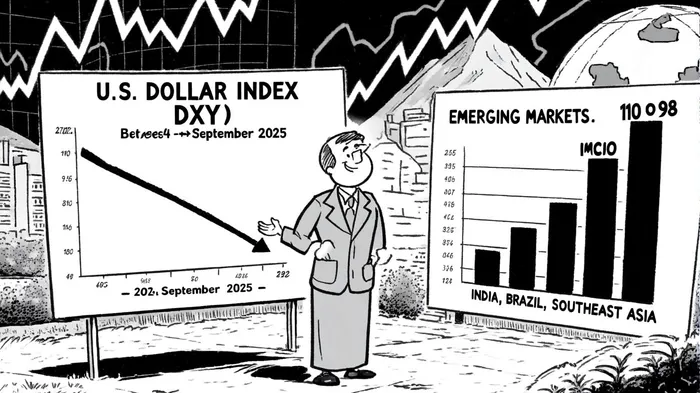
The U.S. dollar's depreciation has been one of the most striking outcomes of the Fed's rate cuts. By September 2025, the DXY had fallen 10.7% year-to-date, marking its worst performance for the period in over five decades[6]. This decline is attributed to dovish Fed signals, weaker U.S. growth forecasts, and a global reallocation of capital toward higher-yielding assets.
Emerging markets have emerged as key beneficiaries. A weaker dollar eases external debt burdens and attracts inflows into equities and local currencies. Morgan StanleyMS-- notes that countries like India and Brazil have seen capital inflows surge, with their equities outperforming developed markets[7]. The euro and British pound are also gaining strength, with J.P. Morgan forecasting EUR/USD to reach 1.22 and GBP/USD to hit 1.39 by mid-2026[8].
The dollar's weakening has broader implications. For the U.S., it boosts export competitiveness but risks inflation from pricier imports. Conversely, multinational corporations face margin pressures as overseas earnings lose value in dollar terms. Emerging markets, however, are leveraging the greenback's decline to attract foreign direct investment and stabilize their economies[9].
Interplay and Future Outlook
The interplay between re-rating growth assets and currency dynamics is reshaping global equity momentum. As the Fed projects two more rate cuts in 2025, markets are pricing in further dollar weakness and accommodative conditions. This environment favors sectors with exposure to economic cycles and international trade, while financials face headwinds from compressed net interest margins[10].
Looking ahead, investors must navigate a dual challenge: capitalizing on growth re-ratings while hedging against currency volatility. The Fed's forward guidance—suggesting a terminal rate of 3.5%–3.75% by year-end—provides clarity but also underscores the need for agility in portfolio management[11].





Comentarios
Aún no hay comentarios