
Global Equity Diversification: How VEU's Resilience Stands Out in Turbulent Times
Global Equity Diversification: How VEU's Resilience Stands Out in Turbulent Times
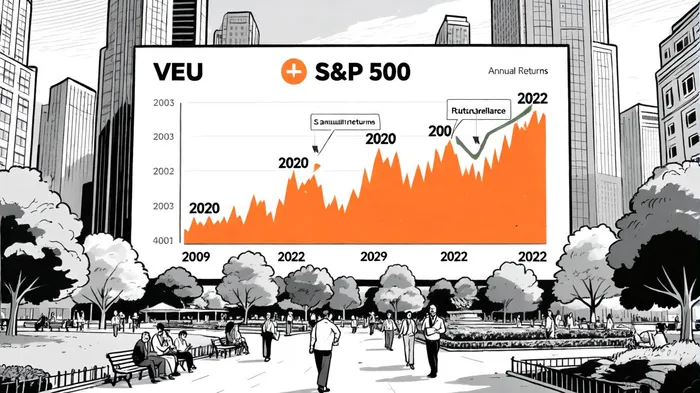
Global equity diversification has long been a cornerstone of prudent investing, offering a buffer against regional economic shocks. The Vanguard FTSE All-World ex-US Index Fund ETF (VEU), which tracks international equities outside the United States, and the S&P 500, a U.S.-centric benchmark, have exhibited divergent performances during major market events since 2009. This analysis examines how VEU's exposure to global markets has both complemented and contrasted with the S&P 500's trajectory during periods of crisis and recovery.
2009: The Great Recession's Aftermath
The 2009 market rebound following the 2008 financial crisis saw the S&P 500 surge 28.73%, according to S&P 500 returns, driven by aggressive U.S. monetary policy and a rapid recovery in domestic equities. In contrast, VEUVEU-- returned 21.83% for the year, according to VEU performance. While the S&P 500's outperformance reflected its focus on large-cap U.S. companies, VEU's lag highlighted the uneven pace of international economic stabilization.
2015: Global Volatility and Currency Woes
The 2015 market turbulence, fueled by geopolitical tensions and currency fluctuations, saw the S&P 500 eke out a modest 1.24% return. VEU, however, fell by -4.78%, as emerging markets and European economies grappled with the fallout from China's slowdown and the European debt crisis. This period underscored the vulnerability of international portfolios to cross-border contagion, with VEU's global exposure amplifying downside risks during a synchronized downturn (per FinanceCharts).
2020: The Pandemic's Asymmetric Impact
The 2020 pandemic-induced crash presented a turning point. While the S&P 500 plummeted by -18.92% in February before rebounding, VEU recorded a -15.58% annual return. The divergence stemmed from the U.S. market's rapid recovery in sectors like technology, whereas international markets faced prolonged disruptions in travel, energy, and manufacturing. VEU's relative resilience reflected its exposure to economies with earlier pandemic containment measures, such as parts of Asia (based on official S&P data and VEU performance figures).
2022: Inflation and Geopolitical Shocks
The 2022 inflationary surge and Russia's invasion of Ukraine tested global markets. The S&P 500 fell by -18.17%, while VEU declined by -15.58%. Here, VEU's outperformance-albeit marginal-was driven by its underrepresentation in energy and commodity sectors, which bore the brunt of inflationary pressures in the U.S. index. This contrast illustrated how diversification can mitigate sector-specific risks during macroeconomic shocks.
Strategic Implications for Investors
VEU's performance during these high-impact years reveals a nuanced picture. While it underperformed the S&P 500 in 2009 and 2015, it outperformed in 2020 and 2022, demonstrating that global diversification is not a guarantee of outperformance but a tool to smooth returns across cycles. For investors, this underscores the importance of balancing regional exposure with risk tolerance. As markets become increasingly interconnected, a hybrid approach-combining U.S. and international equities-may offer the best hedge against unpredictable global events.





Comentarios
Aún no hay comentarios