
Global Currency Stability and Emerging Market Equities: How U.S.-Japan Policy Alignment Could Reshape Asia's Capital Flows
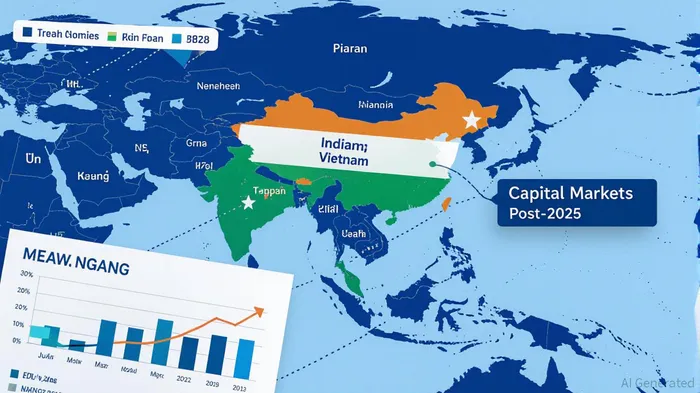
The 2025 U.S.-Japan trade and investment agreement, coupled with renewed commitments to exchange rate transparency, marks a pivotal shift in global economic dynamics. By establishing a 15% tariff baseline on Japanese imports and securing $550 billion in Japanese investments into U.S. strategic sectors like semiconductors and energy, the deal has recalibrated the bilateral relationship into one of structured interdependence [1]. Simultaneously, the U.S. and Japan reaffirmed their adherence to “market-determined” exchange rates, pledging to avoid manipulative interventions and to disclose foreign exchange operations publicly [2]. These developments, while primarily bilateral, have far-reaching implications for capital flows into Asia's export-driven emerging markets.
The Mechanics of Policy Alignment
The U.S.-Japan agreement's emphasis on transparency and structured investment frameworks has created a new paradigm for global capital allocation. By reducing trade tensions and stabilizing exchange rate expectations, the pact has lowered uncertainty for investors. Japan's commitment to direct investments in the U.S. through special purpose vehicles (SPVs) and its focus on high-value sectors suggest a disciplined approach to capital deployment [1]. This discipline could indirectly free up liquidity for Japanese investors to seek opportunities in Asia, where manufacturing and technology ecosystems are expanding.
Meanwhile, the U.S. and Japan's joint statements on exchange rate transparency—such as monthly disclosure of foreign exchange interventions—have reinforced market confidence in the yen and the dollar. This stability is critical for emerging markets, where sudden currency swings often trigger capital flight. By signaling a commitment to avoid competitive devaluations, the two nations have reduced the risk of destabilizing spillovers, making Asia's export-oriented economies more attractive to foreign investors [2].
Capital Flows and Asia's Structural Resilience
Asia's emerging markets have long been sensitive to shifts in global capital flows, particularly those driven by U.S. monetary policy. However, the 2025 agreement introduces a new dynamic: Japan's role as a conduit for capital. With its $550 billion investment pledge to the U.S., Japan may reallocate surplus capital to neighboring markets like Vietnam, India, and Indonesia, where supply chain diversification and industrialization are accelerating [3]. For instance, India's foreign direct investment (FDI) inflows surged to $81 billion in fiscal 2025, driven by manufacturing and energy projects, while Vietnam's FDI remained resilient despite U.S. tariff pressures [4].
The Bank of Japan's emphasis on transparency in monetary policy has also played a role. By gradually raising interest rates and aligning with global central banks, Japan has reduced the risk of sudden capital outflows that could destabilize Asian markets. This alignment has allowed emerging economies to adopt prudentialPUK-- measures, such as capital flow management tools, to insulate themselves from volatility [5].
Investor Behavior and Market Sentiment
Investor sentiment in Asia has been shaped by the U.S.-Japan agreement's indirect effects. Japanese equities have gained traction, with J.P. Morgan estimating a 0.3 percentage point GDP boost from the trade deal [6]. This optimism has spilled over into regional markets, where investors are increasingly favoring high-growth sectors like renewable energy and AI. Between 2020 and 2025, Asia raised over $100 billion annually in venture capital and private equity, with 60% directed toward technology and energy [7].
However, challenges persist. U.S. tariffs on South Korean and Chinese goods, along with geopolitical tensions, have created fragmented trade dynamics. For example, Vietnam and India face reciprocal tariffs of 26% and 46%, respectively, which could deter some investment [4]. Yet, the U.S.-Japan agreement's clarity on exchange rates and trade terms has provided a stabilizing backdrop, encouraging investors to focus on structural opportunities rather than short-term volatility.
Conclusion: A New Equilibrium for Emerging Markets
The U.S.-Japan policy alignment on exchange rate transparency and trade has created a more predictable environment for global capital flows. While direct data on Asia's capital inflows post-2025 remains limited, the structural shifts in investment patterns and investor behavior suggest a recalibration is underway. For emerging markets, the key lies in leveraging this stability to deepen domestic reforms and attract long-term capital. Investors, in turn, should focus on markets with strong governance, diversified supply chains, and ESG-aligned growth trajectories—sectors where Japan's investments and U.S. market access could catalyze further inflows.







Comentarios
Aún no hay comentarios