
Global Crypto Policy Acceleration and Institutional Investment Flows: Strategic Positioning in Regulatory-Compliant Assets
The year 2025 marks a pivotal inflection point in the institutional adoption of cryptocurrency, driven by a synchronized acceleration of global regulatory frameworks. As governments and financial authorities move to codify crypto markets into mainstream finance, institutional investors are rapidly reallocating capital toward compliant digital assets. This shift is not merely speculative but strategically calculated, with firms leveraging regulatory clarity to optimize risk-adjusted returns, diversify portfolios, and access novel infrastructure. Below, we dissect the interplay between policy evolution and institutional strategy, focusing on the U.S. GENIUS Act, the EU's MiCA regulation, and the emerging compliance-driven asset classes shaping 2025's landscape.
U.S. Regulatory Clarity: The GENIUS Act and Institutional Entry
The U.S. enacted the GENIUS Act (Global Economic and National Security Innovation in United States Stablecoins Act) in July 2025, establishing a federal framework for payment stablecoins, as outlined in the global crypto laws. This legislation mandates 1:1 reserve backing in high-quality liquid assets (e.g., U.S. Treasuries, FDIC-insured deposits) and enforces stringent AML/KYC compliance, according to a compliance guide. By demarcating stablecoins as non-securities and non-commodities, the act eliminated regulatory ambiguity, enabling institutions to integrate them into treasury operations and cross-border payments.
The impact has been immediate. Major ETF providers like BlackRock and Fidelity launched regulated BitcoinBTC-- and EthereumETH-- products, attracting $57.4 billion in inflows by Q3 2025, according to a market update. The Office of the Comptroller of the Currency (OCC) further catalyzed adoption by clarifying that national banks could offer crypto custody services in OCC guidance, reducing operational friction for institutions. Tokenized U.S. Treasuries, now backed by the same reserve requirements as stablecoins, have seen assets under management (AUM) nearly quadruple in 12 months, per a market overview.
EU's MiCA Framework: Harmonization and Cross-Border Access
The European Union's Markets in Crypto-Assets (MiCA) regulation, fully implemented in 2025, represents a contrasting yet complementary approach. By harmonizing rules across the EU Single Market, MiCA grants passporting rights to licensed crypto-asset service providers (CASPs), allowing firms authorized in one member state to operate across the bloc, as discussed in MiCA vs. GENIUS. This has spurred innovation, with 53 licenses issued to date-including 14 stablecoin issuers-and a 34% share of global stablecoin activity in the EU, according to Bolder Group.
MiCA's emphasis on transparency-requiring detailed whitepapers, segregated reserves, and monthly audits-has made euro-backed stablecoins a cornerstone of institutional strategies. For example, nine European banks collaborated on a MiCA-compliant E-Money Token (EMT), leveraging it for treasury optimization and liquidity management, as described in a stablecoin adoption analysis. The framework's broader scope, covering utility tokens and asset-referenced tokens (ARTs), also enables institutions to diversify beyond Bitcoin and Ethereum, with 73% of surveyed investors now holding altcoins, per a trends analysis.
Strategic Positioning: Compliant Vehicles and Diversification
Institutional strategies in 2025 revolve around regulated vehicles that mitigate counterparty risk while aligning with evolving policies. Exchange-traded products (ETPs) and spot ETFs dominate, with U.S.-listed Bitcoin ETFs alone reaching $179.5 billion in AUM by mid-July 2025, according to a Chainalysis report. These products offer familiar structures for traditional investors, bridging the gap between crypto and conventional assets.
Custody solutions have also evolved. Firms like Coinbase Institutional and Fireblocks now provide institutional-grade security, with multi-signature wallets and insurance against hacks, as highlighted in a regulatory clarity piece. Meanwhile, tokenized securities-such as equity and real estate-have gained traction, with platforms like Robinhood piloting 24/7 trading and fractional ownership models (CryptoToolsHub's market overview).
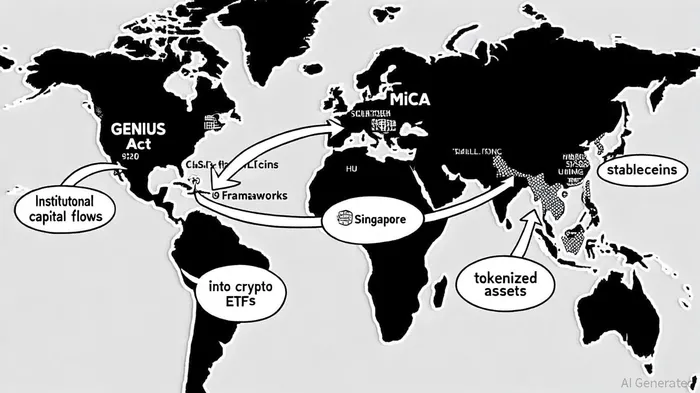
A key trend is geographic arbitrage. Institutions are structuring operations to exploit jurisdictional advantages: U.S.-based firms focus on stablecoin-driven payments under the GENIUS Act, while EU entities leverage MiCA's passporting to scale cross-border. Asian hubs like Singapore and Hong Kong further diversify the mix, offering innovation-friendly licensing regimes, according to a PwC report.
Case Studies: JPMorgan, Binance, and the New Paradigm
- JPMorgan launched a GENIUS Act-compliant stablecoin in Q1 2025, targeting corporate clients for cross-border settlements. By leveraging its banking license, the firm reduced transaction costs by 40% compared to traditional SWIFT transfers, per a RAND commentary.
- Binance secured an EU MiCA license in Q2 2025, enabling it to offer staked Ethereum ETFs and ARTs to institutional clients. This move capitalized on the bloc's appetite for altcoin diversification, as noted by Stablecoin Insider.
- Hong Kong's Securities and Futures Commission introduced a sandbox for tokenized assets, attracting firms like DBS Bank to testTST-- tokenized bonds. By Q3 2025, Hong Kong-based institutions managed $12.3 billion in tokenized AUM, according to the PwC report.
Challenges and Future Outlook
Despite progress, challenges persist. Cross-border interoperability remains fragmented: U.S. issuers must establish separate entities to operate in the EU, while EU-based firms face hurdles in accessing U.S. markets, per the stablecoin adoption analysis. Regulatory "silos" could stifle innovation unless harmonization efforts-such as mutual recognition agreements-gain traction.
Looking ahead, institutions are prioritizing long-term strategies over short-term gains. A January 2025 survey by Coinbase and EY-Parthenon found that 59% of institutional investors plan to allocate over 5% of AUM to crypto in 2025, according to a Regulatory Clarity report. This signals a shift from speculative exposure to strategic allocation, with compliance and infrastructure now central to risk management.
Conclusion
The acceleration of global crypto policy in 2025 has transformed digital assets from speculative novelties into institutional staples. By anchoring strategies in regulatory-compliant vehicles-be it GENIUS Act-backed stablecoins, MiCA-licensed ETPs, or tokenized treasuries-investors are mitigating risk while capturing the liquidity and innovation of the crypto ecosystem. As frameworks mature, the next frontier will be navigating cross-jurisdictional complexities and leveraging policy-driven opportunities in emerging markets. For institutions, the message is clear: compliance is no longer optional-it is the foundation of competitive advantage.





Comentarios
Aún no hay comentarios