
Global Bonds and the Fed: A Strategic Reentry into Fixed Income Amid Policy Easing
The global bond market has endured a turbulent post-2022 environment, marked by aggressive central bank tightening, inflationary shocks, and shifting investor sentiment. As the U.S. Federal Reserve signals a policy pivot amid moderating inflation and economic softness, fixed-income markets are recalibrating to a new paradigm. For investors considering a reentry into bonds, the critical question remains: Is the current rebound in bond prices and yields sustainable, or is it a fleeting correction in a broader bear market?
The Fed’s Policy Trajectory: A Delicate Balancing Act
The Federal Reserve’s monetary policy has been a linchpin for global bond markets since 2022. After hiking rates aggressively to combat inflation, the Fed now faces a dual challenge: maintaining price stability while avoiding a recessionary tightening. As of July 2025, the Fed’s target federal funds rate remains at 4.25%–4.50%, a level justified by lingering inflationary pressures (Core PCE at 2.7% in May 2025) and trade policy uncertainties [2]. However, market expectations for rate cuts have intensified, with a 87% implied probability of a 25-basis-point reduction at the September 2025 meeting and an estimated 2.5 cuts anticipated for the remainder of the year [1].
This shift reflects a recalibration of the Fed’s stance. Deloitte’s chief global economist notes that the Fed is poised to ease monetary policy at a “modest pace” in 2025, allowing the U.S. economy to grow by 2.4% before slowing in 2026 [3]. Such a path suggests a measured approach to rate cuts, prioritizing economic resilience over rapid normalization. Yet, the Fed’s balance sheet reduction—shrinking from nearly $9 trillion in 2022 to $6.6 trillion by 2025—remains a headwind for bond prices, as quantitative tightening (QT) continues to drain liquidity from markets [1].
Global Bond Yields: A Tale of Divergence and Volatility
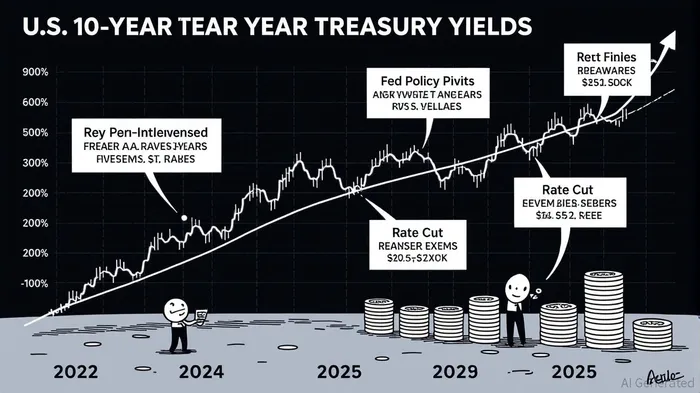
The U.S. 10-year Treasury yield, a bellwether for global fixed income, has traded in a narrow range of 4.1%–4.7% since mid-2023, reflecting moderate historical norms but elevated levels compared to the previous decade [1]. This range-bound behavior contrasts sharply with the sharp spike in 2022, when yields surged to 3.97% amid the Fed’s aggressive rate hikes [3]. However, recent data suggests a potential inflection pointIPCX--. By late August 2025, the 10-year yield had dipped to 4.0650%, its lowest since April, while the 2-year note fell to 3.51%, signaling market expectations of prolonged low rates [5].
Globally, bond yields remain fragmented. The UK’s 10-year yield hit 4.6090% in September 2025, with 30-year yields breaching 5.72%—a 27-year high—due to fiscal deficits and inflation concerns [4]. In contrast, Japan’s 10-year yield languished at 1.5680%, underscoring the Bank of Japan’s accommodative stance. Germany’s 2.6471% yield highlights Europe’s inflationary challenges, while U.S. yields remain anchored by the Fed’s policy trajectory [1].
Assessing the Sustainability of the Bond Market Rebound
The current rebound in bond prices hinges on three key factors: Fed policy easing, inflation dynamics, and global macroeconomic stability.
Policy Easing and Liquidity: The Fed’s anticipated rate cuts and potential cessation of QT could inject liquidity into bond markets, supporting yields. However, the Fed’s balance sheet remains a drag, with securities holdings still $2 trillion below pre-2022 levels [1]. A full normalization of monetary policy—returning to an “ample-reserves” regime—could take years, limiting the magnitude of the bond market’s recovery.
Inflation and Data Dependency: While Core PCE has fallen to 2.7%, it remains above the 2% target. The September 2025 meeting’s outcome will depend heavily on incoming data, particularly the August employment report (which added just 22,000 jobs) and inflation readings [6]. If inflation persists, the Fed may delay cuts, prolonging bond market volatility.
Global Macro Risks: Trade policy uncertainty, fiscal deficits in advanced economies, and emerging market vulnerabilities pose risks to a sustained rebound. For instance, the UK’s fiscal challenges and France’s rising yields underscore the fragility of global fixed-income markets [4].
Strategic Considerations for Investors
For investors reentering fixed income, a strategic approach is essential. The Fed’s pivot offers a window of opportunity, but the bond market’s sustainability depends on the Fed’s ability to balance inflation control with economic growth. Key strategies include:
- Duration Management: Extending duration in anticipation of rate cuts, while hedging against inflation risks.
- Geographic Diversification: Capitalizing on yield differentials between the U.S. and other markets (e.g., UK, Europe) while avoiding overexposure to high-risk sovereigns.
- Active Monitoring: Closely tracking the September 2025 meeting and subsequent inflation data, as well as the Fed’s balance sheet normalization timeline.
Conclusion
The bond market’s post-2022 rebound is neither a full-blown bull market nor a temporary correction. Instead, it reflects a cautious repositioning in response to the Fed’s policy easing and evolving macroeconomic conditions. While the path forward remains uncertain, investors who adopt a disciplined, data-driven approach may find value in fixed income—provided they remain vigilant to the Fed’s next moves and global macro risks.
Source:
[1] Federal Reserve Calibrates Policy to Keep Inflation in Check, [https://www.usbank.com/investing/financial-perspectives/market-news/federal-reserve-tapering-asset-purchases.html]
[2] Monetary Policy Report – June 2025, [https://www.federalreserve.gov/monetarypolicy/2025-06-mpr-part1.htm]
[3] Global economic outlook, January 2025, [https://www.deloitte.com/us/en/insights/economy/global-economic-outlook-2025.html]
[4] Market navigator: week of 8 September 2025, [https://www.ig.com/en/news-and-trade-ideas/weekly-market-navigator--8-sep-2025-250908]
[5] Treasury Yields Snapshot: September 5, 2025, [https://www.advisorperspectives.com/dshort/updates/2025/09/08/treasury-yields-snapshot-september-5-2025]
[6] Weekly fixed income commentary | 09/08/2025, [https://www.nuveenSPXX--.com/en-us/insights/investment-outlook/fixed-income-weekly-commentary]







Comentarios
Aún no hay comentarios