
Global Bond Market Resilience Amid Trade War Uncertainty: The Rise of Safe-Haven Reallocation
The global bond market in 2025 has demonstrated remarkable resilience amid escalating trade war uncertainties, with investors recalibrating their strategies to prioritize risk mitigation and capital preservation. As geopolitical tensions and protectionist policies disrupt traditional economic frameworks, the role of safe-haven assets has evolved, reshaping the landscape of global capital flows. This analysis examines the interplay between trade-driven volatility, investor sentiment shifts, and the reconfiguration of safe-haven preferences, drawing on recent market data and institutional insights.
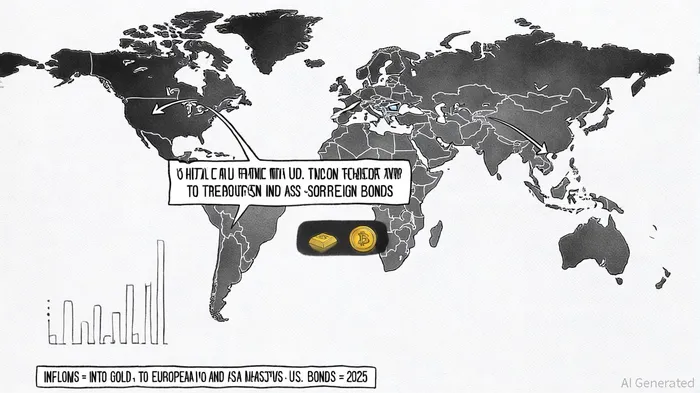
The Erosion of U.S. Treasuries as a Safe Haven
Historically, U.S. Treasuries have served as the cornerstone of global safe-haven demand. However, their dominance has been challenged in 2025. According to a BIS report, the correlation between U.S. Treasuries and traditional risk gauges like the VIX collapsed to near-zero following the U.S. tariff announcements in early April 2025. This decoupling reflects investor skepticism about the U.S. dollar's role as a stable refuge amid policy uncertainty and geopolitical fragmentation. Despite this, U.S. bond markets have retained resilience, supported by the depth of American financial infrastructure and strong macroeconomic fundamentals, the BIS report notes.
The Federal Reserve's September 2025 rate cut-a response to inflationary pressures and trade-driven supply chain disruptions-further complicated the narrative. While the move spurred a bond market rally and a steeper yield curve, it also underscored the Fed's balancing act between inflation control and economic growth, according to the Twelve Points review. The Bloomberg U.S. Aggregate Bond Index recorded a 1.1% gain in Q3 2025, driven by falling interest rates and a flight to quality; the review also noted these dynamics. Yet, market expectations for additional rate cuts in 2026 remain cautious, with analysts noting the U.S. economy's unexpected resilience and inflation persisting above targets, as observed in the BIS analysis.
The Rise of Alternatives: Gold, Currencies, and Diversification
As confidence in U.S. assets wanes, investors have turned to alternative safe-haven assets. Gold, in particular, has surged to record highs in 2025, serving as a hedge against trade policy volatility and monetary easing, according to the Twelve Points review. The Gold-to-Oil ratio-a measure of risk appetite-peaked at 68.8 in October 2025, signaling a pronounced shift toward defensive positioning, according to a MarketReportAnalytics article. Meanwhile, the U.S. dollar's weakening against a broad basket of currencies has prompted a reevaluation of currency risk management strategies, with the Swiss franc, euro, and Japanese yen gaining traction as alternative safe havens, the BIS report highlights.
Regional reallocation patterns further highlight this diversification. European and Asian sovereign bonds have attracted significant inflows, outpacing U.S. counterparts. German bunds, for instance, have maintained a strong positive correlation with the VIX, reinforcing their appeal in a risk-off environment, according to the BIS analysis. In emerging markets, low global interest rates and a weaker dollar have driven capital into Asian sovereign bonds, particularly in India and South Korea, where fiscal discipline and trade liberalization efforts are gaining traction, the BIS report adds.
Investor Sentiment and the Fragmentation of Capital Flows
The 2025 market environment has been marked by a fragmentation of global capital flows, driven by diverging economic cycles and geopolitical realignments. As noted by Invesco's Global Market Strategist Arnab Das, rising U.S.-China trade disputes have accelerated capital shifts toward Europe and Asia, where supply chain diversification and regulatory stability are perceived as advantages, as discussed in the MarketReportAnalytics article. This trend is compounded by a reassertion of home country bias, with investors in Europe and Asia increasingly favoring domestic equities and fixed-income instruments over global benchmarks, the BIS report indicates.
Active ETF adoption has also surged, reflecting a demand for tailored solutions in a fragmented market. Investors are leveraging these instruments to hedge against currency devaluation and inflation, particularly in regions with weaker fiscal frameworks, the BIS analysis observes. The convergence of traditional and alternative asset management has further amplified this trend, with firms offering multi-asset platforms capturing a disproportionate share of inflows in private markets, the BIS report notes.
Implications for Risk Mitigation and Future Outlook
The evolving dynamics of safe-haven assets underscore the need for a nuanced approach to risk mitigation. While U.S. Treasuries remain a critical component of diversified portfolios, their role is being supplemented by gold, high-quality corporate bonds, and regional sovereign debt. For institutional investors, the key challenge lies in balancing liquidity, yield, and geopolitical exposure in an environment where traditional correlations are breaking down.
Looking ahead, the interplay between trade policy, central bank actions, and investor behavior will likely remain a defining feature of global bond markets. As geopolitical uncertainties persist, the demand for uncorrelated assets-such as BitcoinBTC-- in select markets-may continue to rise, albeit cautiously, the BIS report warns. For now, the resilience of the bond market lies in its adaptability, with capital reallocation serving as both a response to and a buffer against the turbulence of a fragmented global economy.






Comentarios
Aún no hay comentarios