
Global Automotive Sector Disruption and the Rise of Chinese EV Dominance: Strategic Underinvestment and Regulatory Risks in the West
The global automotive sector is undergoing a seismic shift, driven by the rapid electrification of transportation. At the center of this transformation is China, whose aggressive industrial policies, robust infrastructure, and strategic investments have cemented its dominance in the electric vehicle (EV) market. Meanwhile, the United States and Europe face mounting challenges from policy uncertainty, underinvestment in critical infrastructure, and supply chain vulnerabilities. These factors are creating a widening gap between China's forward-looking strategy and the West's fragmented approach, with profound implications for investors and policymakers alike.
China's Strategic Advantages: Policy, Infrastructure, and Scale
China's EV ecosystem is a masterclass in state-led industrial strategy. By 2024, the country accounted for 70% of global EV production and 80% of lithium-ion battery manufacturing, a feat enabled by decades of targeted policies such as "Made in China 2025" and localized supply chains. According to analysis, the government's VII vehicle emission standards, which mandate stricter efficiency requirements for internal combustion engines, have accelerated the phaseout of fossil-fuel vehicles while keeping EV costs competitive.
Infrastructure has been equally pivotal. China's 2 million public EV charging points-compared to just 170,000 in the U.S. as of 2024-and innovations like battery-swapping stations have alleviated range anxiety, enabling a 50% market share for new energy vehicles by 2025. This infrastructure advantage is compounded by a domestic supply chain that controls 80% of global lithium-ion battery production, ensuring cost parity with internal combustion engines (ICEs) and insulating manufacturers from global supply shocks.
U.S. Challenges: Policy Rollbacks and Market Imbalances
The U.S. EV market, once buoyed by federal incentives like the $7,500 tax credit, has been stymied by recent policy shifts. According to reports, the removal of the tax credit in September 2025 and the rollback of fuel economy standards have created a vacuum in consumer incentives, pushing the 50% BEV adoption milestone to 2039. According to BCG analysis, these changes have also exposed vulnerabilities in the U.S. supply chain, which relies heavily on imports for critical components like batteries and rare earth minerals.
Compounding these issues is a mismatch between market demand and product offerings. Automakers have largely abandoned the entry-level EV segment, with affordable models priced below $45,000 now scarce. This has left a gap in the market that Chinese manufacturers-whose NEVs now account for 80% of domestic production-are poised to exploit. Meanwhile, tariffs on Chinese EVs and export controls on U.S. battery technologies have further strained supply chains, creating a self-reinforcing cycle of underinvestment.
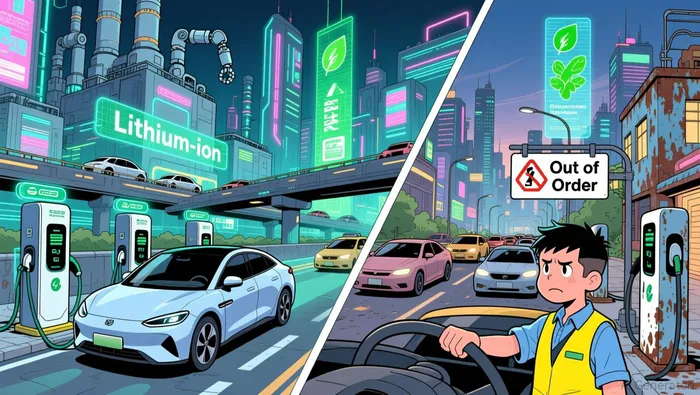
European Hurdles: Economic Pressures and Hybrid Reliance
Europe's EV transition has been similarly hampered by inconsistent policies and economic headwinds. While the region's stricter CO₂ emission standards are projected to drive BEV sales past 50% by 2032, growth has been muted through 2027 due to reduced subsidies and inflation-driven cost pressures. According to EY analysis, hybrid vehicles, which are expected to outsell BEVs in Europe until 2030, have become a stopgap solution rather than a long-term strategy.
The continent's manufacturing sector has also stagnated, with EV production flatlining at 2.4 million units in 2024. European automakers face a dual challenge: reliance on Chinese battery production and a growing influx of Chinese EVs into the EU market. Chinese EVs now account for 6% of EU sales, a figure that could rise as European producers struggle to match China's cost efficiency and innovation pace.
Strategic Underinvestment and Regulatory Risk: A Comparative Analysis
The contrast between China's proactive approach and the West's reactive policies is stark. China's gigascale battery production and localized supply chains have insulated it from global volatility, while the U.S. and Europe grapple with fragmented supply chains and regulatory uncertainty. For instance, the U.S. lacks a cohesive strategy to address bottlenecks in charging infrastructure, and Europe's reliance on hybrid technologies risks locking in outdated solutions.
Regulatory risks further exacerbate these challenges. In the U.S., the absence of federal EV incentives and the politicization of climate policy have created a "One Big Beautiful Bill" scenario, where legislative gridlock delays critical investments. In Europe, the EU's 35.3% tariffs on Chinese EVs have slowed market access for Chinese automakers but failed to address the root issue: a lack of competitive domestic production.
Investment Implications and the Path Forward
For investors, the takeaway is clear: China's EV ecosystem is a high-conviction opportunity, while the U.S. and Europe require structural reforms to remain competitive. The U.S. must restore federal incentives, reconfigure supply chains with allies, and prioritize battery research. Europe, meanwhile, needs to accelerate BEV adoption and reduce its dependence on Chinese components.
The global EV race is no longer a contest of technology but of policy and execution. As China's dominance solidifies, the West's ability to close the gap will depend on its willingness to confront underinvestment and regulatory inertia head-on.







Comentarios
Aún no hay comentarios