
The New Glenn Launch and Its Implications for Private Space Investment
Strategic Milestones and Technical Capabilities
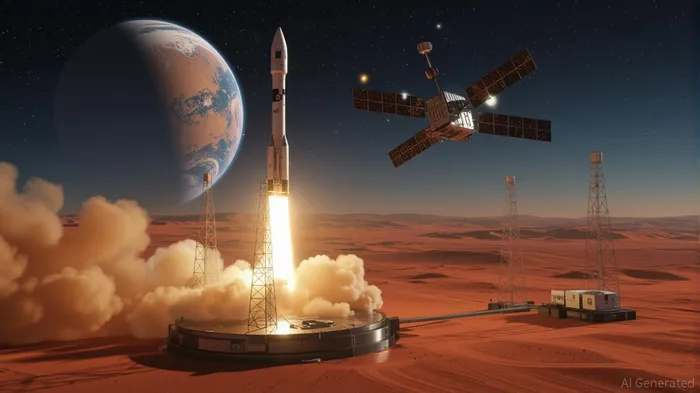
The New Glenn rocket, , is a two-stage heavy-lift vehicle designed for reusability, with . Its successful landing on a drone ship in the Atlantic during the November 2025 launch underscores Blue Origin's progress in mastering reusable technology-a critical factor for reducing long-term costs according to industry analysis. This mission, the company's first NASA science launch, also aligns with its broader strategy to secure government contracts, such as its role in supporting NASA's Artemis V lunar mission.
By targeting six to eight New Glenn launches in 2025, Blue Origin is positioning itself to challenge SpaceX's dominance in the heavy-lift segment. The ESCAPADE mission, which will deploy satellites to Mars in 2027, further cements the company's credibility in executing complex interplanetary missions.
Financial Analysis and Cost Competitiveness
The New Glenn's cost structure is a key factor in its competitive positioning. According to estimates, , according to Wikipedia data. This pricing is particularly compelling when compared to SpaceX's Falcon Heavy, according to Reddit discussions. While exact 2025 figures for Falcon Heavy remain undisclosed, .
Reusability is the linchpin of Blue Origin's financial strategy. , , aligning with industry trends toward sustainable spaceflight. This model mirrors SpaceX's approach with the Falcon 9, but Blue Origin's focus on larger payloads positions it to capture niche markets requiring heavy-lift capabilities.
Investor Reactions and Market Positioning
Investors are closely monitoring Blue Origin's progress, viewing the New Glenn's success as a potential catalyst for broader adoption of commercial space infrastructure. A Bloomberg report notes that the Mars mission could enhance the company's reputation, leading to increased contracts and partnerships with entities like NASA. This is particularly relevant as the space economy expands, with private firms and governments investing heavily in lunar and interplanetary exploration.
However, challenges remain. Unlike SpaceX, which has a publicly traded stock (via its parent company, Tesla, indirectly), Blue Origin operates as a private entity, limiting direct investment opportunities. This opacity raises questions about long-term financial transparency, though its government contracts and strategic partnerships provide a degree of stability.
Long-Term Implications for the Space Economy
The New Glenn's success could accelerate the democratization of space access by lowering launch costs and increasing mission frequency. With reusable technology becoming standard, the space economy is poised for exponential growth, driven by applications in satellite internet, planetary science, and deep-space logistics. Blue Origin's Artemis V contract further underscores its role in shaping the future of lunar exploration, a sector projected to attract billions in investment over the next decade.
Critically, the company's focus on heavy-lift capabilities differentiates it from competitors. While SpaceX's Falcon 9 dominates the small-to-medium payload market, the New Glenn's capacity to carry large satellites or interplanetary probes fills a critical gap. This specialization could attract clients in defense, telecommunications, and scientific research, all of which require robust and reliable launch services.
Conclusion
Blue Origin's New Glenn rocket represents more than a technical achievement-it is a strategic lever for reshaping the space economy. By combining reusability, competitive pricing, and high-profile missions like ESCAPADE, the company is positioning itself as a formidable player in the race to make spaceflight economically viable. For investors, the key question is whether Blue Origin can sustain its momentum while navigating the complexities of private-sector funding and market competition. As the space economy matures, the New Glenn's performance will serve as a litmus test for the viability of private investment in large-scale space infrastructure.







Comentarios
Aún no hay comentarios