
GitLab's Stock Volatility and Valuation Attractiveness Post-Earnings: A Strategic Buy Opportunity
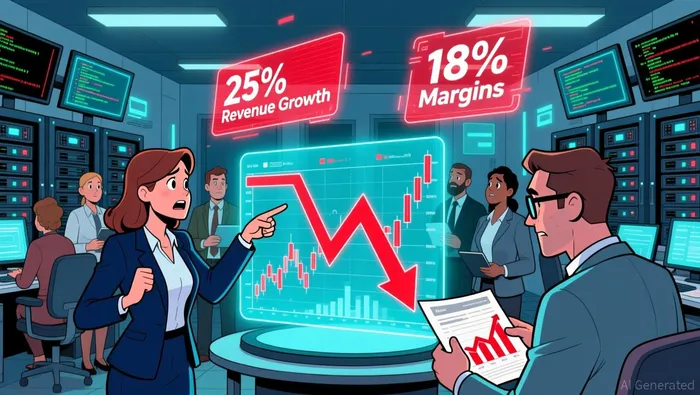
GitLab (GTLB) has experienced significant stock volatility following its Q3 FY2026 earnings release, with shares declining post-earnings despite strong financial performance and strategic advancements. This disconnect between earnings results and market reaction raises critical questions for long-term investors: Is the sell-off a reflection of conservative guidance, or does it signal a mispricing of the company's long-term growth potential? By analyzing GitLab's earnings performance, forward guidance, free cash flow trajectory, and valuation metrics, this article argues that the recent correction presents a compelling entry point for investors who can tolerate short-term volatility and recognize the company's durable competitive advantages.
Earnings Performance: Strong Revenue Growth and Margin Expansion
, , exceeding analyst expectations. , driven by disciplined cost management and slower growth in operating expenses relative to revenue. These results underscore the company's improving operational efficiency, a critical factor for high-growth SaaS businesses.
Customer growth metrics further reinforce this narrative. , while . Such metrics indicate robust customer satisfaction and expansion revenue, which are essential for sustaining long-term growth. Additionally, GitLab's product innovations-such as its AI-powered Duo Agent Platform and recognition as a -position it as a key player in the DevOps and AI code assistant markets.
Forward Guidance and Market Reaction: The Disconnect
Despite these positives, GitLab's stock fell post-earnings due to conservative forward guidance. The company . For the full fiscal year 2026, , . While these figures are solid, they fell short of investor expectations for more aggressive growth, particularly in a market environment where high-growth SaaS stocks are often valued on aspirational rather than conservative metrics.
This reaction highlights a common challenge for SaaS companies: balancing near-term profitability with long-term growth. GitLab's management emphasized in and customer success, which may temporarily dampen growth rates but are critical for capturing market share in the long run. For long-term investors, the key question is whether the company's and innovation roadmap justify a premium valuation.
Valuation Metrics: A Mixed Picture
GitLab's price-to-free cash flow (P/FCF) ratio provides a nuanced view of its valuation. As of November 2025, the company's P/FCF , . as of November 2025. However, when contextualized against the company's historical performance, the current P/FCF appears more attractive.
Free cash flow (FCF) trends also warrant closer examination. GitLabGTLB-- , as reported in Q4 results. This downward trend raises concerns about the sustainability of cash flow generation, particularly if the company continues to prioritize and market expansion over short-term profitability. That said, the Q4 FCF dip may reflect one-time investments in and infrastructure, which could yield long-term returns.
Strategic Case for a "Buy" Recommendation
The recent sell-off creates an opportunity for long-term investors to acquire GitLab at a discount to its historical valuation peaks. While the P/FCF ratio remains elevated relative to traditional benchmarks, it is now closer to the company's given its strong customer retention, product leadership, and . Key catalysts for future growth include:
- AI-Driven Product Innovation: GitLab's and Duo Agent Platform are well-positioned to capitalize on the AI boom in software development.
- Leadership Stability: The appointment of Jessica Ross as CFO in early 2026 signals a commitment to balancing growth and profitability.
- : GitLab's recognition as a Gartner Magic Quadrant Leader reinforces its credibility in a competitive .
For investors with a multi-year horizon, the current valuation offers a compared to the company's 3-year P/FCF average. While the forward guidance may appear conservative, it reflects prudent management of expectations in a volatile market. The risk-reward profile tilts in favor of buyers who can stomach short-term volatility for exposure to a company with durable growth drivers.
Conclusion
GitLab's post-earnings sell-off is a classic example of market overreaction to conservative guidance, masking the company's strong fundamentals and strategic momentum. While the P/FCF ratio remains high by traditional standards, it is now more aligned with the company's long-term . For long-term investors, the current price represents an attractive entry point to participate in GitLab's evolution as a leader in the AI-enhanced DevOps ecosystem.





Comentarios
Aún no hay comentarios