
Is GitLab's Stock Still a Buy Amid Rising Short Interest and Post-Earnings Downturn?
GitLab (GTLB) has long been a darling of the SaaS sector, celebrated for its consistent revenue growth and pivotal role in the DevOps ecosystem. However, recent developments-ranging from a sharp post-earnings stock decline to a recalibration of analyst expectations-have sparked renewed debate about its investment potential. This article dissects the interplay between bearish sentiment, as reflected in short interest data, and the company's evolving growth narrative to determine whether GTLBGTLB-- remains a compelling buy.
Short Interest: A Barometer of Bearish Sentiment
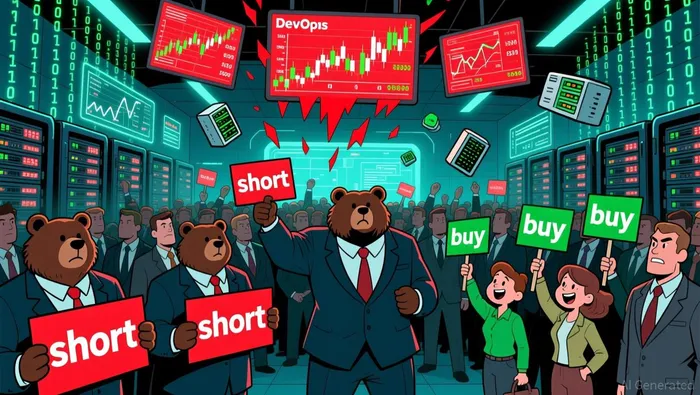 Short interest in GitLabGTLB-- has remained elevated, with 12.06 million shares shorted as of November 14, 2025, representing 8.68% of its public float. While this marked a slight decline from 12.31 million shares in October, the short interest ratio (SIR) of 2.51 days to cover suggests lingering skepticism among bearish investors. By December 2025, the SIR had dropped to 1.40 days to cover, potentially signaling partial short-covering or reduced bearish bets. However, the off-exchange short volume of 3.89 million shares-accounting for 41.3% of total off-exchange trading volume-highlights institutional activity that could amplify volatility if short sellers face margin calls or forced coverages.
Earnings Beat vs. Guidance Concerns
GitLab's Q4 2025 earnings report delivered a mixed bag. The company exceeded profit estimates with adjusted earnings per share (EPS) of $0.33 (vs. $0.23 expected) and revenue of $211.4 million, a 29% year-over-year increase. These results underscore its resilience in a competitive SaaS landscape. Yet, the stock fell 3.2% in extended trading after management issued a full-year 2026 EPS forecast of $0.68–$0.72, below the $0.81 consensus. This disconnect between quarterly performance and forward-looking guidance has rattled investor confidence, particularly given GitLab's historical tendency to see a 1.7% average gain on the first day post-earnings.
Analyst Reassessments and Strategic Shifts
Analysts have recalibrated their expectations for GitLab, trimming its fair value estimate to $53.67 from $57.59, reflecting a more cautious outlook on demand and revenue growth. The revised growth forecast of 18.23% (down from 19.62%) and a marginally higher discount rate of 8.46% (vs. 8.39%) signal a perceived increase in risk. Despite these adjustments, the current consensus price target of $53.29 implies a 42.68% upside from its recent price, suggesting that optimism about its long-term potential persists.
Strategically, GitLab is positioning itself for a new phase. The appointment of Jessica Ross as CFO in January 2026-a seasoned executive with experience at Microsoft and LinkedIn-signals a focus on financial discipline and strategic scaling. This leadership shift could address concerns about operational efficiency and unlock value as the company navigates a maturing market.
Market Sentiment and the Growth Narrative
The post-earnings downturn and rising short interest reflect a broader reassessment of GitLab's growth narrative. While its 25%+ revenue growth since its 2021 IPO is impressive, investors are now demanding clearer visibility into profitability and market share gains in an increasingly crowded DevOps space. The recent 13.5% stock drop following a strong Q3 2025 report further illustrates the market's sensitivity to short-term volatility.
However, GitLab's year-to-date total return of 6.9%-outpacing the S&P 500's 1.2% gain-suggests that its core value proposition remains intact. The company's strategic pivot toward AI-driven development tools and enterprise adoption could reinvigorate its narrative, particularly as generative AI reshapes software development workflows.
Conclusion: A Buy with Caution
GitLab's stock presents a nuanced case for investors. The elevated short interest and post-earnings selloff highlight near-term risks, particularly if the company fails to meet revised growth targets. Yet, its strong quarterly results, strategic leadership changes, and long-term analyst price targets indicate that the underlying business remains robust. For risk-tolerant investors who can stomach volatility, GTLB could offer compelling upside if it executes on its AI and enterprise expansion plans. However, those prioritizing stability may prefer to wait for clearer signs of momentum before entering.





Comentarios
Aún no hay comentarios