
Gilead Sciences' Q3 IPR&D Expenditure Outlook: Strategic R&D Allocation and Shareholder Value Implications
Gilead Sciences' strategic allocation of resources toward in-process research and development (IPR&D) has emerged as a critical factor in its long-term value proposition. In Q3 2025, the biopharmaceutical giant incurred $61 million in IPR&D expenses, primarily tied to its strategic partnership with Kymera TherapeuticsKYMR--, Inc., according to Gilead's Q3 IPR&D filing. This follows a similar charge in Q2 2025 and reflects Gilead's commitment to advancing its pipeline through targeted collaborations. However, the broader implications of these expenditures-both for innovation and shareholder returns-require a nuanced analysis of R&D trends and financial discipline.
Strategic R&D Allocation: A Shift Toward Partnerships
Gilead's Q3 2025 IPR&D charge underscores a deliberate pivot toward strategic partnerships over broad R&D spending. While the company's total R&D expenses for Q1 2025 reached $1.379 billion, according to Macrotrends data, the Q2 and Q3 charges of $61 million each, per a GuruFocus report, highlight a focus on high-impact collaborations. The Kymera partnership, announced in June 2025, aligns with Gilead's strategy to leverage external innovation in oncology and immunology, areas where internal R&D cycles are lengthy and costly.
This approach contrasts with Gilead's 2024 experience, when a $3.8 billion IPR&D charge from the CymaBay acquisition and $4.2 billion in impairment losses from discontinued programs like Trodelvy signaled the risks of overreliance on in-house development, as detailed in Gilead's 10-Q report. By prioritizing partnerships, GileadGILD-- appears to mitigate such risks while maintaining access to cutting-edge science.
R&D Trends: Balancing Innovation and Profitability
The company's R&D trajectory reveals a mixed picture. Total R&D expenses for the trailing twelve months ending March 31, 2025, declined 0.43% year-over-year to $5.766 billion (Macrotrends data), while full-year 2024 expenses rose 3.31% to $5.907 billion (Macrotrends data). This volatility underscores the challenge of balancing innovation with financial prudence.
The Q3 2025 IPR&D charge, though modest compared to prior-year write-offs, is part of a broader trend of targeted investments. For instance, Q4 2024 R&D expenses reached $1.6 billion, reflecting a higher overall outlay than the Q2 and Q3 IPR&D charges. This suggests Gilead is diversifying its R&D strategy: combining large-scale internal programs with smaller, high-impact partnerships to optimize returns.
Shareholder Value: Long-Term Gains vs. Short-Term Pressures
While IPR&D expenditures reduce GAAP and non-GAAP earnings per share (EPS) in the short term, their long-term value hinges on successful commercialization. The Kymera partnership, for example, could yield novel therapies in oncology, a sector with high unmet medical needs and pricing power. However, investors must weigh these potential gains against historical risks, such as the $3.9 billion IPR&D charge from CymaBay in Q1 2025 reported in Gilead's 10-Q report, which stemmed from a single acquisition.
Gilead's ability to convert IPR&D investments into revenue will determine whether these expenditures enhance shareholder value. The company's 2024 impairment charges-linked to Trodelvy's discontinuation-serve as a cautionary tale. To mitigate such risks, Gilead must ensure that partnerships like Kymera are not only scientifically promising but also financially aligned with its strategic goals.
Conclusion: A Calculated Path Forward
Gilead Sciences' Q3 2025 IPR&D expenditure of $61 million reflects a calculated shift toward strategic partnerships, a departure from the high-risk, high-reward model of past years. While this approach reduces immediate financial exposure, its success will depend on the Kymera collaboration's ability to deliver transformative therapies. For shareholders, the key metric will be how these targeted investments translate into revenue growth and market share gains in competitive therapeutic areas.
As the biopharma landscape evolves, Gilead's ability to balance innovation with fiscal discipline will remain central to its long-term value creation.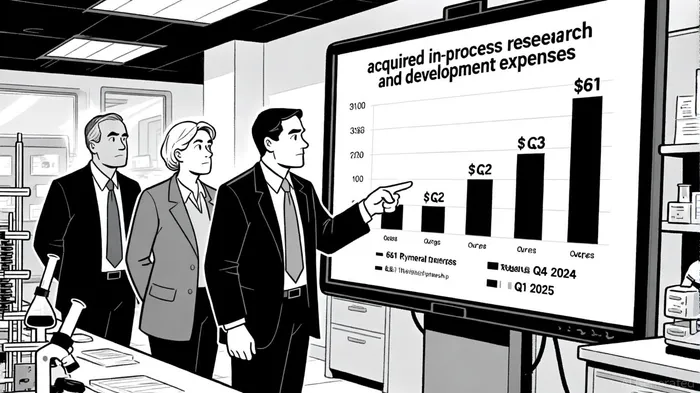





Comentarios
Aún no hay comentarios