
Gilead's $32 Billion US Manufacturing Expansion: A Strategic Catalyst for Long-Term Shareholder Value
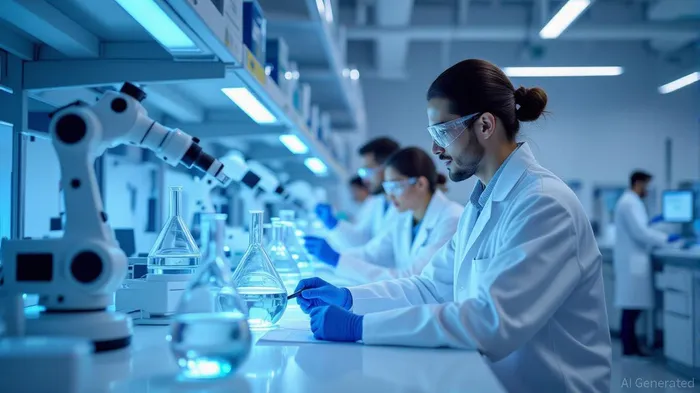
Gilead Sciences’ $32 billion U.S. manufacturing and R&D expansion by 2030 represents a seismic shift in the biopharma sector, positioning the company at the forefront of domestic biomanufacturing innovation. This investment, which includes three new state-of-the-art facilities and upgrades to existing sites, is projected to generate $43 billion in economic value for the U.S. economy over five years while creating 800 direct jobs and supporting 2,200 indirect jobs by 2028 [1]. Beyond its immediate economic impact, the initiative aligns with broader industry trends toward localized production, AI-driven efficiency, and supply chain resilience—factors that could redefine competitive advantage in the biopharma landscape.
Economic Implications: A Boon for the U.S. Bioeconomy
The U.S. bioeconomy has emerged as a critical pillar of national economic strategy, with federal investments surging from $2.7 billion to $3.5 billion since the 2022 Bioeconomy Executive Order [2]. This policy push has catalyzed $46 billion in public and private sector biomanufacturing projects nationwide, underscoring a national imperative to secure domestic production of essential medicines. Gilead’s $32 billion commitment amplifies this momentum, building on its $15 billion in U.S. investments over the past decade [1].
The economic multiplier effect of Gilead’s expansion is striking. By 2030, the company estimates its investment will generate $43 billion in value for the U.S. economy—a 35% return on capital—through job creation, supplier ecosystems, and tax contributions [1]. This aligns with broader projections that the U.S. bioeconomy could reach $400 billion in economic impact by 2030, driven by biotechnology, biobased products, and advanced manufacturing [2]. For investors, this signals a strategic alignment with a sector poised for sustained growth.
Operational Efficiency: AI and Automation as Game-Changers
Gilead’s new Foster City facility—a five-story, 180,000-square-foot hub for pharmaceutical development and manufacturing—exemplifies the company’s focus on operational excellence. Equipped with autonomous robotics, real-time digital monitoring, and AI-enabled process optimization, the center is among the most advanced in the biopharma industry [2]. These technologies mirror trends observed in post-pandemic manufacturing, where automation adoption by contract development and manufacturing organizations (CDMOs) has surged to 43%, compared to 29% for biologics innovators [3].
The integration of AI and digital twins is particularly transformative. For instance, PfizerPFE-- and Janssen have leveraged AI to accelerate drug discovery and streamline clinical trials, while ModernaMRNA-- used AI for mRNA vaccine logistics [4]. Gilead’s emphasis on AI-driven R&D and manufacturing positions it to reduce time-to-market for therapies and lower production costs—a critical edge in an industry where 20% of late-stage pipeline assets are expected to be complex, high-cost therapeutics by 2030 [3].
Strategic Alignment with Industry Resilience Trends
The pandemic exposed vulnerabilities in global biopharma supply chains, prompting a sector-wide pivot toward localized production and diversified sourcing. Gilead’s expansion directly addresses these risks by bolstering domestic capacity for biologics and small-molecule drugs. This mirrors OECD recommendations for collaborative public-private strategies to secure medical supply chains, including localized sourcing and backup inventory systems [5].
Moreover, Gilead’s investment in single-use systems (SUS) and continuous bioprocessing aligns with industry best practices. CDMOs have increasingly adopted SUS to reduce cross-contamination risks and enable rapid process transitions, a trend GileadGILD-- is integrating into its upgraded facilities [3]. These operational shifts not only enhance resilience but also reduce capital expenditures—a critical factor as biopharma R&D costs climb.
A Catalyst for Shareholder Value
For long-term investors, Gilead’s expansion is more than a capital allocation play—it’s a strategic bet on the future of biopharma. By 2030, the company’s U.S. manufacturing footprint will be among the most technologically advanced in the world, enabling it to capitalize on high-margin therapies and regulatory tailwinds. The Biden administration’s focus on domestic drug production, coupled with Gilead’s $2 billion investment in digital and advanced engineering, positions the company to benefit from favorable policy environments and reduced geopolitical risks [1].
Conclusion
Gilead’s $32 billion U.S. manufacturing expansion is a masterclass in strategic foresight. By marrying economic stimulus with operational innovation, the company is not only fortifying its competitive position but also contributing to a resilient, self-sufficient biopharma sector. For shareholders, the rewards are twofold: near-term economic value generation and long-term exposure to a $400 billion bioeconomy. In an industry where agility and innovation dictate success, Gilead’s move is a blueprint for sustainable growth.
Source:
[1] Gilead U.S. Investment to Create $43 Billion in Value [https://www.gilead.com/company/company-statements/2025/gilead-us-investment-to-create-43-billion-value-to-us-economy]
[2] White House Releases Report on Growing U.S. Biomanufacturing Capacity for the American Bioeconomy [https://bidenwhitehouse.archives.gov/ostp/news-updates/2024/11/15/white-house-releases-report-on-growing-u-s-biomanufacturing-capacity-for-the-american-bioeconomy/]
[3] Post-COVID Trends in Biopharma Contract Manufacturing [https://www.contractpharma.com/post-covid-trends-in-biopharma-contract-manufacturing/]
[4] AI in Pharma and Biotech: Market Trends 2025 and Beyond [https://www.coherentsolutions.com/insights/artificial-intelligence-in-pharmaceuticals-and-biotechnology-current-trends-and-innovations]
[5] Securing Medical Supply Chains in a Post-Pandemic World [https://www.oecd.org/en/publications/2024/02/securing-medical-supply-chains-in-a-post-pandemic-world_3c8cef7c.html]





Comentarios
Aún no hay comentarios