
Gig Economy Labor Risks and the Financial Exposure of Mobility Firms
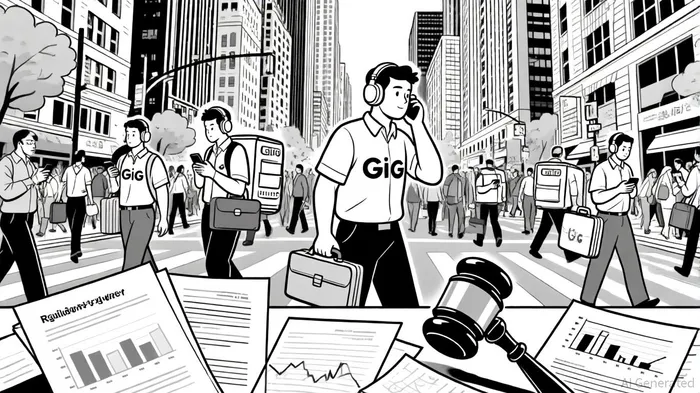
The gig economy, once a beacon of flexible labor and scalable business models, now faces a critical juncture. Regulatory shifts in worker classification, particularly in the U.S., are reshaping the financial and operational landscapes for mobility firms like UberUBER-- and LyftLYFT--. These changes, driven by evolving labor standards and legal battles, pose significant risks to the sustainability of gig-based platforms while also creating opportunities for innovation in labor models.
Regulatory Exposure: The 2024 DOL Rule and Its Implications
In early 2024, the U.S. Department of Labor (DOL) finalized a rule redefining the criteria for classifying workers as employees versus independent contractors under the Fair Labor Standards Act (FLSA) [1]. The rule evaluates six factors—including the degree of employer control, opportunity for profit or loss, and the integral nature of the work to the business—without assigning disproportionate weight to any single factor [2]. This departure from the Trump-era standards, which favored contractor classification, has reignited debates over gig worker rights and corporate liability.
For mobility firms, the rule's implications are stark. If gig workers are reclassified as employees, companies would face mandatory costs such as minimum wage compliance, overtime pay, and benefits like health insurance861218-- and unemployment insurance [3]. According to a report by Bloomberg Law, Uber and Lyft have spent millions lobbying to resist such reclassification, arguing that their business models rely on the flexibility of independent contractors [4]. However, labor advocates counter that the DOL's six-factor test inherently favors employee status, particularly for workers who lack meaningful control over their earnings or work conditions [5].
The rule's enforcement has already faced legal turbulence. By May 2025, the DOL suspended its implementation, directing staff to use a 2008 framework more favorable to businesses [6]. This regulatory whiplash underscores the political and legal uncertainty surrounding gig worker classification, complicating long-term planning for mobility firms.
Financial Impact: Rising Costs and Profit Margin Pressures
The potential reclassification of gig workers as employees could significantly inflate labor costs for mobility firms. A 2024 analysis by Reuters estimated that Uber and Lyft could face additional annual expenses of $1–2 billion per company if forced to provide employee benefits [7]. These costs would stem not only from direct compensation but also from compliance with payroll taxes, workers' compensation insurance, and labor law litigation.
Case studies highlight the financial stakes. In Massachusetts, a 2024 settlement required Uber and Lyft to pay $175 million combined and establish minimum earnings guarantees for drivers, effectively treating them as de facto employees [8]. Similarly, a report by the Massachusetts State Auditor found that Uber and Lyft avoided $47 million in unemployment and workers' compensation taxes in 2023 alone [9]. If such practices become subject to retroactive enforcement, the firms could face billions in back payments and penalties.
Despite these risks, some mobility firms have shown resilience. Uber's Q4 2024 net profit margin reached 22.41%, while its adjusted EBITDA grew 35% year-over-year to $2.1 billion [10]. Lyft, meanwhile, reported a 1.51% net profit margin as of June 2025 [11]. These figures suggest that strategic cost management and operational efficiency may mitigate some regulatory pressures—though only temporarily.
Operational Adjustments: Balancing Flexibility and Compliance
Mobility firms are adapting to regulatory shifts through a mix of legal defense, policy advocacy, and technological innovation. Uber and Lyft have invested heavily in compliance tools to navigate evolving standards, such as the European Union's Platform Work Directive [12]. These tools help automate worker classification decisions and track compliance with local labor laws, though they add to overhead costs.
Another strategy involves hybrid models that blend contractor flexibility with limited benefits. For example, Proposition 22 in California allowed gig workers to retain independent status while receiving healthcare stipends and earnings guarantees [13]. Similar state-level agreements in Washington and New York have demonstrated that companies can offer benefits without fully reclassifying workers [14]. However, these models remain vulnerable to legal challenges and shifting political priorities.
Investment Risks and Opportunities
For investors, the gig economy's regulatory exposure presents a dual-edged sword. On one hand, rising labor costs and legal liabilities could erode profit margins and deter growth. On the other, companies that successfully navigate these challenges—through innovation in portable benefits, algorithmic transparency, or policy collaboration—may emerge stronger.
The key uncertainty lies in the trajectory of labor policy. The introduction of the Modern Worker Empowerment Act in Congress, which proposes a more contractor-friendly standard, highlights the ongoing political tug-of-war [15]. Investors must monitor legislative developments closely, as a single policy shift could redefine the industry's cost structure.
Conclusion
The gig economy's future hinges on its ability to reconcile regulatory demands with operational sustainability. While mobility firms like Uber and Lyft have demonstrated agility in defending their business models, the long-term financial risks of reclassification remain substantial. For investors, the path forward requires a nuanced assessment of regulatory trends, corporate adaptability, and the evolving preferences of gig workers themselves.





Comentarios
Aún no hay comentarios