
Ghana's Monetary Policy Easing: Strategic Opportunities in Sovereign and Local-Currency Debt Markets
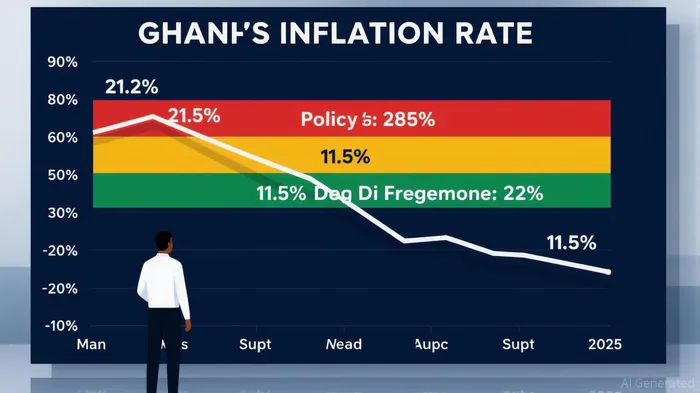
Ghana's monetary policy landscape in 2025 has entered a pivotal phase, marked by aggressive interest rate cuts and a stabilizing macroeconomic environment. The Bank of Ghana's Monetary Policy Committee (MPC) is poised to reduce the policy rate by 300 basis points in September 2025, bringing it to 22.0%—a dramatic shift from the 28% rate maintained in May 2025[1]. This easing follows a 300-basis-point cut in July 2025 and is driven by disinflationary trends, with headline inflation dropping to 11.5% in August 2025, the lowest since October 2021[2]. The central bank's pivot reflects confidence in sustained food and transport cost declines, as well as a favorable base effect from prior high-inflation periods[3].
For investors, this policy shift creates a unique window to reassess exposure to Ghana's sovereign and local-currency debt markets. The Bank of Ghana's commitment to gradual rate cuts—potentially extending to 100–200 basis points in future meetings—signals a broader strategy to stimulate growth while anchoring inflation expectations[4]. This aligns with Fitch Ratings' recent upgrade of Ghana's Long-Term Foreign-Currency Issuer Default Rating (IDR) to 'B-' with a stable outlook, citing progress in restructuring $13.1 billion in Eurobond liabilities and a projected decline in public debt-to-GDP from 72% in 2024 to 60% by 2026[5].
Sovereign Debt: A Post-Restructuring Rally
The debt restructuring process has been a cornerstone of Ghana's economic recovery. With external creditors on board and an IMF Extended Credit Facility (ECF) program in place, the country's credit profile has improved markedly. Domestic debt service costs, while still elevated at 3.6% of GDP in 2025, are expected to decline as fiscal consolidation measures take hold[5]. This progress has spurred a rebound in investor sentiment, evidenced by a 106% surge in secondary bond market trading volumes to GH¢1.14 billion in Q3 2025[6].
However, risks persist. Treasury bill yields remain above 25%, reflecting lingering concerns over liquidity and the government's reliance on short-term financing[7]. For foreign investors, currency volatility—exacerbated by global trade tensions and utility tariff adjustments—adds another layer of complexity[3]. Yet, the high yields on Ghana's 10-year bonds (averaging 23.5% in Q3 2025) present an attractive risk-rebalance opportunity, particularly for those with a medium-term horizon and appetite for emerging markets[6].
Local-Currency Debt: A Gradual Reawakening
The local-currency bond market is showing early signs of recovery. General Category bonds maturing in 2030 and 2033 have drawn renewed interest, with yields stabilizing after years of turbulence[6]. The Bank of Ghana's projected rate cuts, coupled with the IMF's $370 million staff-level agreement, have bolstered confidence in the cedi's resilience. Yet, structural challenges—such as opaque private debt placements and limited foreign participation—remain hurdles to deeper market development[1].
Investors considering entry should prioritize instruments with maturities aligned to the central bank's easing cycle. Short-to-medium-term bonds (2–5 years) may benefit from declining refinancing costs, while long-term instruments offer exposure to higher yields but carry greater inflation risk[7]. The government's planned re-entry into the domestic bond market in 2025 also presents an opportunity to secure favorable terms amid improved macroeconomic conditions[6].
Strategic Entry Points and Risk Mitigation
The key to navigating Ghana's debt markets lies in balancing the central bank's accommodative stance with structural risks. A phased entry strategy, starting with short-dated instruments and gradually extending duration as inflation stabilizes, could optimize returns while managing currency exposure. Additionally, hedging strategies—such as forward contracts or cedi-denominated derivatives—may mitigate the impact of exchange rate fluctuations[3].
For institutional investors, the Fitch upgrade and IMF support provide a degree of downside protection. However, vigilance is required. The MPC's cautious approach to rate cuts—potentially limited to 50–100 basis points in future meetings—underscores the need to monitor inflationary pressures and global economic signals, such as U.S. Federal Reserve decisions[4].
In conclusion, Ghana's monetary policy easing and debt restructuring efforts have created a compelling case for strategic entry into its sovereign and local-currency debt markets. While risks remain, the combination of falling inflation, improved credit ratings, and attractive yields positions Ghana as a high-conviction opportunity for investors willing to navigate emerging market volatility.







Comentarios
Aún no hay comentarios