
GFL's Strategic Recapitalization of GIP: A High-Conviction Play for Shareholder Value and Growth Synergy
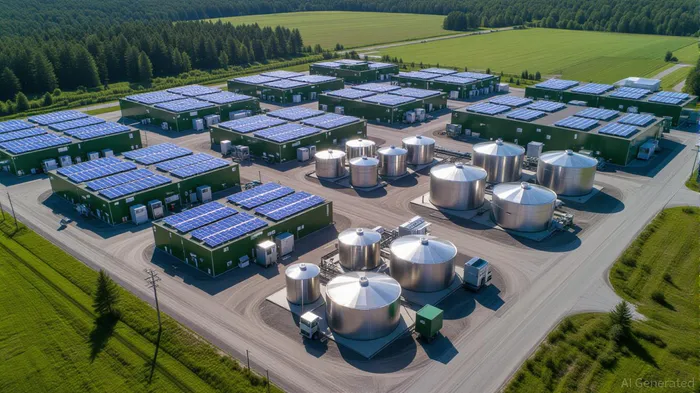
In the evolving landscape of infrastructure and environmental services, capital allocation has become a masterclass in strategic alignment. GFL Environmental Inc.GFL-- (NYSE: GFL) has just executed a recapitalization of its joint venture, Green Infrastructure Partners (GIP), that exemplifies how disciplined capital deployment and sector-specific expertise can unlock extraordinary value. This $4.25 billion transaction—valuing GIP at a 340% return on GFL's original $250 million investment—positions the company as a bellwether for the sector's next phase of growth.
Capital Allocation: A Blueprint for Value Creation
GFL's recapitalization of GIP is not merely a financial maneuver but a calculated response to the sector's shifting dynamics. By securing $775 million in gross proceeds—$585 million of which will be returned to shareholders—GFL has optimized its capital structure while retaining a 30.1% stake in GIP. This move allows the company to reduce debt, fund organic and inorganic growth, and potentially repurchase shares, all while maintaining a robust balance sheet. GFL's current ratio of 6.82 and debt-to-capital ratio of 0.16 underscore its financial flexibility, enabling it to pursue high-conviction opportunities without overleveraging.
The transaction's timing is equally strategic. With the environmental services sector experiencing a surge in private equity interest—driven by regulatory tailwinds like the EPA's $21 billion Bipartisan Infrastructure Law allocation—GFL is capitalizing on a market primed for consolidation. The recapitalization aligns with broader industry trends, including the rise of PFAS remediation and digital infrastructure, where GFL's vertically integrated model and geographic diversification provide a competitive edge.
Strategic Alignment: Leveraging Sector Megatrends
The infrastructure and environmental services sector is undergoing a transformation fueled by three megatrends: regulatory pressure, technological innovation, and sustainability mandates. GFL's recapitalization of GIP directly addresses these forces.
- Regulatory Tailwinds: The EPA's focus on PFAS remediation and hazardous waste managementWM-- has created a $71.4 billion market for environmental services. GFL's stake in GIP, which specializes in infrastructure and waste management, positions it to benefit from long-term government contracts and rising demand for PFAS treatment technologies.
- Technological Integration: As seen in the sector's shift toward digital solutions—such as CIMA+'s digital twin capabilities for water treatment—GFL's $175 million infusion into GIP's balance sheet will likely fund R&D and automation, enhancing operational efficiency.
- Sustainability-Driven Growth: With global infrastructure spending projected to reach $150 trillion by 2040, GFL's focus on renewable natural gas (RNG) and compressed natural gas (CNG) fleets aligns with decarbonization goals. The company's Q2 2025 results, including 6.8% organic growth and updated EBITDA guidance of $1.95–$1.975 billion, reflect its ability to monetize these trends.
Comparative Analysis: GFL vs. Peers
GFL's capital allocation strategy outpaces many peers in the sector. While companies like Republic ServicesRSG-- and Waste Management focus on margin expansion through M&A, GFL's recapitalization of GIP demonstrates a more aggressive approach to value creation. For instance, Republic Services' 5.2% EBITDA growth in Q2 2025 pales in comparison to GFL's 14.6% EBITDA increase, driven by its ability to leverage shareholder returns and reinvest in high-margin infrastructure.
Moreover, GFL's EBITDA margin of 30.7%—projected to reach 29.9% for 2025—surpasses the sector average of 25–28%, a testament to its pricing power and operational discipline. This margin expansion, coupled with a $750 million Free Cash Flow target, provides ample room for strategic acquisitions and shareholder returns.
Investment Thesis: High Conviction in a High-Growth Sector
For investors, GFL's recapitalization of GIP represents a rare confluence of strategic foresight, financial prudence, and sector-specific expertise. The transaction not only enhances GFL's equity value but also positions it to capitalize on the $12 billion EPA drinking water infrastructure fund and the $9 billion PFAS remediation pipeline.
Key risks include regulatory uncertainty and competition from private equity-backed firms, but GFL's vertically integrated model and geographic diversification mitigate these concerns. The company's ability to generate consistent Free Cash Flow—$137.1 million in Q2 2025 alone—further insulates it from macroeconomic volatility.
Conclusion: A Core Holding for the Long Term
GFL's recapitalization of GIP is a masterstroke in capital allocation, aligning with the infrastructure and environmental services sector's most compelling growth drivers. By retaining a 30.1% stake in a $3 billion equity-valued entity while returning capital to shareholders, GFLGFL-- has created a win-win scenario for investors. As the sector pivots toward PFAS remediation, digital infrastructure, and sustainable energy, GFL's strategic alignment and financial discipline make it a high-conviction play.
For those seeking exposure to the next phase of infrastructure innovation, GFL offers a compelling case: a company that not only adapts to industry trends but actively shapes them. With a clear path to $6.55–$6.575 billion in 2025 revenue and a robust Free Cash Flow trajectory, the stock deserves a prominent place in any investor's portfolio.





Comentarios
Aún no hay comentarios