
Gevo Inc's Extended Conditional Commitment from DOE: Strategic Positioning and Shareholder Value Implications
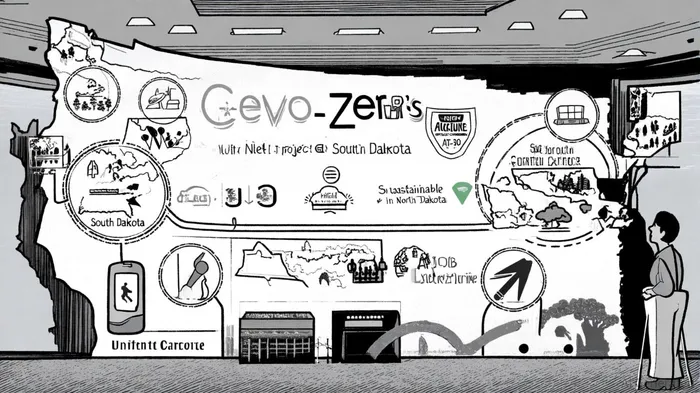
Gevo Inc. (NASDAQ: GEVO) has secured a pivotal $1.46 billion Extended Conditional Commitment (ECC) from the U.S. Department of Energy (DOE) for its Net-Zero 1 (NZ1) sustainable aviation fuel (SAF) project in South Dakota, with a borrowing capacity of up to $1.63 billion when including capitalized interest during construction [1]. This financing, extended until April 2026, allows GevoGEVO-- to evaluate a smaller, lower-cost 30 million gallon-per-year (MMgy) ethanol-to-jet (ATJ-30) facility in North Dakota, reflecting a strategic pivot to align with evolving energy policies and reduce capital intensity [2]. The move underscores Gevo's agility in navigating the renewable fuels sector, where demand for low-carbon alternatives is accelerating due to corporate net-zero commitments and regulatory tailwinds.
Strategic Positioning in the Renewable Fuels Sector
Gevo's NZ1 project is a cornerstone of its long-term strategy to dominate the SAF market, which is projected to grow at a compound annual growth rate (CAGR) of 15.12% through 2030, reaching $276.31 billion in value [3]. The project's use of 100% U.S.-sourced feedstocks and its net-zero carbon footprint on a lifecycle basis position it as a scalable solution for decarbonizing aviation, a sector responsible for 2.5% of global CO₂ emissions [4]. By leveraging its proprietary Alcohol-to-Jet (ATJ) technology, Gevo claims to achieve the lowest cost-per-ton of carbon abatement among current SAF producers, a critical differentiator in a market where cost competitiveness remains a barrier to adoption [5].
The company's competitive edge is further amplified by its strategic partnerships and technological innovations. For instance, Gevo's collaboration with Axens to license its ATJ technology and its Verity carbon accounting platform-set to generate first revenues in 2024-enhance transparency and scalability in carbon abatement [6]. Additionally, Gevo's recent acquisition of Red Trail Energy in North Dakota has provided operational ethanol production with carbon capture capabilities, enabling the monetization of Section 45Z tax credits and boosting profitability [7]. These moves position Gevo to outperform peers like Renewable Energy Group (REG) and Amyris Inc., which lack comparable integration of carbon capture and modular production facilities [8].
Implications for Long-Term Shareholder Value
The DOE's conditional commitment significantly de-risks Gevo's capital-intensive projects, reducing execution risk and attracting equity investors. According to a report by Charles River Associates (CRA), the NZ1 project is projected to create 1,300 indirect jobs during construction and 100 permanent jobs, generating over $100 million annually in economic impact for South Dakota [9]. Such metrics align with ESG (Environmental, Social, and Governance) investment trends, which are increasingly driving capital allocation in the renewable energy sector.
Financially, Gevo's Q1 2025 results highlight its progress toward profitability. Revenue surged $25 million year-over-year, driven by RNG growth, carbon credit gains, and the Red Trail acquisition [10]. The company anticipates achieving positive Adjusted EBITDA in 2025, supported by 45Z tax credits and offtake agreements for 10 million and 5 million gallons/year of SAF [11]. Analysts project a wide range of outcomes for Gevo's stock, with price targets spanning $1.15 to $14.00 as of October 2025, reflecting both optimism about its technological leadership and skepticism about near-term profitability [12]. However, the conditional commitment and modular ATJ-30 project-50% of which is already sold-suggest a path to scalable, capital-efficient growth [13]. Historically, GEVO's stock has shown positive short-term reactions to earnings releases, with average abnormal returns of ~3.8% on day 1 and ~5.1% on day 2, though these effects tend to fade within a week.
Risks and the Road Ahead
While the DOE's support is transformative, Gevo must satisfy stringent technical, legal, and environmental conditions to finalize the loan guarantee [14]. Delays in permitting or unmet performance benchmarks could derail the NZ1 timeline. Additionally, the renewable fuels market remains volatile, with policy shifts and commodity price swings posing risks. However, Gevo's diversified revenue streams-spanning SAF, RNG, carbon credits, and chemical feedstocks-mitigate these exposures.
In conclusion, Gevo's Extended Conditional Commitment from the DOE represents a strategic inflection point, validating its technology and business model while accelerating its path to commercialization. As the renewable fuels sector matures, Gevo's ability to scale low-cost, net-zero solutions will be critical to unlocking long-term shareholder value. Investors should monitor the company's progress on the NZ1 and ATJ-30 projects, as well as its capacity to monetize carbon abatement in an increasingly carbon-constrained world.





Comentarios
Aún no hay comentarios