
Germany's Shifting China Strategy: Risks, Resilience, and Opportunities for European Investors
Germany's evolving relationship with China has become a focal point for European investors navigating a complex interplay of economic interdependence, geopolitical rivalry, and strategic recalibration. Once defined by a "win-win" model of trade and investment, Berlin's approach has shifted toward a more cautious, competitive stance under Chancellor Friedrich Merz, aligning with the EU's broader "de-risking" agenda. This transformation, however, is not a clean break from the past but a recalibration of priorities in response to technological vulnerabilities, human rights concerns, and Beijing's growing alignment with Moscow. For investors, the implications are both daunting and promising, as Germany seeks to balance its economic reliance on China with efforts to reduce systemic risks.
The New Normal: Strategic Competition and Economic Interdependence
Germany's 2023 China Strategy marked a pivotal shift, dropping the term "partnership" in favor of framing China as a "competitor" and "systemic rival" while retaining cooperation on climate change and technology innovation. This duality reflects the reality of deep economic ties: bilateral trade hit €163.4 billion in the first eight months of 2025, with Germany remaining China's largest EU trading partner. Yet, geopolitical tensions have forced Germany to accelerate domestic investments in infrastructure and defense to mitigate vulnerabilities.
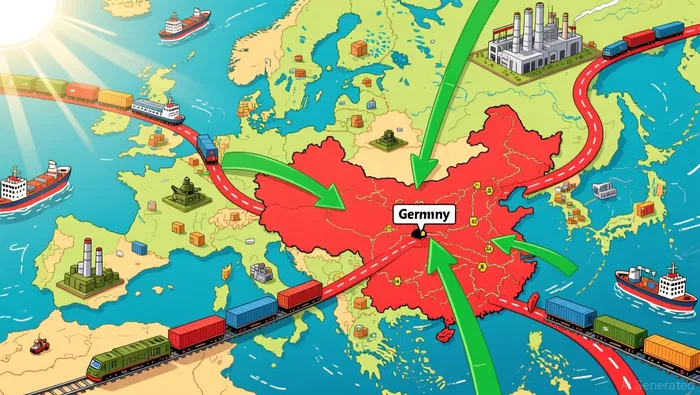
The automotive and energy sectors exemplify this tension. Germany's EV industry, for instance, relies heavily on China for rare earth materials critical to permanent magnets and battery production. China controls 94% of global permanent magnet manufacturing, leaving European automakers exposed to supply chain disruptions. At the same time, Chinese Premier Li Qiang has actively courted German firms proposing collaboration in hydrogen energy, smart manufacturing, and biomedicine during the 2025 G20 summit. This push for "strategic industries" underscores China's intent to maintain its economic leverage despite political friction.
Navigating the Rare Earth Conundrum
Rare earth elements (RREs) have emerged as a flashpoint in Germany-China relations. While Europe holds significant deposits, it lacks the processing infrastructure to refine these materials, leaving it dependent on China for over 90% of processed RREs. Germany's recent negotiations with Beijing introduced a streamlined licensing system for rare earth exports, aiming to address supply chain bottlenecks. However, this diplomatic progress masks a deeper structural challenge: China's upstream dominance in the supply chain.
Chinese firms like Shenghe Resources and Ganfeng are expanding their control through acquisitions in Australia and Africa, further entrenching their grip on critical inputs for EVs and renewable energy technologies. In response, the EU launched the RESourceEU plan in 2025, allocating €3 billion to boost domestic mining, recycling, and international partnerships. Yet, industry experts caution that these efforts face hurdles, including lengthy regulatory approvals and limited technical expertise in processing RREs. For investors, this creates a paradox: while diversification initiatives offer long-term opportunities, the immediate reliance on China remains a risk.
Geopolitical Alliances and the EU's Role
Germany's China strategy is increasingly shaped by its alignment with the EU. The bloc's Critical Raw Materials Act and RESourceEU plan aim to reduce dependency on China by securing alternative suppliers in Ukraine, Canada, and Greenland. However, internal EU fragmentation and corporate lobbying have slowed implementation, as German firms-particularly in automotive and machinery-resist abrupt disengagement from Chinese markets.
This tension is evident in the rare earth sector. While the EU seeks to build a circular economy to recycle RREs from existing products, its funding pales in comparison to the capital required for large-scale mining projects. Meanwhile, Germany's government has quietly courted Beijing for rare earth relief, raising questions about the sustainability of its dual-track approach. For investors, the key takeaway is that Germany's strategy is not a zero-sum game but a calculated balancing act between reducing risks and preserving access to China's vast market.
Opportunities in Strategic Sectors
Despite the challenges, Germany-China cooperation in sectors like hydrogen energy and EVs presents compelling opportunities. Chinese Vice Premier He Lifeng recently urged Germany to leverage its EU influence to ease trade tensions, signaling openness to increased investment in German infrastructure and technology. This aligns with Germany's push to become a global leader in green hydrogen, a sector where China's expertise in electrolyzer production and cost efficiency could prove invaluable.
Moreover, the EU's focus on industrial policy-exemplified by the RESourceEU plan-creates avenues for European investors to participate in supply chain diversification. For instance, joint ventures with Ukrainian or Canadian mining firms could provide alternative RRE sources, while investments in recycling technologies align with the bloc's circular economy goals. However, success will depend on overcoming regulatory inertia and geopolitical headwinds.
Conclusion: A Delicate Equilibrium
Germany's China strategy in 2025 reflects a nation caught between its economic ties to Beijing and its geopolitical alignment with Washington and Brussels. For European investors, the path forward lies in hedging bets: diversifying supply chains while maintaining engagement with Chinese markets where competitive advantages persist. The rare earth sector, EVs, and green hydrogen will be critical battlegrounds, where strategic partnerships and policy agility will determine long-term resilience. As Chancellor Merz navigates this complex landscape, investors must remain attuned to both the risks of over-reliance and the opportunities in a recalibrated transatlantic and transpacific order.







Comentarios
Aún no hay comentarios